About This Image
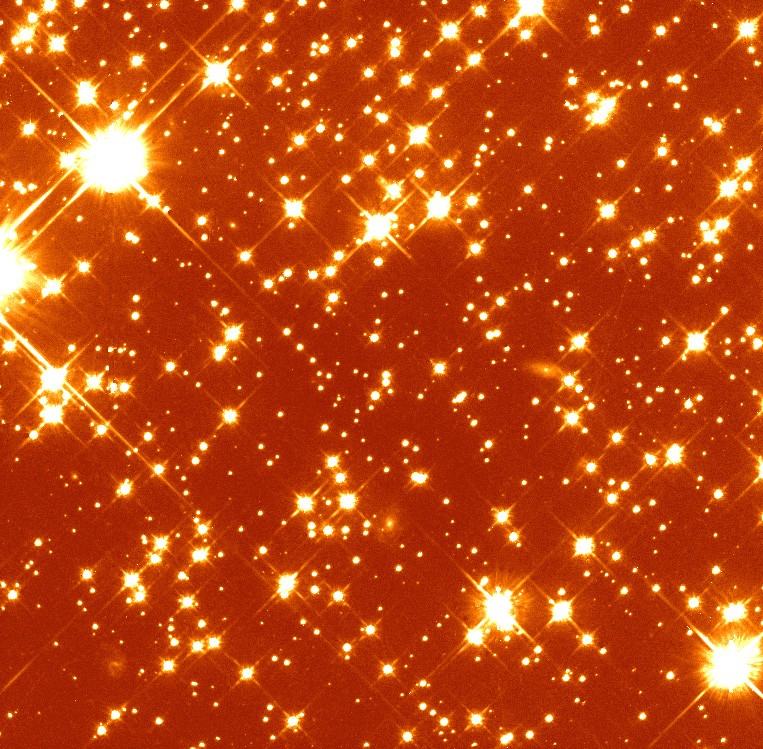
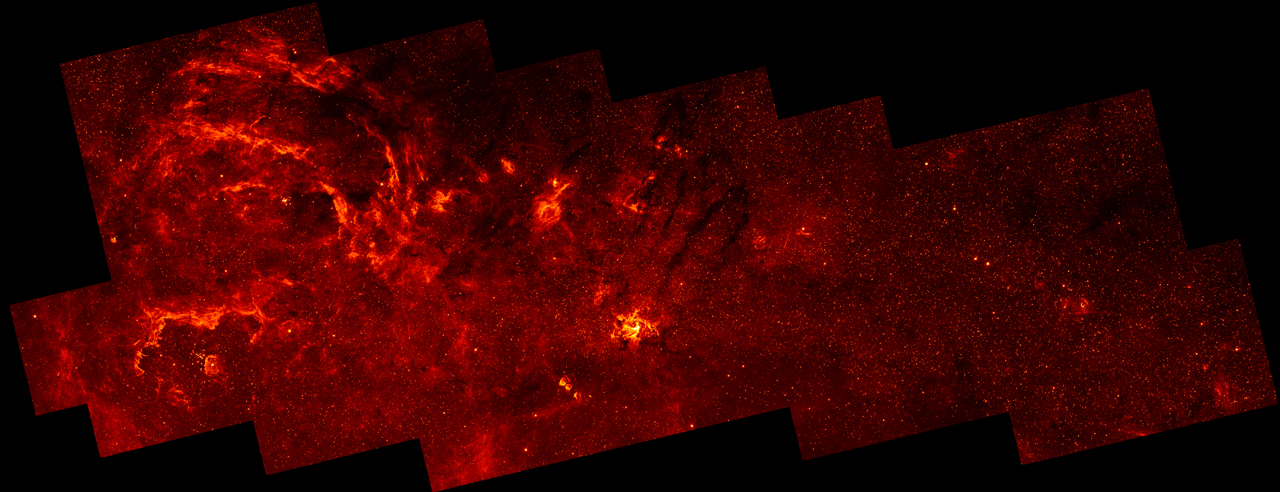
This infrared image of the center of our Milky Way galaxy reveals a population of massive stars and complex structures in the hot ionized gas that swirls around the galactic core. In visible light, the Galactic Center is completely hidden behind dense curtains of interstellar dust that absorb virtually all optical radiation, but infrared wavelengths penetrate this obscuring material, unveiling the extraordinary environment at the heart of our galaxy. The region teems with massive, luminous stars — some among the most massive known in the Milky Way — that orbit perilously close to Sagittarius A*, the supermassive black hole with a mass of four million suns that anchors our galaxy. Dense clusters of young stars, filamentary structures of hot gas, and complex dust formations all jostle for space in this crowded cosmic metropolis, creating one of the most extreme environments in our galactic neighborhood.
Scientific Significance
The Galactic Center is the closest galactic nucleus to Earth and thus provides the most detailed view available of the physical processes that occur near a supermassive black hole. Hubble's infrared observations have been instrumental in identifying and characterizing the population of massive, hot stars that orbit within the central parsec, including the Arches and Quintuplet clusters — among the densest and most massive star clusters known in the Milky Way. The paradoxical presence of young, massive stars so close to the supermassive black hole challenges star formation theory, as the extreme tidal forces should prevent gas clouds from collapsing into stars in this region. Several theories have been proposed to explain this 'paradox of youth,' including formation in a dense accretion disk around the black hole and inward migration from larger distances. Hubble's multi-epoch observations have also contributed to measuring the proper motions of stars near the Galactic Center, adding to the orbital data that ultimately earned Reinhard Genzel and Andrea Ghez the 2020 Nobel Prize in Physics for demonstrating the existence of the central supermassive black hole.
Observation Details
This image was captured using Hubble's Near Infrared Camera and Multi-Object Spectrometer (NICMOS) at wavelengths between 1.1 and 1.9 micrometers. Infrared observations are essential for studying the Galactic Center because interstellar dust along the 26,000-light-year line of sight absorbs virtually all visible light from this region. At near-infrared wavelengths, the dust becomes partially transparent, allowing detection of the luminous stellar populations and ionized gas structures near the black hole. The NICMOS observations provided the spatial resolution necessary to distinguish individual stars in the extremely crowded Galactic Center environment and to map the complex morphology of the hot gas filaments and dust features. Paschen-alpha narrowband imaging specifically targeted the emission from ionized hydrogen gas, revealing the locations of stellar wind interactions and the irradiation patterns produced by the most luminous stars.
Location in the Universe
Constellation
Sagittarius
Distance from Earth
26,000 light-years
Fun Facts
- 1
The supermassive black hole Sagittarius A* at the very center has a mass of about 4 million suns yet occupies a region smaller than the orbit of Mercury — its gravitational influence dominates the motions of stars within the central few light-years of the galaxy.
- 2
Stars near the Galactic Center orbit Sagittarius A* at incredible speeds — the closest known star, S2, completes a full orbit in just 16 years at speeds exceeding 5,000 miles per second, providing one of the most direct confirmations that the central object is indeed a black hole.
- 3
If we could see the Galactic Center in visible light, it would be one of the brightest and most spectacular regions in the night sky — but roughly 25 magnitudes of dust extinction (a factor of 10 billion) between us and the center renders it invisible to the naked eye.
Image credit: NASA, ESA, Hubble Space Telescope