About This Image
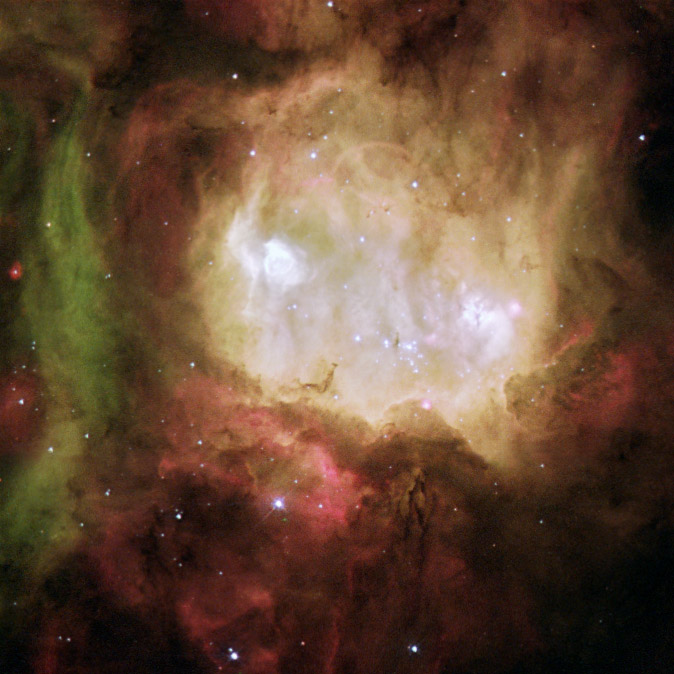
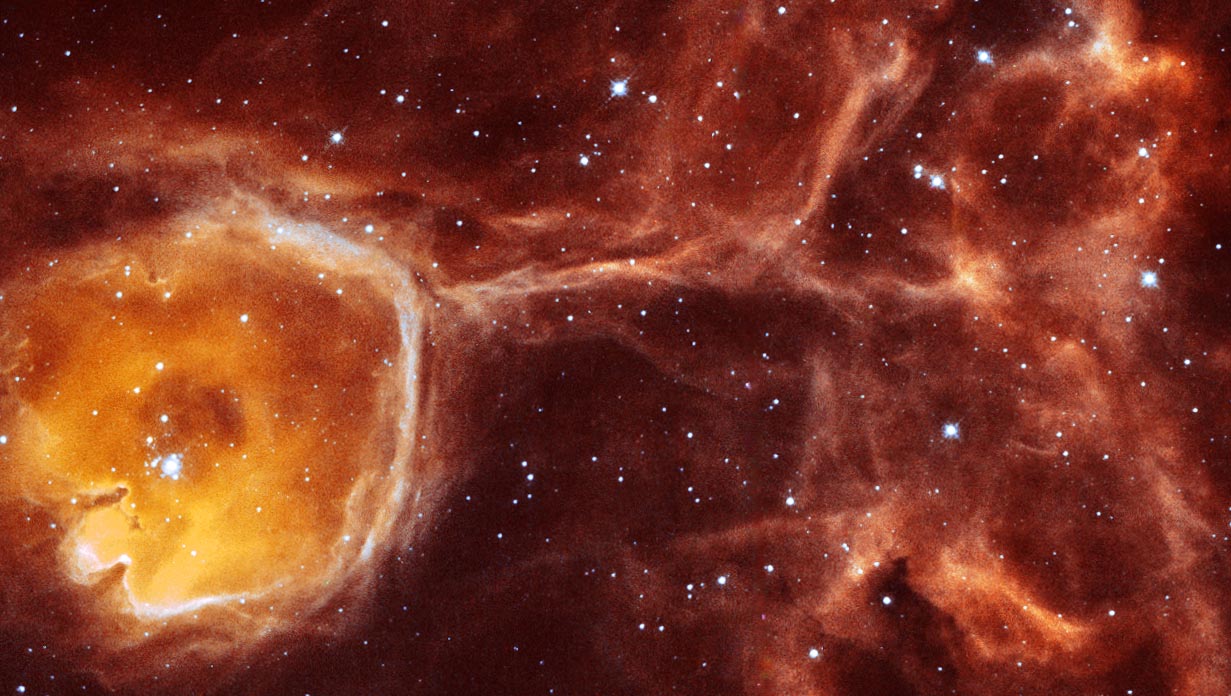
This circular feature on the left side of this image is an interstellar bubble called N44F, a striking example of how individual stars can sculpt the surrounding cosmos. The bubble is being inflated by a torrent of fast-moving particles — a fierce stellar wind — from an exceptionally hot star once buried inside this cold, dense cloud of gas and dust. As the star's energetic wind rams into the surrounding molecular cloud, it sweeps up the gas into a thin, glowing shell that expands outward like an inflating balloon. The bubble spans approximately 35 light-years across and is located within the larger N44 superbubble complex in the Large Magellanic Cloud, a satellite galaxy of the Milky Way. These wind-blown bubbles represent one of the primary mechanisms by which massive stars inject energy into the interstellar medium, transforming the environments in which future generations of stars will form.
Scientific Significance
N44F is a textbook example of stellar feedback — the process by which massive stars modify their surrounding environment through radiation, stellar winds, and eventually supernova explosions. Understanding stellar feedback is one of the central challenges in astrophysics because it regulates the rate at which galaxies convert gas into stars and drives the chemical enrichment of the interstellar medium. The clean, well-defined geometry of N44F's bubble — a single hot star inflating a nearly spherical cavity in a relatively uniform molecular cloud — provides an idealized case for testing theoretical models of wind-blown bubble evolution. By measuring the bubble's size, expansion velocity, and the properties of the central star, astronomers can directly test the analytical predictions of stellar wind theory originally developed by Castor, McCray, and Weaver in the 1970s. N44F also serves as a probe of conditions in the Large Magellanic Cloud, whose lower metallicity compared to the Milky Way means that stellar winds behave differently and bubble evolution follows alternative pathways, providing valuable data for understanding star formation feedback in the metal-poor galaxies that dominated the early universe.
Observation Details
This image was captured using Hubble's Wide Field and Planetary Camera 2 (WFPC2) in narrowband filters tuned to hydrogen-alpha and doubly ionized oxygen [O III] emission lines. These narrowband observations isolate the light emitted by specific atomic species in the hot, ionized gas of the bubble shell, revealing the temperature and density structure of the expanding cavity wall. The hydrogen-alpha emission traces the overall distribution of ionized gas, while the [O III] emission highlights the hottest regions where the stellar wind shocks the surrounding material. The observations resolved the thin shell structure of the bubble and the complex morphology of the surrounding molecular cloud, revealing pillars, filaments, and dense knots of material being sculpted by the central star's radiation and wind.
Location in the Universe
Constellation
Dorado (in LMC)
Distance from Earth
160,000 light-years
Fun Facts
- 1
N44F sits within the much larger N44 superbubble complex, which spans over 1,000 light-years and has been inflated by the combined stellar winds and supernova explosions of hundreds of massive stars — it is one of the largest coherent structures in the Large Magellanic Cloud.
- 2
The hot star powering the N44F bubble has a surface temperature exceeding 40,000 degrees Celsius — more than seven times hotter than our Sun — and its stellar wind blasts outward at speeds of over 4 million miles per hour.
- 3
Interstellar bubbles like N44F can trigger new star formation by compressing gas at their expanding edges, creating a self-propagating cycle where one generation of stars gives birth to the next through their energetic deaths and outbursts.
Image credit: NASA, ESA, Hubble Space Telescope