About This Image
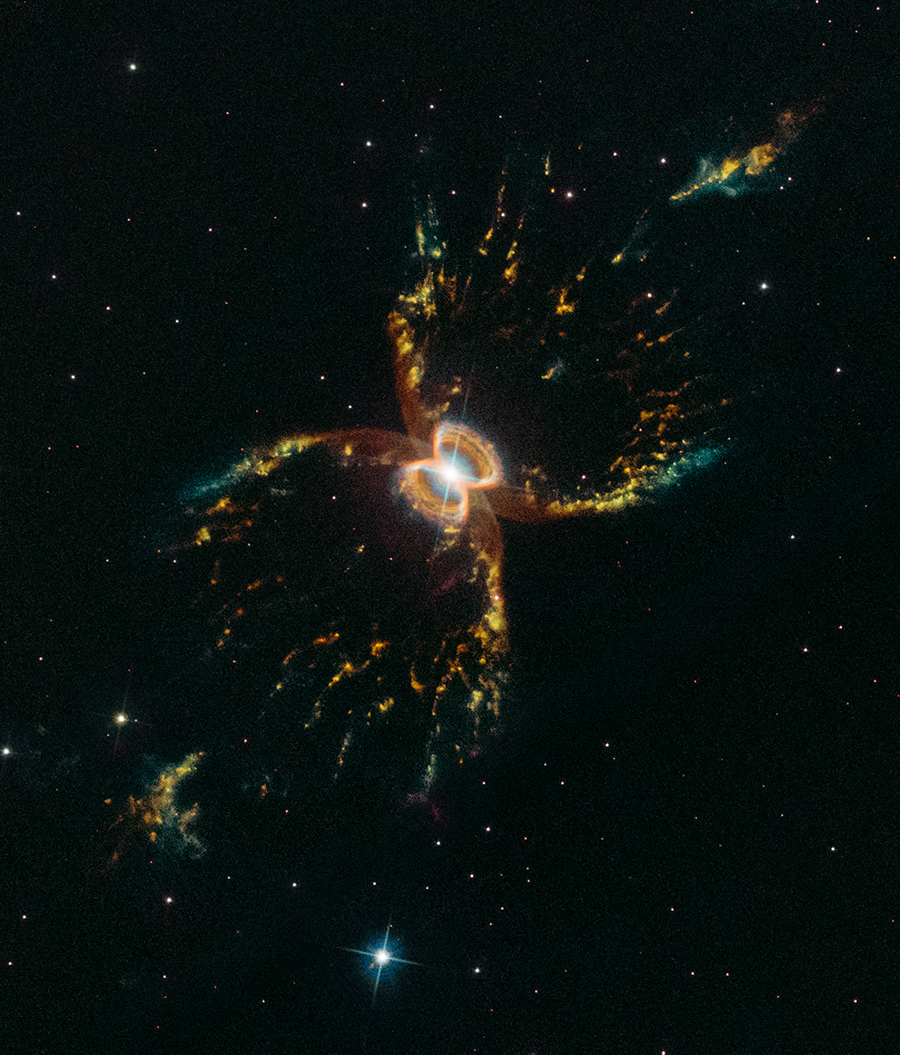
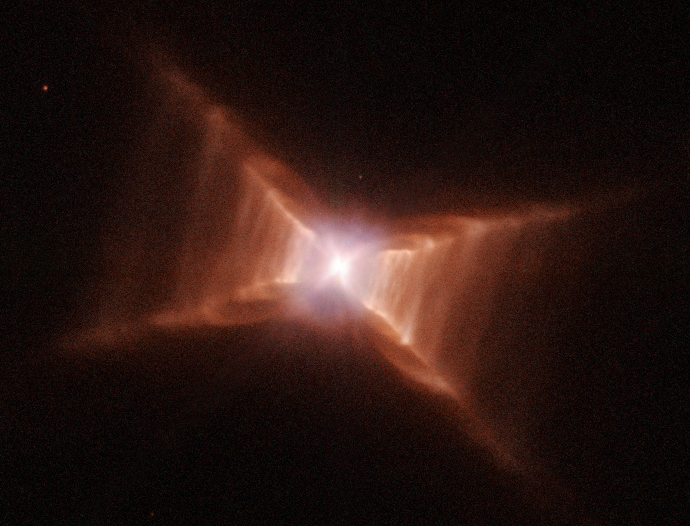
This image reveals details of one of the most unusual nebulas known in our Milky Way. Cataloged as HD 44179, this nebula is more commonly called the "Red Rectangle" because of its unique shape and color as seen through ground-based telescopes. Hubble's sharper view reveals that the nebula is not actually a rectangle at all but rather an X-shaped structure consisting of two cone-shaped outflows emanating from the central binary star system. The distinctive rung-like patterns visible within the cones resemble the rungs of a ladder and are thought to represent successive episodes of mass ejection from the dying star. The vivid red color comes from unusual organic molecules in the outflowing gas, including polycyclic aromatic hydrocarbons — complex carbon compounds that may represent building blocks for the chemistry of life itself.
Scientific Significance
The Red Rectangle Nebula represents a critical transitional phase in stellar evolution known as the protoplanetary nebula stage — the brief interval between the asymptotic giant branch (AGB) phase, when a sun-like star sheds its outer layers, and the planetary nebula phase, when the exposed hot stellar core ionizes the ejected material. This transition is poorly understood because it occurs rapidly in astronomical terms, lasting only a few thousand years, making objects like the Red Rectangle exceptionally valuable for studying the physical and chemical processes that shape planetary nebulae. The nebula's X-shaped biconical morphology is produced by a dense equatorial torus of dust that collimates the outflowing gas into two opposing cones — a geometry that reveals how binary star interactions and disk formation influence the shaping of nebular envelopes. The Red Rectangle is also notable for containing a rich inventory of organic molecules, including polycyclic aromatic hydrocarbons (PAHs) and possibly even proto-fullerene compounds. These carbon-rich molecules are dispersed into the interstellar medium as the nebula expands, seeding future generations of star-forming clouds with the complex chemistry that ultimately contributes to the formation of organic materials on planets like Earth.
Observation Details
This image was captured using Hubble's Wide Field and Planetary Camera 2 (WFPC2) in multiple narrowband and broadband filters. The observations resolved the X-shaped biconical structure and the ladder-like rung pattern for the first time, transforming our understanding of the nebula's geometry from the rectangular shape suggested by ground-based images. Polarimetric observations revealed that much of the nebula's light is reflected starlight scattered by dust grains in the cone walls, while spectroscopic data identified the molecular species responsible for the distinctive red emission. The central binary star system remains partially obscured by the edge-on equatorial dust torus, which blocks direct visible light from the stellar cores.
Location in the Universe
Constellation
Monoceros
Distance from Earth
2,300 light-years
Fun Facts
- 1
The Red Rectangle is one of only a few known sources of the mysterious Extended Red Emission (ERE) — a broad band of red fluorescence thought to come from carbon nanoparticles or polycyclic aromatic hydrocarbons excited by ultraviolet starlight.
- 2
The ladder-like rungs visible in the X-shaped outflow are spaced at remarkably regular intervals, suggesting they were produced by periodic mass-ejection events occurring roughly every few hundred years as the central star pulsated and shed its outer layers.
- 3
Despite its name, the Red Rectangle is not actually rectangular — the shape appeared boxy in early ground-based images, but Hubble revealed its true X-shaped biconical structure, showing how limited resolution can mislead astronomers about the true geometry of cosmic objects.
Image credit: NASA, ESA, Hubble Space Telescope