About This Image
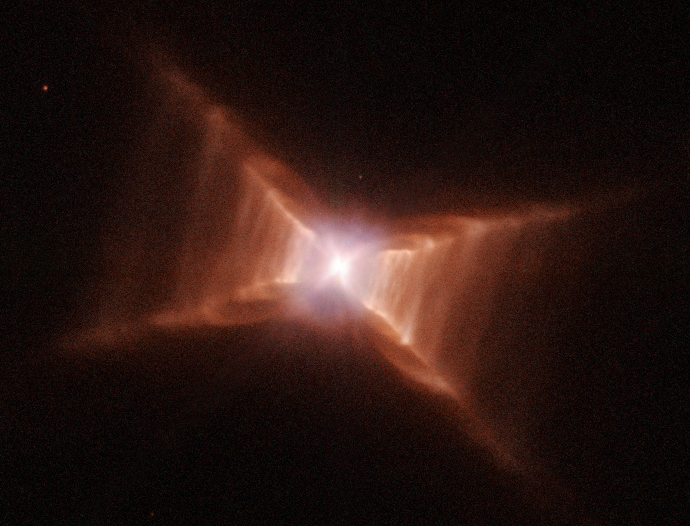
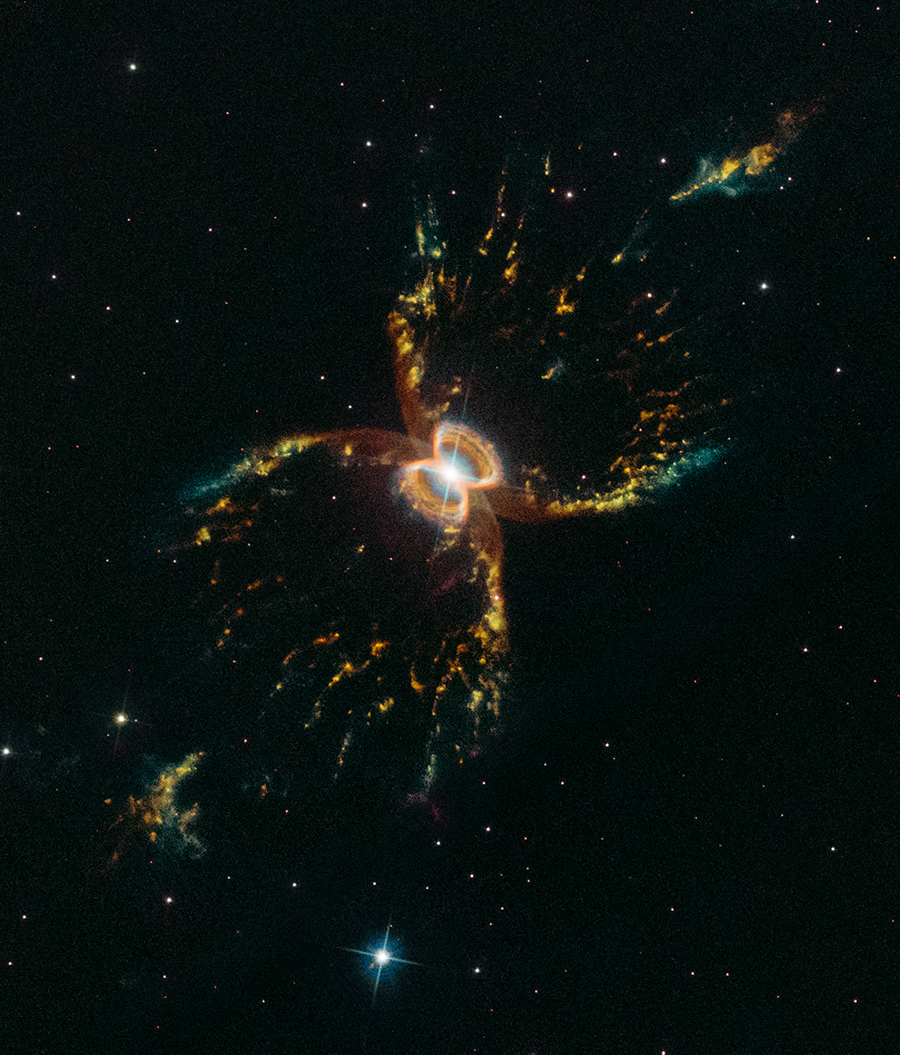
An aging red giant star is shedding its outer layers to produce the Southern Crab Nebula (Hen 2-104), creating one of the most visually striking hourglass-shaped structures in the cosmos. The "legs" of the crab are likely to be the places where the outflowing material slams into surrounding gas and dust, creating bright shock-heated regions where the fast stellar wind meets the slower material ejected in earlier epochs. This remarkable nebula is powered by a symbiotic binary star system — a red giant and a white dwarf locked in a gravitational embrace — where mass transfer between the two stars drives periodic ejection events that sculpt the nebula's distinctive shape. The hourglass structure reveals the profound influence that binary star interactions have on the death throes of stellar systems.
Scientific Significance
The Southern Crab Nebula is one of the finest examples of a symbiotic nebula — a class of objects produced by the interaction between a red giant star and a compact white dwarf companion. In this system, the red giant is losing mass through a slow stellar wind, and a portion of this material is captured by the white dwarf's gravitational field. Periodically, the accumulated material on the white dwarf's surface ignites in thermonuclear eruptions (nova-like events), producing fast outflows that collide with the slower red giant wind and inflate the nebula's distinctive hourglass lobes. The nested hourglass structures visible in Hubble's image suggest that multiple ejection events have occurred over the past several thousand years, each producing a new set of bipolar lobes with slightly different orientations. Understanding these symbiotic systems is important because they represent one possible evolutionary pathway toward Type Ia supernovae — the standardizable explosions used to measure the accelerating expansion of the universe — if the white dwarf can accumulate enough mass to reach the Chandrasekhar limit.
Observation Details
This image was captured using Hubble's Wide Field Camera 3 (WFC3) in optical and near-infrared filters. The color composite uses narrowband filters tuned to specific emission lines: hydrogen-alpha (red), doubly ionized oxygen [O III] (blue/green), and ionized nitrogen [N II] (red), which highlight different physical conditions within the nebula. The hydrogen emission traces the overall distribution of ejected gas, while the oxygen emission reveals the hottest, most energetic regions where the fast wind shocks the surrounding material. The extraordinary detail in the image resolves fine filamentary structure within the hourglass walls and reveals the complex internal architecture of the nested bipolar lobes.
Location in the Universe
Constellation
Centaurus
Distance from Earth
7,000 light-years
Fun Facts
- 1
This image was released to celebrate Hubble's 29th anniversary in April 2019, continuing NASA's tradition of marking each year of the telescope's remarkable lifetime with a spectacular new image.
- 2
The Southern Crab Nebula appears to have experienced at least two separate ejection events — the inner hourglass structure and the outer one have different sizes and orientations, suggesting they were produced at different times as the binary system evolved.
- 3
Despite its name, the Southern Crab Nebula is unrelated to the famous Crab Nebula (M1) in Taurus — the 'crab' nickname comes purely from its visual resemblance to a crustacean's body when viewed from Earth.
Image credit: NASA, ESA, Hubble Space Telescope