About This Image
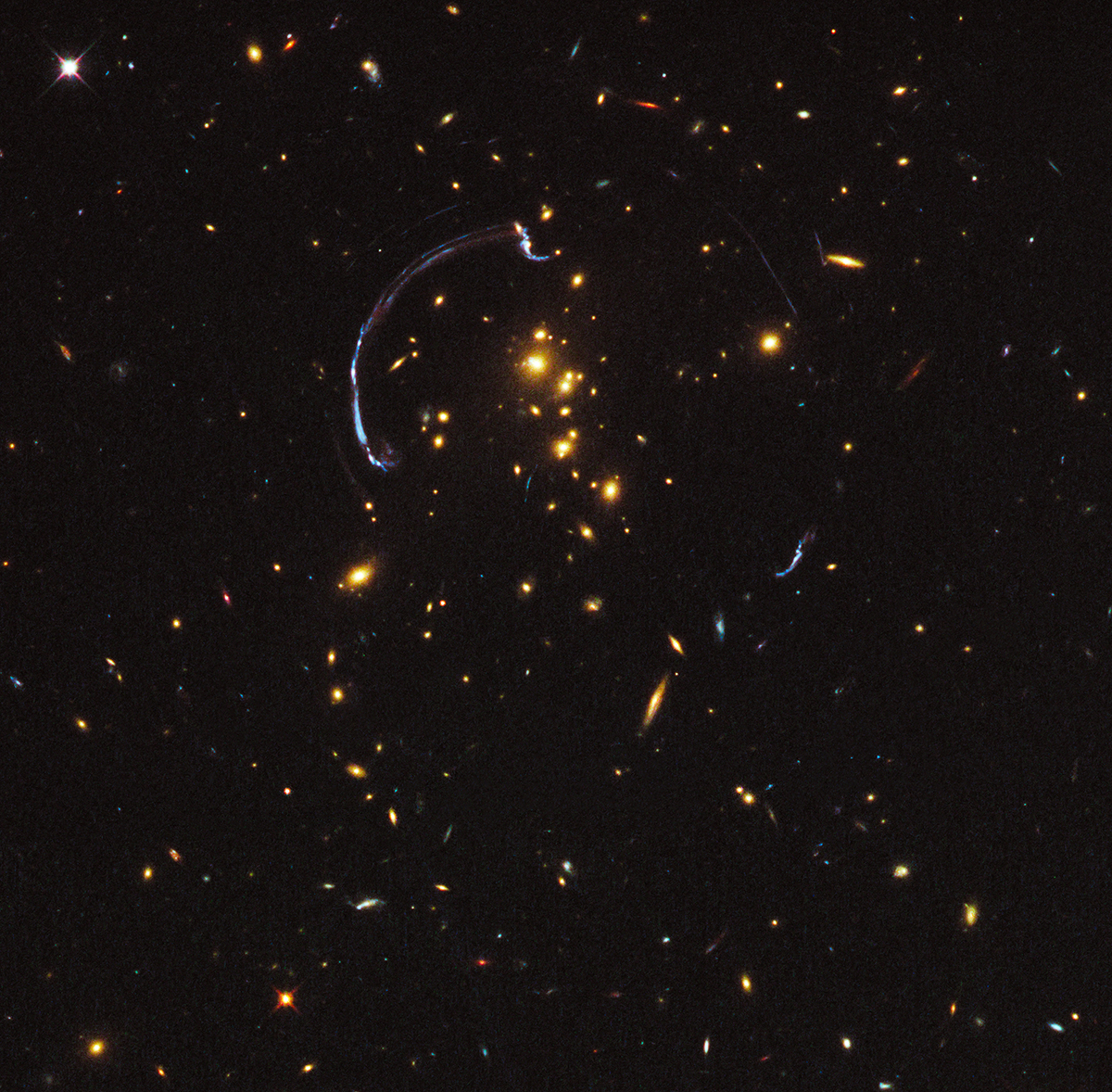
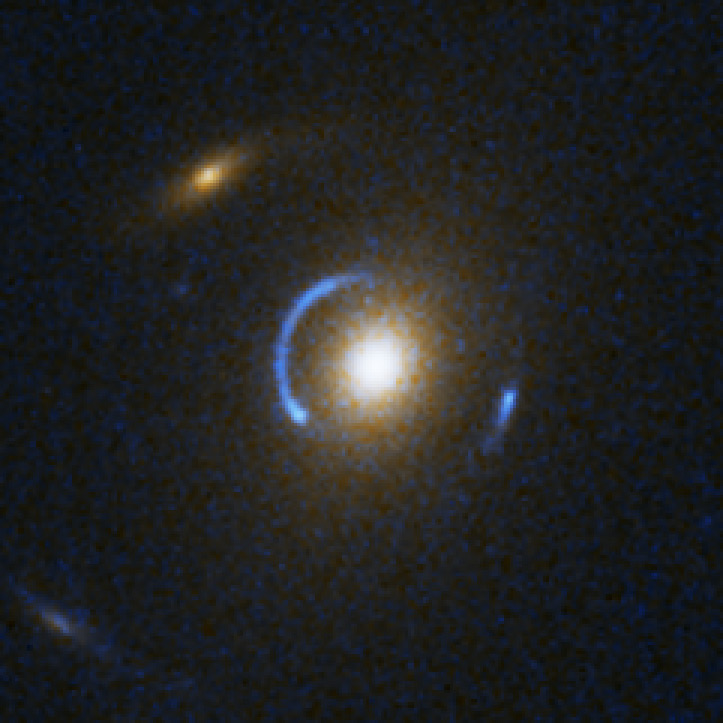
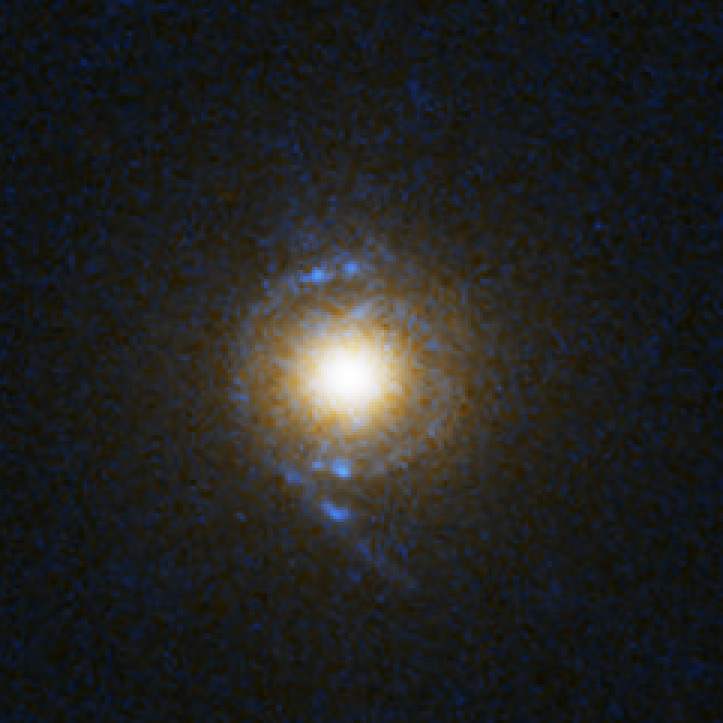
Einstein rings like this form when two galaxies are almost perfectly aligned, one behind the other, and the gravitational field of the closer galaxy bends the light from the more-distant galaxy into bright arcs around itself. This particular example, SDSS J125028.25+052349, showcases one of the most elegant predictions of Einstein's general theory of relativity — that massive objects curve the geometry of spacetime, deflecting light from its straight-line path. The smooth, luminous arc encircling the foreground galaxy is actually a heavily distorted image of a much more distant galaxy, stretched and magnified by the gravitational lens into a near-perfect ring. Each Einstein ring system provides astronomers with a precision instrument for measuring the total mass of the lensing galaxy, including the vast quantities of invisible dark matter that dominate its gravitational field.
Scientific Significance
SDSS J125028.25+052349 belongs to the SLACS sample of gravitational lens galaxies, which collectively have transformed our understanding of the internal mass structure of elliptical galaxies. By combining the gravitational lensing mass measurement (which probes the total mass projected within the Einstein ring radius) with stellar velocity dispersion measurements from spectroscopy (which probe the gravitational potential in a complementary way), astronomers can separately constrain the contributions of dark matter and luminous matter to the total mass budget. The SLACS survey results demonstrated that the total mass profiles of massive elliptical galaxies follow a nearly universal power-law form close to isothermal (density proportional to 1/r²), regardless of galaxy size or luminosity. This remarkable uniformity provides a strong constraint on galaxy formation models and suggests that the processes of star formation and dark matter assembly conspire to produce a consistent end result across a wide range of galaxy masses.
Observation Details
This image was obtained using Hubble's Advanced Camera for Surveys (ACS) in the F435W and F814W filters (approximately B-band and I-band) as part of the SLACS survey's snapshot imaging program. The two-filter approach allowed astronomers to separate the blue light from the lensed background source from the redder light of the foreground lensing galaxy, enabling clean modeling of both components. The ACS imaging was essential because the Einstein ring radii of SLACS lenses are typically 1-2 arcseconds — too small to resolve clearly with ground-based telescopes but perfectly suited to Hubble's 0.05-arcsecond resolution.
Location in the Universe
Constellation
Virgo
Distance from Earth
Lens: ~3 billion light-years; Source: ~8 billion light-years
Fun Facts
- 1
This Einstein ring was discovered as part of the Sloan Lens ACS (SLACS) survey, which systematically searched through millions of galaxy spectra from the Sloan Digital Sky Survey to identify candidates where two galaxies at different distances happened to lie along the same line of sight.
- 2
The nearly perfect ring shape means the alignment between the background galaxy, the lensing galaxy, and Earth is accurate to within a fraction of an arcsecond — equivalent to the width of a human hair viewed from a distance of about 10 miles.
- 3
Einstein ring systems allow astronomers to measure the total mass enclosed within the ring radius to an accuracy of just a few percent — making gravitational lensing one of the most precise mass-measurement techniques in all of astrophysics.
Image credit: NASA, ESA, Hubble Space Telescope