About This Image
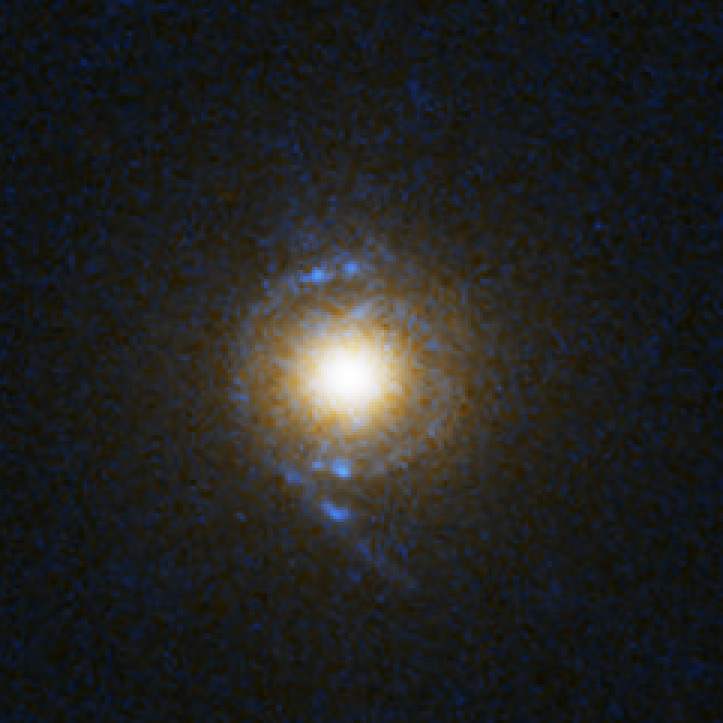
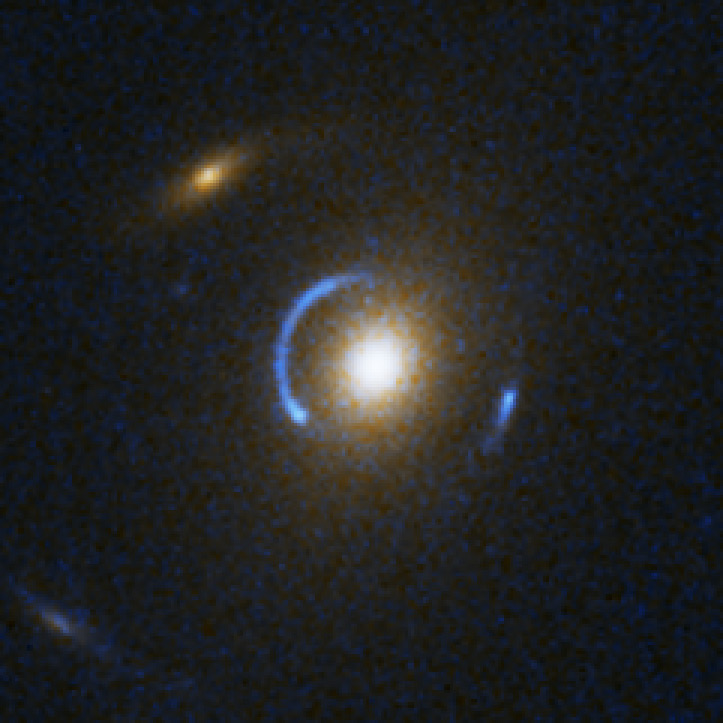
Einstein rings like this form when two galaxies are almost perfectly aligned, one behind the other, and the gravitational field of the closer galaxy bends the light from the more-distant galaxy into bright arcs around itself. This particular Einstein ring, SDSS J120540, represents one of nature's most elegant demonstrations of general relativity — the theory Albert Einstein published over a century ago predicting that massive objects warp the fabric of spacetime and bend the paths of light passing near them. The near-perfect circular arc formed by the background galaxy's distorted light indicates an extraordinarily precise alignment between the two galaxies, the kind of cosmic coincidence that occurs only a handful of times across the entire observable sky. These gravitational lenses serve as cosmic scales, allowing astronomers to weigh the foreground galaxy by measuring how much it bends the light passing around it.
Scientific Significance
Einstein rings provide one of the most direct and model-independent methods for measuring the total mass of galaxies, including the dark matter that constitutes the majority of their gravitational influence. The geometry of the ring — its radius, ellipticity, and brightness distribution — encodes precise information about the mass distribution of the lensing galaxy, allowing astronomers to probe the dark matter halo that extends far beyond the visible stars. SDSS J120540's nearly complete ring geometry indicates an almost perfect alignment and a relatively symmetric mass distribution in the lensing galaxy, making it an ideal case for testing general relativity on extragalactic scales. Comparative studies of Einstein rings at different redshifts have revealed how galaxy mass profiles evolve over cosmic time, showing that dark matter halos grow more extended as galaxies age and merge with their neighbors. These gravitational lens systems also magnify the background source galaxies, enabling studies of distant galaxies that would otherwise be too faint for detailed spectroscopic analysis.
Observation Details
This image was captured using Hubble's Advanced Camera for Surveys (ACS) in visible-light filters as part of the Sloan Lens ACS (SLACS) survey, a systematic search for gravitational lenses among spectroscopically identified candidates from the Sloan Digital Sky Survey. The ACS provided the angular resolution necessary to resolve the ring structure and separate it from the light of the foreground lensing galaxy. Careful subtraction of the foreground galaxy's smooth light profile was required to reveal the full extent of the Einstein ring. Follow-up spectroscopy confirmed the redshifts of both the lens and source galaxies, establishing the physical geometry of the lensing system.
Location in the Universe
Constellation
Virgo
Distance from Earth
Lens: ~2 billion light-years; Source: ~6 billion light-years
Fun Facts
- 1
Einstein himself believed gravitational lenses would never be observed because the alignment required is so precise — yet Hubble has now discovered hundreds of them, proving that the universe is large enough to produce even the most improbable configurations.
- 2
The ring shape forms only when the alignment between the background source, the lensing galaxy, and Earth is nearly perfect — even a slight offset transforms the ring into partial arcs or multiple distinct images of the background galaxy.
- 3
By measuring the radius and brightness of the Einstein ring, astronomers can calculate the total mass of the lensing galaxy — including its invisible dark matter halo — with remarkable precision, independent of any assumptions about the galaxy's stellar content.
Image credit: NASA, ESA, Hubble Space Telescope