About This Image
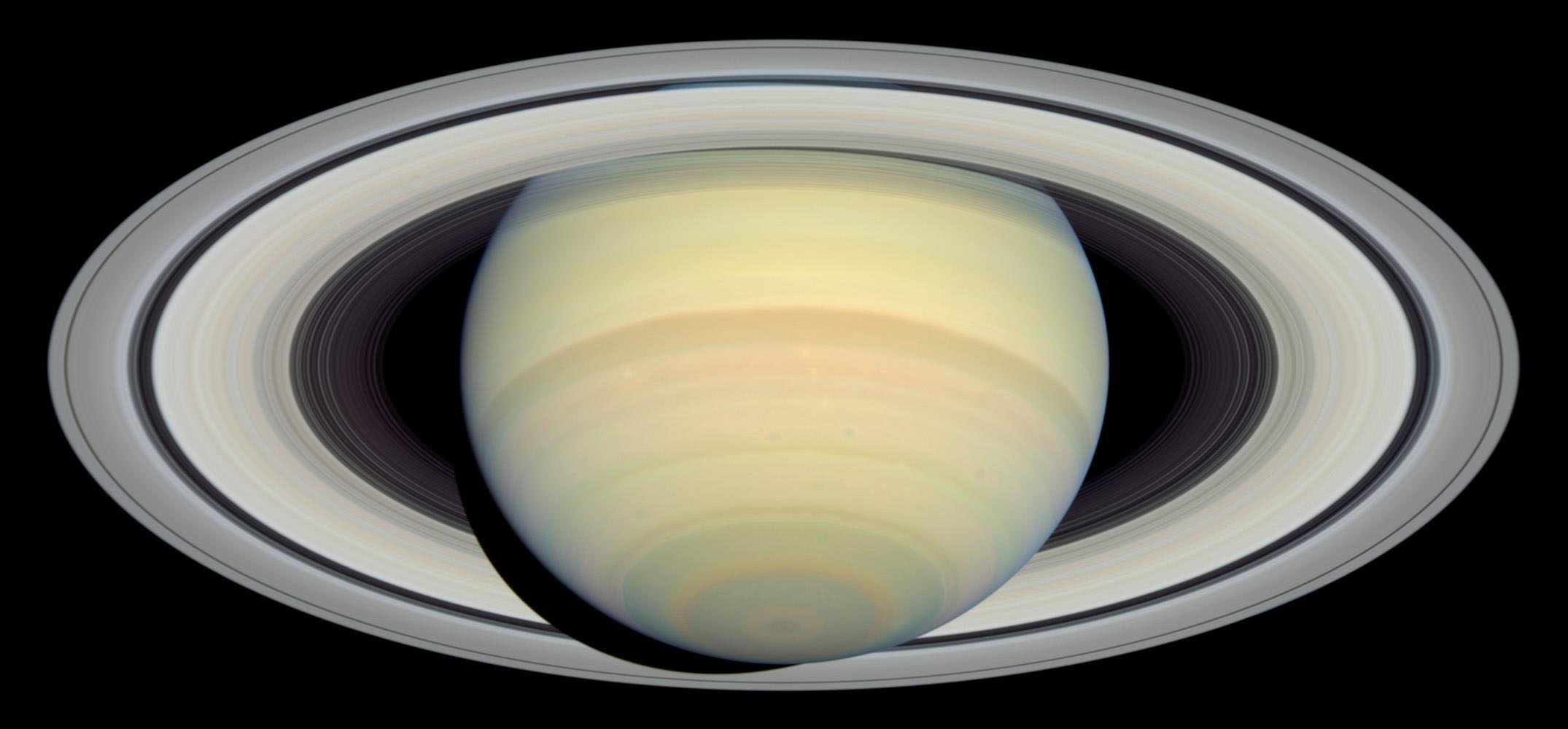
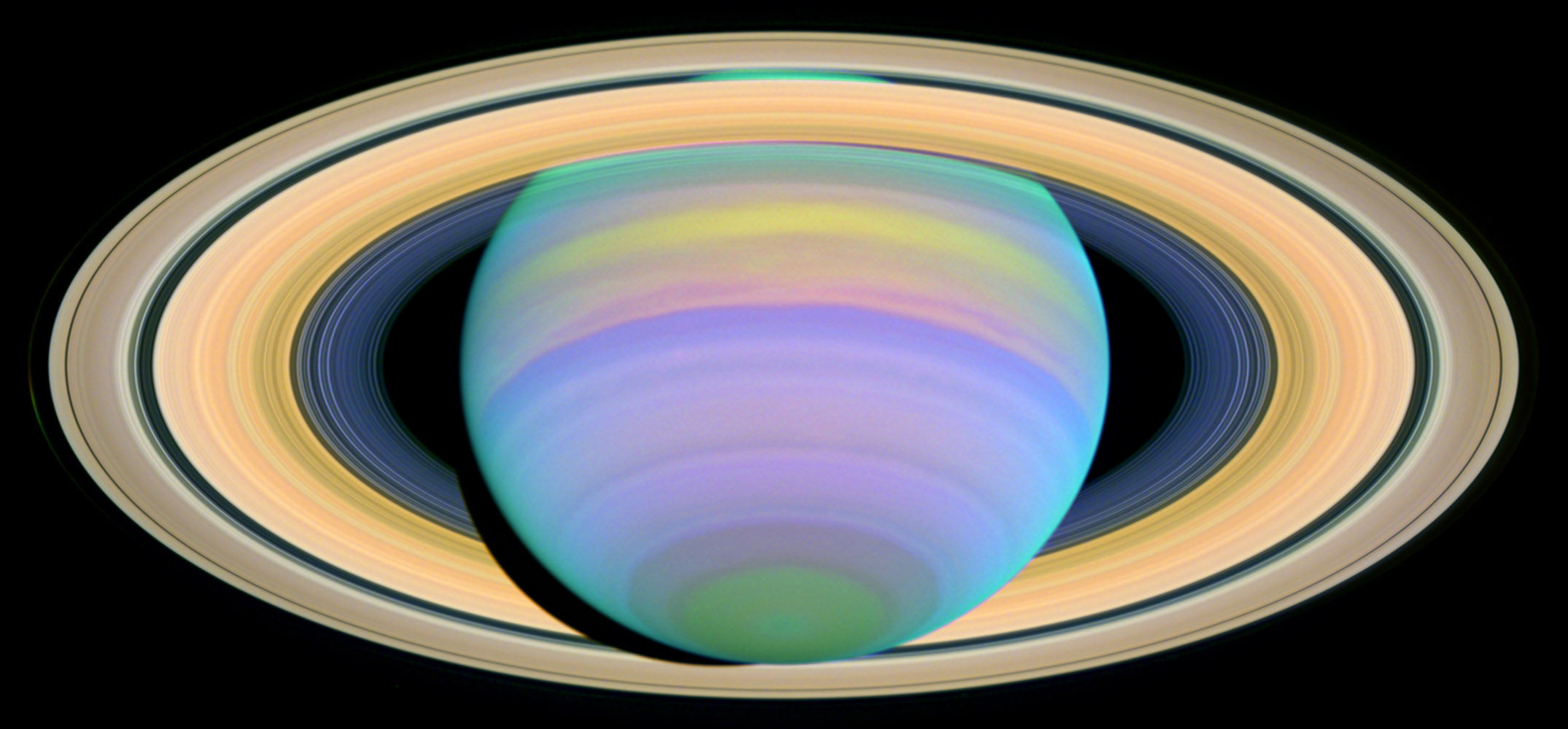
This false-color image of Saturn, taken in ultraviolet light, reveals details in the hazes and clouds of the planet's atmosphere that are not easy or possible to see in visible light. Ultraviolet observations strip away the familiar golden hues of Saturn to expose hidden layers of atmospheric chemistry and dynamics. Different altitudes of cloud layers become visible as distinct color bands, while the ring system takes on an ethereal quality as particles of varying composition scatter ultraviolet light differently than visible light. These observations provide astronomers with critical information about the chemical processes occurring high in Saturn's atmosphere, including the production and destruction of photochemical hazes driven by solar ultraviolet radiation.
Scientific Significance
Ultraviolet observations of Saturn are uniquely valuable for probing the upper atmospheric chemistry that drives the planet's photochemical haze production. Solar UV radiation breaks apart methane and other hydrocarbons high in Saturn's stratosphere, initiating a cascade of chemical reactions that produce complex organic molecules — a process similar to smog formation on Earth but on a planetary scale. By imaging Saturn in UV wavelengths that are absorbed by specific molecular species, astronomers can map the vertical and horizontal distribution of these photochemical products, constraining atmospheric circulation models that predict how gases are transported between Saturn's equator and poles. UV observations also reveal the planet's powerful auroral emissions, which trace the interaction between Saturn's magnetosphere and the solar wind. Long-baseline Hubble UV monitoring has tracked seasonal variations in Saturn's atmospheric chemistry across its 29.5-year orbital period, providing insights into how the changing angle of solar illumination drives hemispheric differences in haze production and atmospheric dynamics.
Observation Details
This image was captured using Hubble's Space Telescope Imaging Spectrograph (STIS) in ultraviolet wavelength bands centered around 255 and 330 nanometers. These wavelengths are completely absorbed by Earth's ozone layer, making them accessible only from space-based observatories like Hubble. The false-color rendering assigns visible colors to different UV bands, with shorter wavelengths mapped to blue and longer wavelengths to red, revealing compositional variations in the clouds and hazes. The observations were carefully timed to capture Saturn at a favorable ring tilt angle and were designed to complement the Cassini spacecraft's in-situ atmospheric measurements during its orbital mission at Saturn.
Location in the Universe
Constellation
N/A (Solar System)
Distance from Earth
746 million to 1 billion miles (varies)
Fun Facts
- 1
In ultraviolet light, Saturn's familiar golden color disappears entirely — instead, the planet appears in shades of blue and green because different atmospheric molecules absorb and scatter UV radiation very differently than visible light.
- 2
Saturn's auroral displays at the poles, powered by interactions between the solar wind and the planet's magnetic field, are far more prominent in ultraviolet than in visible light, sometimes forming complete rings of glowing gas around both poles.
- 3
The Cassini Division — the prominent gap in Saturn's rings — appears distinctly different in ultraviolet because the particles on either side of the gap have different surface compositions that reflect UV light in contrasting ways.
Image credit: NASA, ESA, Hubble Space Telescope