About This Image
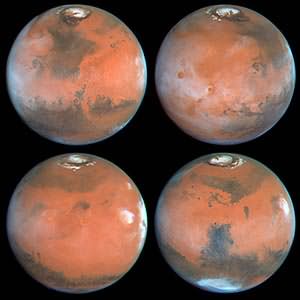
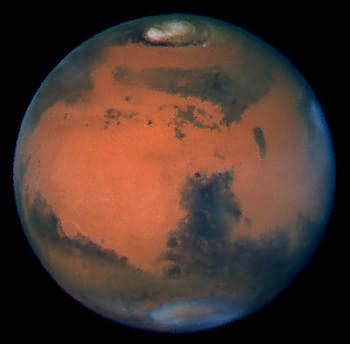
This stunning portrait of Mars was taken just before the planet made one of its closest approaches to Earth, passing about 60 million miles from us. This view was captured on the last day of spring in the planet's northern hemisphere, revealing a wealth of atmospheric and surface details across the Red Planet's face. Bright white water-ice clouds hover over the Martian surface, while the dark volcanic plains of Syrtis Major dominate one hemisphere. The north polar ice cap gleams brightly, partially shrouded in early morning haze as the Martian spring transitions toward summer. Hubble's sharp vision reveals surface features as small as 12 miles across, providing a global perspective that complements the close-up views obtained by orbiting spacecraft.
Scientific Significance
Hubble's regular observations of Mars provide a unique global perspective that no orbiting spacecraft can easily replicate. While Mars orbiters capture exquisite close-up details, they typically see only narrow swaths of the planet at any given time. Hubble, observing from Earth orbit, can image the entire visible hemisphere in a single exposure, making it ideal for tracking large-scale atmospheric phenomena such as planet-encircling dust storms, seasonal polar cap recession, and global weather patterns. These global monitoring campaigns have revealed that Mars experiences dramatic year-to-year variability in its climate, with some years producing massive dust storms that engulf the entire planet while others remain relatively calm. Hubble observations have also detected ozone in the Martian atmosphere, tracked the seasonal cycle of water vapor transport between hemispheres, and measured ultraviolet surface reflectance that constrains the mineralogical composition of the Martian surface. This long-baseline dataset spanning decades of Hubble observations constitutes an invaluable climate record for understanding the Red Planet's atmospheric dynamics.
Observation Details
This image was captured using Hubble's Wide Field and Planetary Camera 2 (WFPC2) in visible-light filters during the 1997 opposition of Mars. At the time of observation, Mars was near its closest approach to Earth, maximizing the apparent size of the planet's disk and enabling Hubble to resolve surface features as small as approximately 19 kilometers (12 miles) across. The image was constructed from exposures in red, green, and blue filters to produce a natural-color view. The timing was chosen to capture the transition from northern spring to summer, when the north polar cap was actively sublimating and atmospheric cloud activity was increasing.
Location in the Universe
Constellation
N/A (Solar System)
Distance from Earth
60 million miles (at time of observation)
Fun Facts
- 1
Mars makes a close approach to Earth approximately every 26 months when the two planets align on the same side of the Sun, but the actual distance varies enormously because Mars has a noticeably elliptical orbit — close approaches range from 34 million to 63 million miles.
- 2
The dark volcanic region Syrtis Major, visible prominently in this image, was the first permanent surface feature identified on another planet, sketched by the Dutch astronomer Christiaan Huygens in 1659.
- 3
Hubble has monitored Mars continuously since the early 1990s, documenting massive dust storms, seasonal ice cap changes, and atmospheric variations that provide crucial context for robotic missions exploring the Martian surface.
Image credit: NASA, ESA, Hubble Space Telescope