About This Image
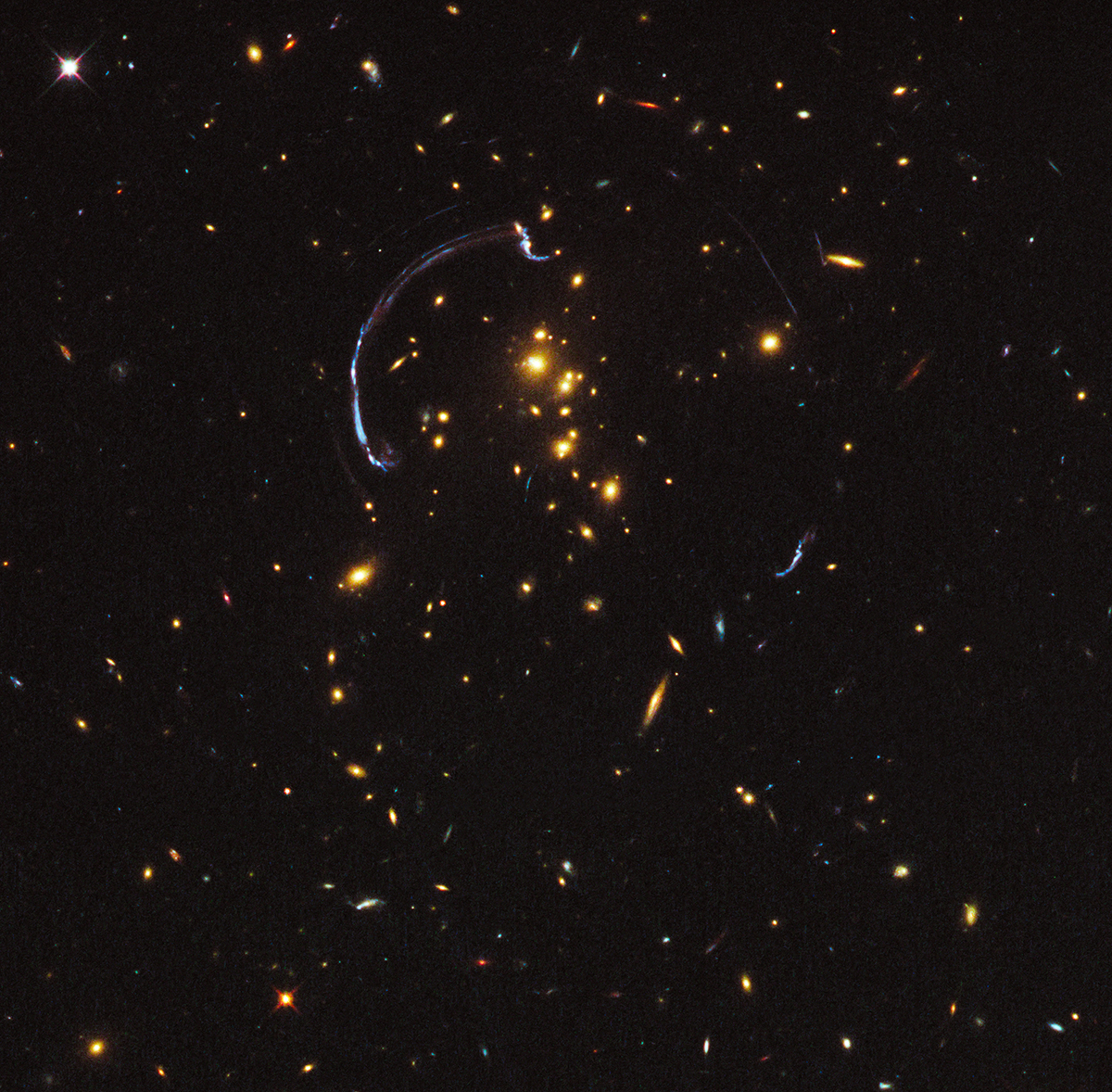
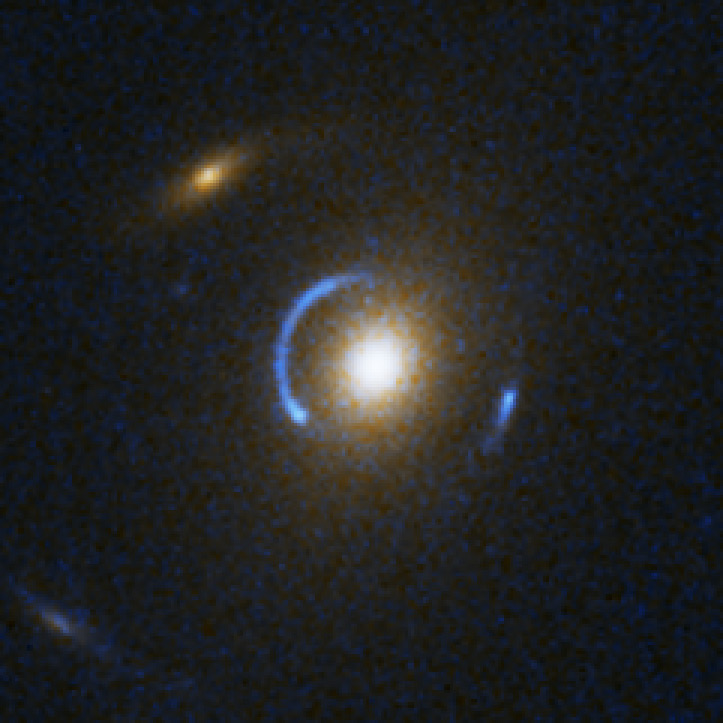
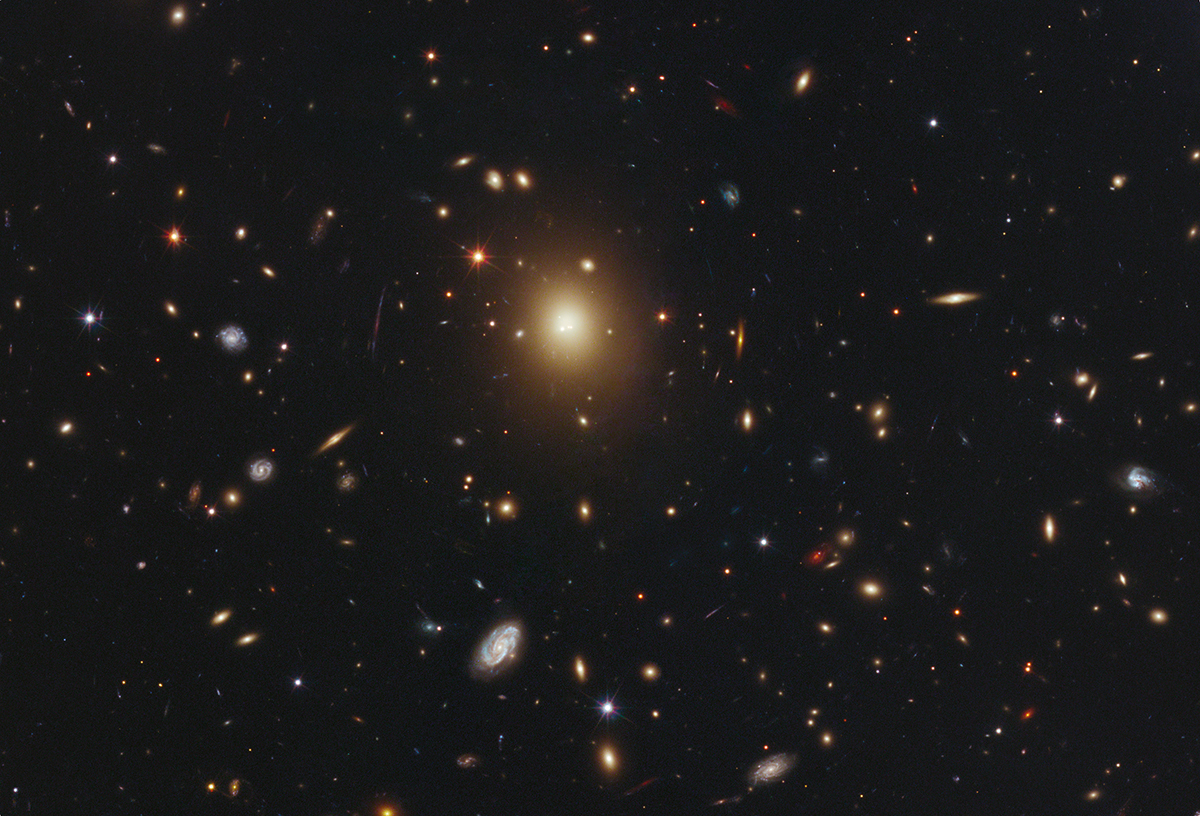
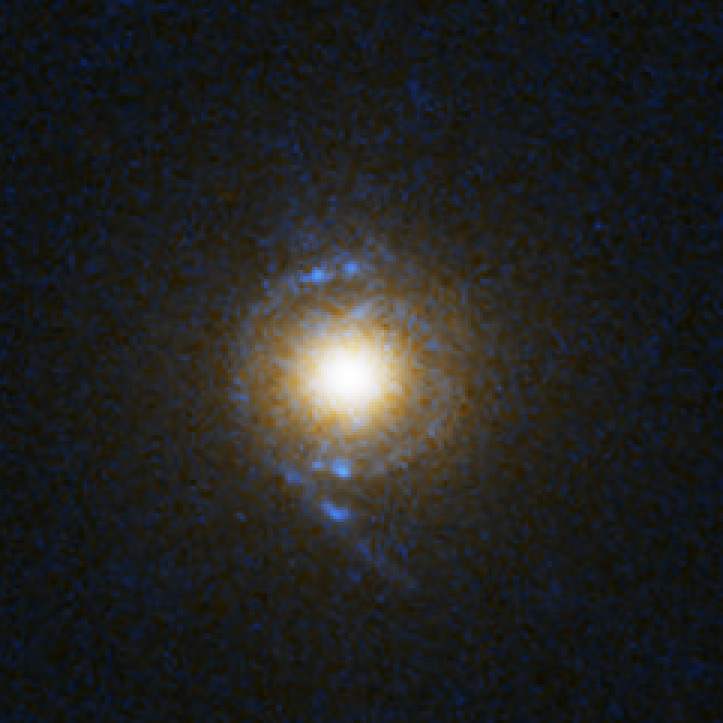
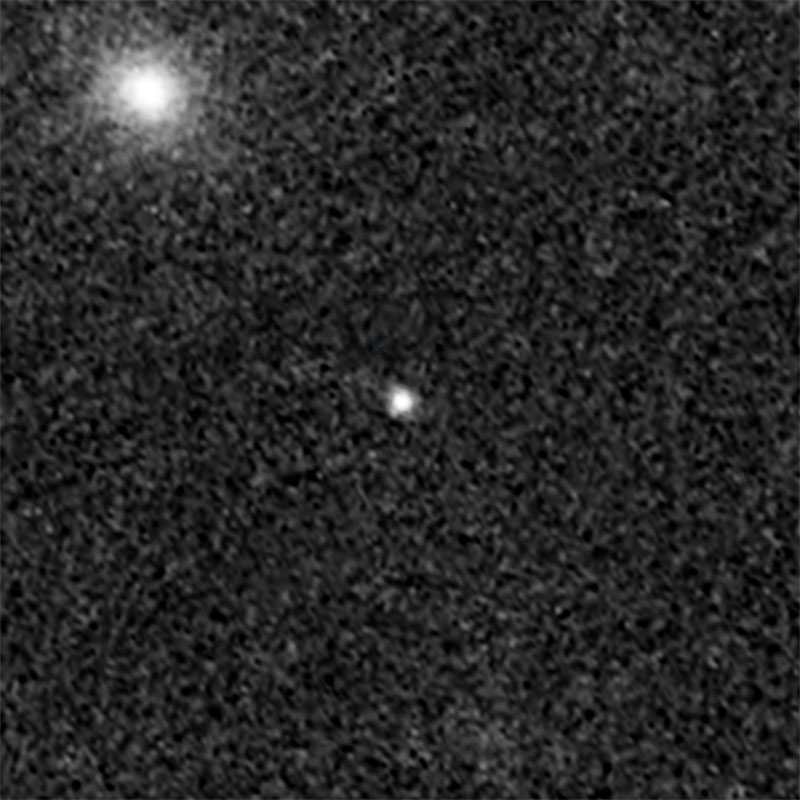
Supernova Didius, named after the Roman emperor Didius Julianus, is the white dot in the center of this image — a stellar explosion of almost inconceivable violence captured across a vast gulf of cosmic time and space. The bright blob at upper left is the core of the supernova's host galaxy, providing a sense of scale for this cataclysmic event. The supernova is so extraordinarily far away that we see it as it appeared 7 billion years ago, when the universe was only half its current age. Despite the immense distance, the explosion was bright enough to be detected by Hubble because Type Ia supernovae are among the most luminous events in the cosmos, briefly outshining their entire host galaxies. These ancient explosions serve as cosmic mile markers that have revealed one of the most profound discoveries in modern science: the accelerating expansion of the universe.
Scientific Significance
Supernova Didius belongs to a class of distant Type Ia supernovae that have been instrumental in measuring the expansion history of the universe and constraining the properties of dark energy. Type Ia supernovae are produced when a white dwarf star in a binary system accumulates enough mass from a companion star to trigger a thermonuclear detonation, completely destroying the white dwarf in an explosion that reaches a nearly uniform peak luminosity. This standardizable brightness makes them invaluable distance indicators at cosmological scales. By comparing the observed brightness of distant supernovae like Didius to their known intrinsic luminosity, astronomers can measure the distance to their host galaxies and, combined with redshift measurements, map out the expansion rate of the universe over billions of years. The discovery of Supernova Didius at a lookback time of 7 billion years places it in the critical epoch when the universe transitioned from matter-dominated deceleration to dark-energy-dominated acceleration, providing key data points for constraining cosmological models and the equation of state of dark energy.
Observation Details
Supernova Didius was discovered and monitored as part of a Hubble Space Telescope survey program designed to find and measure distant Type Ia supernovae for cosmological studies. The observations used the Advanced Camera for Surveys (ACS) and Wide Field Camera 3 (WFC3) in multiple broadband filters spanning visible and near-infrared wavelengths. Repeated observations over several weeks tracked the supernova's light curve — the rise and decline of its brightness over time — which is essential for calibrating its peak luminosity and classifying its subtype. Spectroscopic follow-up with ground-based telescopes confirmed its classification as a Type Ia supernova and measured the redshift of its host galaxy.
Location in the Universe
Constellation
N/A (Deep Field)
Distance from Earth
7 billion light-years
Fun Facts
- 1
Supernova Didius is named after Didius Julianus, who was Roman Emperor for only nine weeks in 193 AD before being deposed and executed — a fitting name for a cosmic event that shines brilliantly but briefly before fading into darkness.
- 2
Type Ia supernovae like Didius all reach approximately the same peak luminosity, making them 'standard candles' that astronomers use as cosmic rulers to measure distances across billions of light-years — this technique led to the 1998 discovery that the universe's expansion is accelerating.
- 3
Because light from Supernova Didius took 7 billion years to reach us, we are literally looking back in time to an era when the universe was transitioning from deceleration to acceleration — a pivotal moment in cosmic history driven by the mysterious force called dark energy.
Image credit: NASA, ESA, Hubble Space Telescope