About This Image
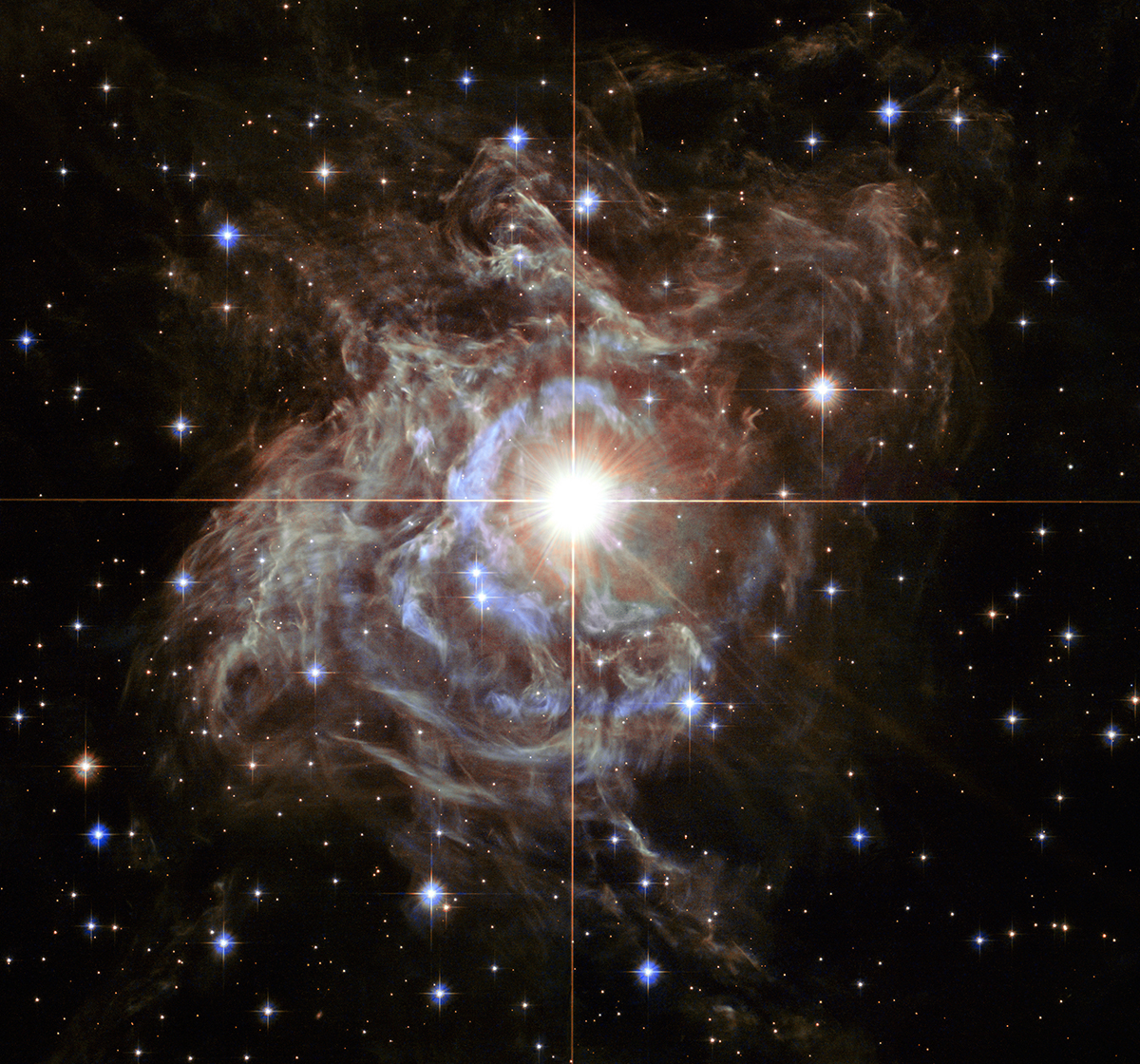
The bright star RS Puppis is swaddled in a cocoon of reflective dust illuminated by the glittering star, creating one of the most remarkable light-echo phenomena ever observed. RS Puppis is a Cepheid variable star — 10 times more massive than our Sun and 200 times larger — that pulsates in brightness over a regular 41.4-day cycle, alternately brightening and dimming as it swells and contracts. As each pulse of light travels outward through the surrounding nebula, it illuminates successive layers of dust, creating an expanding ripple pattern called a light echo that astronomers can actually watch propagate across the nebula over weeks and months. This geometric effect provides one of the most elegant and precise methods for measuring the distance to a star, as the apparent speed of the light echo combined with the known speed of light yields a direct distance measurement through pure geometry.
Scientific Significance
RS Puppis holds extraordinary importance for the calibration of the cosmic distance ladder — the chain of techniques astronomers use to measure distances across the universe. Cepheid variable stars are the fundamental rungs of this ladder because their pulsation periods are directly related to their intrinsic luminosities, a relationship discovered by Henrietta Swan Leavitt in 1912. However, this period-luminosity relationship must be calibrated with precise distance measurements to a sample of nearby Cepheids. RS Puppis's light echoes provide a purely geometric distance measurement that bypasses the systematic uncertainties inherent in other distance methods, making it one of the most valuable calibration points for the entire Cepheid distance scale. The distance to RS Puppis, measured to approximately 1% precision through its light echoes, directly impacts the accuracy of the Hubble constant — the expansion rate of the universe — because Cepheid distances anchor the calibration chain that extends from our local galactic neighborhood to the most distant supernovae used to probe dark energy. The unique nebular environment of RS Puppis also provides insights into mass loss from evolved massive stars and the interaction between stellar radiation and circumstellar dust.
Observation Details
This image was assembled from multiple observations taken with Hubble's Advanced Camera for Surveys (ACS) in visible-light filters over several epochs spanning the star's 41.4-day pulsation cycle. The multi-epoch approach was essential for detecting and tracking the light echoes as they propagated outward through the nebula. By comparing images taken at different phases of the pulsation cycle, astronomers could measure the apparent motion of the illumination pattern across the dust structures and derive a geometric distance to the star. The ACS provided the angular resolution and sensitivity needed to map the complex, filamentary structure of the surrounding nebula and to distinguish genuine light-echo features from static dust illumination. Polarimetric observations confirmed that much of the nebular light is indeed reflected starlight, consistent with the light-echo interpretation.
Location in the Universe
Constellation
Puppis
Distance from Earth
6,500 light-years
Fun Facts
- 1
RS Puppis's light echoes travel outward through the nebula at the speed of light, but because of the geometry of reflection, they appear to move across the sky at apparent speeds of up to 7 light-years per year — faster than light appears to travel, though this is an illusion caused by the light-travel-time effect.
- 2
By measuring the apparent expansion speed of the light echoes and comparing it to the known speed of light, astronomers determined RS Puppis's distance with an accuracy of about 1% — one of the most precisely measured distances to any Cepheid variable star.
- 3
RS Puppis is one of the most luminous Cepheid variable stars in the Milky Way, shining with an average luminosity about 15,000 times that of the Sun — bright enough that if it replaced our Sun, Earth would be well inside the star's outer atmosphere.
Image credit: NASA, ESA, Hubble Space Telescope