About This Image
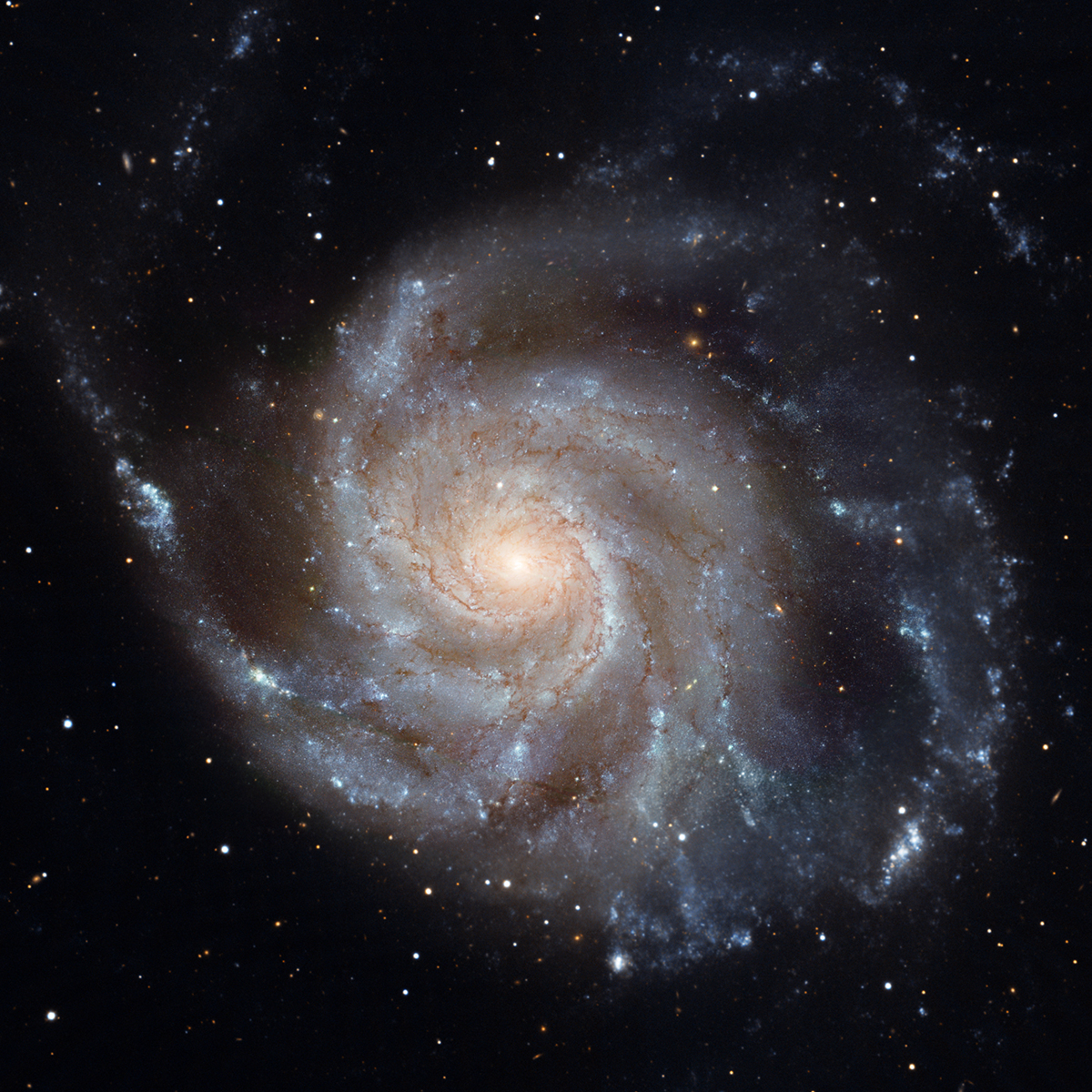
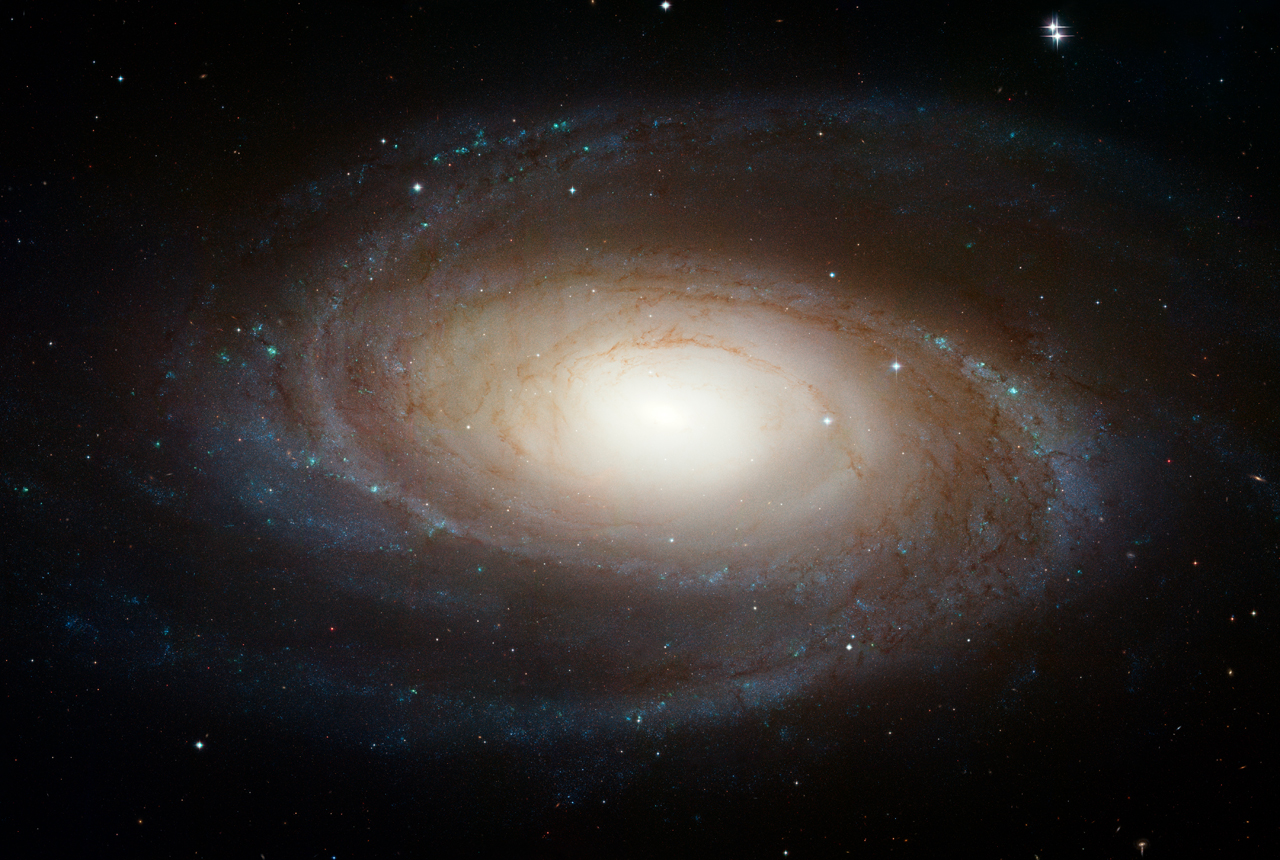
The arms of the "grand design" spiral galaxy M81 are filled with young, bluish, hot stars born from the dense clouds of gas and dust that trace the galaxy's elegant spiral pattern. The greenish regions in the image are bright, gaseous clouds where new stars are actively forming, their intense ultraviolet radiation ionizing the surrounding hydrogen gas and causing it to glow. Also known as Bode's Galaxy after the astronomer who discovered it in 1774, M81 is one of the brightest and most photogenic galaxies visible from the Northern Hemisphere. Its nearly perfect grand-design spiral structure — characterized by two prominent, well-defined spiral arms that can be traced nearly all the way around the galaxy — makes it a textbook example of spiral galaxy architecture and one of the most extensively studied galaxies beyond our Local Group.
Scientific Significance
M81 is one of the most scientifically productive galaxies for extragalactic astronomy, serving multiple roles in our understanding of galaxy structure, stellar populations, and cosmological distances. As the nearest grand-design spiral galaxy, it provides the sharpest view available of the physical processes that create and maintain spiral arm patterns. Hubble's observations resolved millions of individual stars across M81's disk, enabling studies of how stellar populations vary with position in the galaxy — from the young, blue stars concentrated in the spiral arms to the older, redder stars that dominate the inter-arm regions and central bulge. M81's Cepheid variables, identified by the Hubble Key Project, served as essential distance calibrators for measuring the Hubble constant, with 25 Cepheids providing a distance determination with approximately 10% accuracy. The ongoing gravitational interaction between M81, M82, and NGC 3077 has created a remarkable system of tidal hydrogen streams visible in radio observations, demonstrating how galaxy interactions redistribute gas across enormous volumes and trigger starbursts in smaller companions. M81's supermassive black hole, while relatively quiescent compared to active galactic nuclei, shows low-level accretion activity that makes it a valuable target for studying the 'gentle' feeding mode of black holes in normal galaxies.
Observation Details
This image was produced from observations taken with Hubble's Advanced Camera for Surveys (ACS) in blue, visible, and infrared filters. The extraordinary depth of the ACS imaging resolved individual bright stars across the galaxy's full extent, and the wide field of view captured a substantial fraction of M81's disk in a single pointing. The multi-wavelength color information enabled identification of different stellar populations: hot blue main-sequence stars in the spiral arms, red giant and supergiant stars in the disk and bulge, and the ionized gas clouds (HII regions) that mark the most active sites of current star formation. The greenish cast of the HII regions arises from combining their strong emission-line radiation with the broadband filter responses used to construct the color composite.
Location in the Universe
Constellation
Ursa Major
Distance from Earth
11.8 million light-years
Fun Facts
- 1
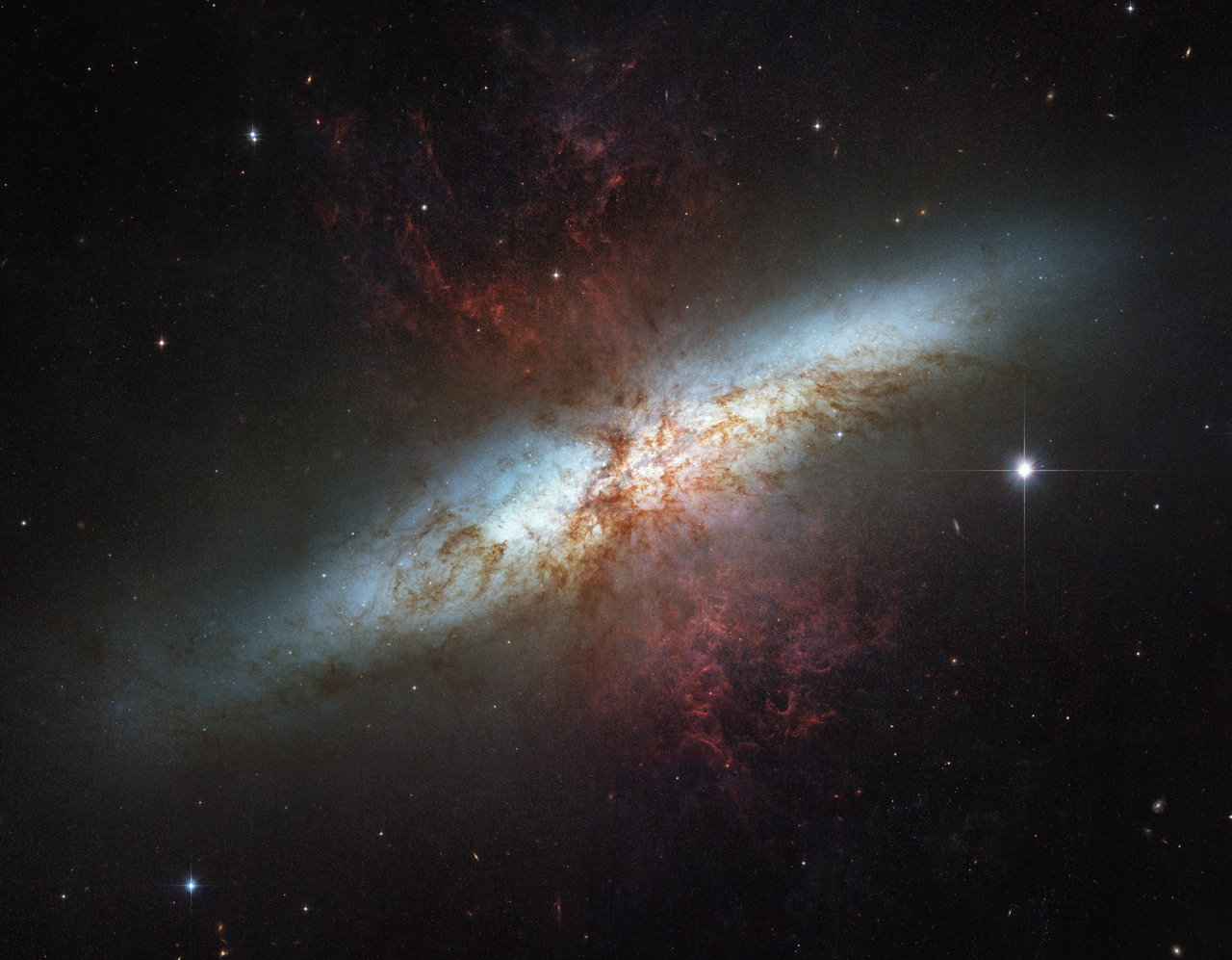
M81 is the gravitational anchor of the M81 Group, a collection of about 34 galaxies that includes its close companions M82 (the Cigar Galaxy) and NGC 3077 — all three are engaged in a gravitational tug-of-war that has pulled enormous streams of hydrogen gas between them.
- 2
M81 harbors a supermassive black hole with a mass of about 70 million suns — roughly 17 times the mass of the Milky Way's central black hole — that was detected through Hubble spectroscopy of rapidly orbiting stars near the galaxy's center.
- 3
M81 played a pivotal role in the Hubble Key Project's determination of the Hubble constant, as its Cepheid variable stars provided a critical distance calibration step linking the Milky Way to more distant galaxies.
Image credit: NASA, ESA, Hubble Space Telescope