About This Image
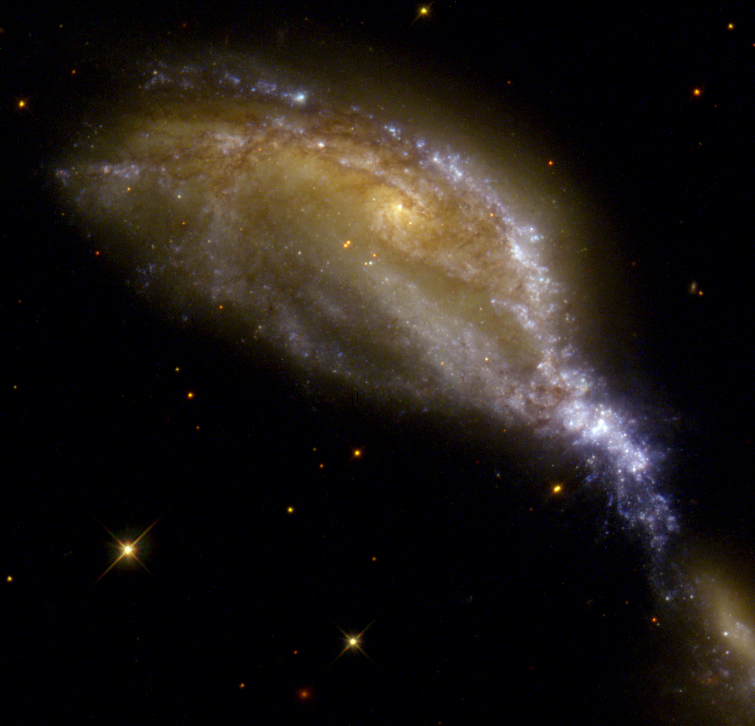
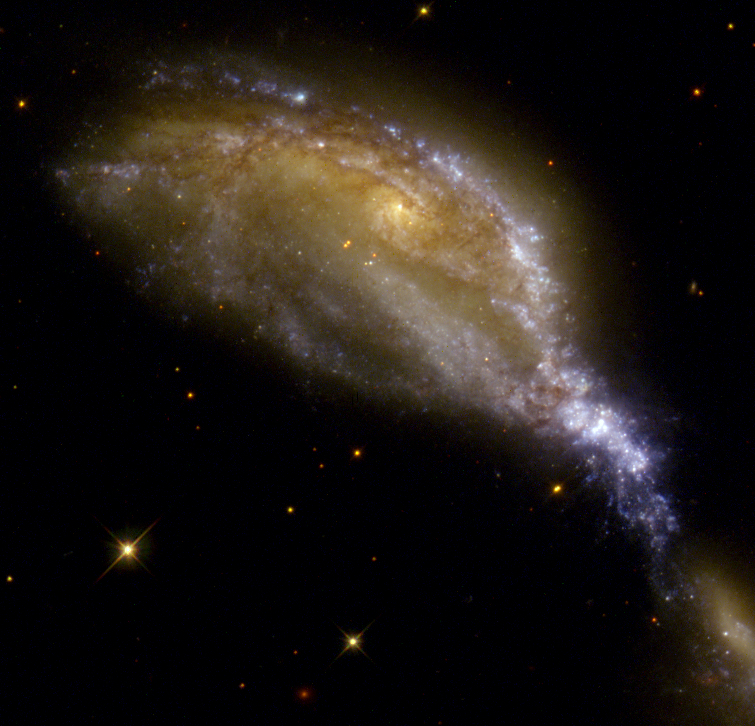
This image captures the dramatic collision of two galaxies in a cosmic crash that has been unfolding over hundreds of millions of years. The larger spiral galaxy, NGC 6745, boasts an intact nucleus as it interacts with the smaller, passing galaxy that is nearly out of the frame to the lower right. The collision has sparked vigorous star formation across NGC 6745, visible as bright blue knots of young, massive stars that have been born from gas compressed by the tremendous gravitational forces of the encounter. A long streamer of stars and gas connects the two galaxies, marking the path of the smaller intruder as it punched through the larger galaxy's disk. This dramatic tableau illustrates how galaxy collisions, while destructive on a large scale, are also powerful engines of stellar creation, transforming quiescent gas into brilliant new generations of stars.
Scientific Significance
NGC 6745 provides a striking example of a 'flythrough' collision, where a smaller galaxy has passed directly through the disk of a larger spiral galaxy rather than merging with it. This type of encounter is distinct from the slow inspiral mergers seen in systems like the Antennae Galaxies, and it produces a characteristic pattern of triggered star formation along the path of the intruder. The collision has compressed gas clouds along the trajectory of the smaller galaxy, creating a linear sequence of star-forming regions that records the passage like a trail of cosmic footprints. The young stellar populations in these regions provide a chronological record of the collision, with the oldest clusters near the point of initial entry and progressively younger clusters toward the current position of the smaller galaxy. This age gradient allows astronomers to measure the velocity and trajectory of the collision with remarkable precision. NGC 6745 also demonstrates how collisions can transform galaxy morphology — the larger galaxy's original spiral structure has been partially disrupted, and the tidal streamer represents material that will never return to the parent galaxy, permanently reducing its mass.
Observation Details
This image was captured using Hubble's Wide Field and Planetary Camera 2 (WFPC2) in visible-light broadband filters. The observations resolved the complex morphological features produced by the collision, including the bright star-forming knots, the tidal streamer connecting the two galaxies, and the distorted spiral arms of NGC 6745. The color composite distinguishes the blue light from young, massive stars in the collision-triggered clusters from the redder light of the older pre-existing stellar population. The smaller galaxy's compact appearance suggests it has retained more of its structural integrity during the passage than the larger galaxy, consistent with its higher surface density.
Location in the Universe
Constellation
Lyra
Distance from Earth
206 million light-years
Fun Facts
- 1
The smaller galaxy visible at the lower right has already passed through NGC 6745's disk and is now moving away, trailing a stream of gas and stars pulled from the larger galaxy — like a cosmic hit-and-run leaving a trail of debris at the scene.
- 2
The bright blue patches scattered across NGC 6745 are massive clusters of newborn stars that formed within the last few tens of millions of years, triggered when the smaller galaxy's passage compressed interstellar gas clouds to the critical density for star formation.
- 3
NGC 6745 is sometimes called the 'Bird Galaxy' because its distorted shape, with the tidal streamer extending to one side, resembles a bird in flight — a nickname given by astronomers who saw a poetic form in this scene of cosmic violence.
Image credit: NASA, ESA, Hubble Space Telescope