About This Image
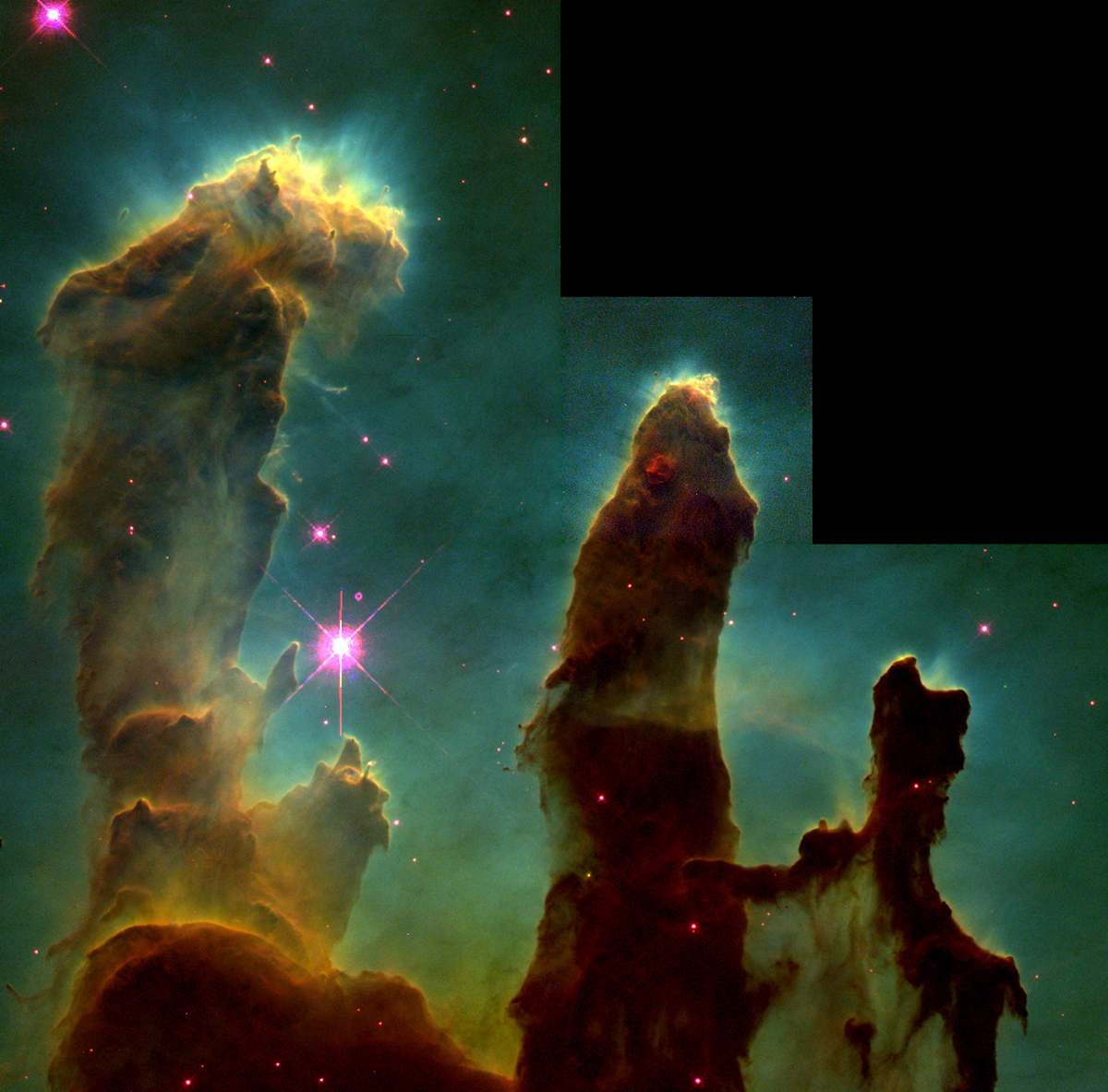
Hubble's iconic view of the "Pillars of Creation" in the Eagle Nebula (M16) displays three towering columns of cold molecular hydrogen gas and interstellar dust that serve as incubators for newborn stars. These pillars, the tallest stretching approximately four light-years from base to tip, are sculpted by the intense ultraviolet radiation and stellar winds from a cluster of hot, massive O-type and B-type stars located just beyond the upper edge of the image. The radiation is slowly eroding the pillars through a process known as photoevaporation, while simultaneously triggering new star formation within the densest regions. Small, finger-like protrusions called evaporating gaseous globules (EGGs) are visible at the surfaces of the pillars, each potentially harboring an embryonic star within its protective cocoon of gas and dust.
Scientific Significance
The Pillars of Creation represent one of the most visually compelling examples of the interplay between stellar radiation and star formation. These structures illustrate triggered star formation, where the same radiation destroying the pillars also compresses gas at their tips and edges, initiating gravitational collapse and the birth of new stars. The evaporating gaseous globules (EGGs) discovered in this image demonstrated that star formation can occur in small, isolated pockets at the boundaries of HII regions. The Eagle Nebula observations have become a benchmark for computational astrophysics, with numerous simulations attempting to reproduce the pillar morphology and predict their evolution. These models have advanced our understanding of how massive star feedback shapes the interstellar medium and regulates the pace of star formation across galaxies.
Observation Details
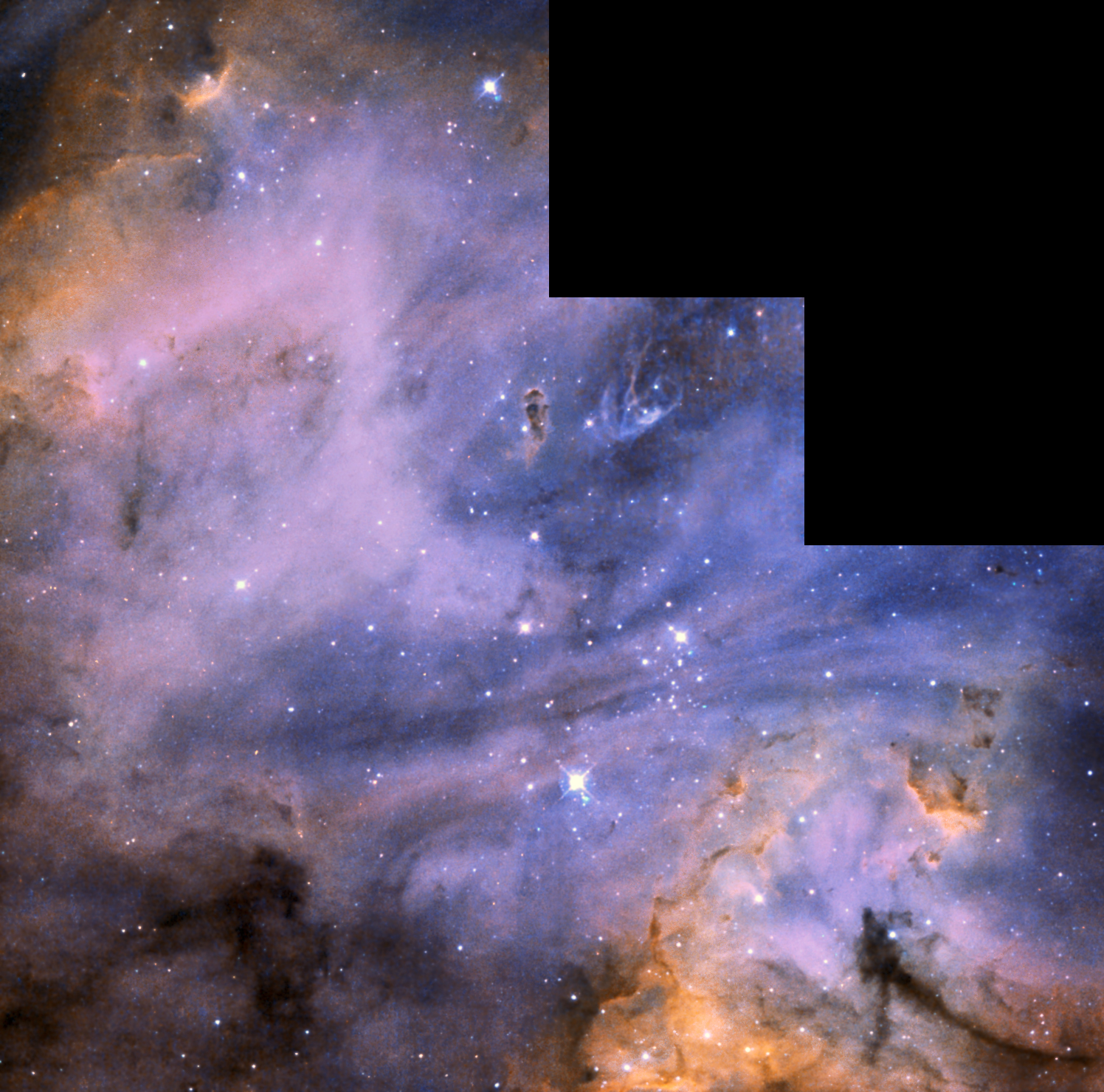
This landmark image was captured on April 1, 1995, using Hubble's Wide Field and Planetary Camera 2 (WFPC2). The composite was assembled from 32 separate exposures taken through four different filters isolating the light of ionized sulfur (red), hydrogen-alpha (green), and doubly ionized oxygen (blue) to create the false-color palette that reveals chemical composition and physical conditions within the nebula. The observations required multiple pointings to mosaic the full extent of the pillars, and the signature WFPC2 staircase pattern is visible in the original image.
Location in the Universe
Constellation
Serpens
Distance from Earth
6,500 light-years
Fun Facts
- 1
The Pillars of Creation image is one of the most reproduced astronomical photographs in history and has appeared on everything from postage stamps to T-shirts, becoming a true icon of space exploration.
- 2
Infrared observations suggest the pillars may have already been destroyed by a supernova shockwave about 6,000 years ago — but because of the speed of light, we won't see their destruction for another 1,000 years.
- 3
The tallest pillar is about 4 light-years long, which is roughly the distance from our Sun to the nearest star, Proxima Centauri.
Image credit: NASA, ESA, Hubble Space Telescope