About This Image
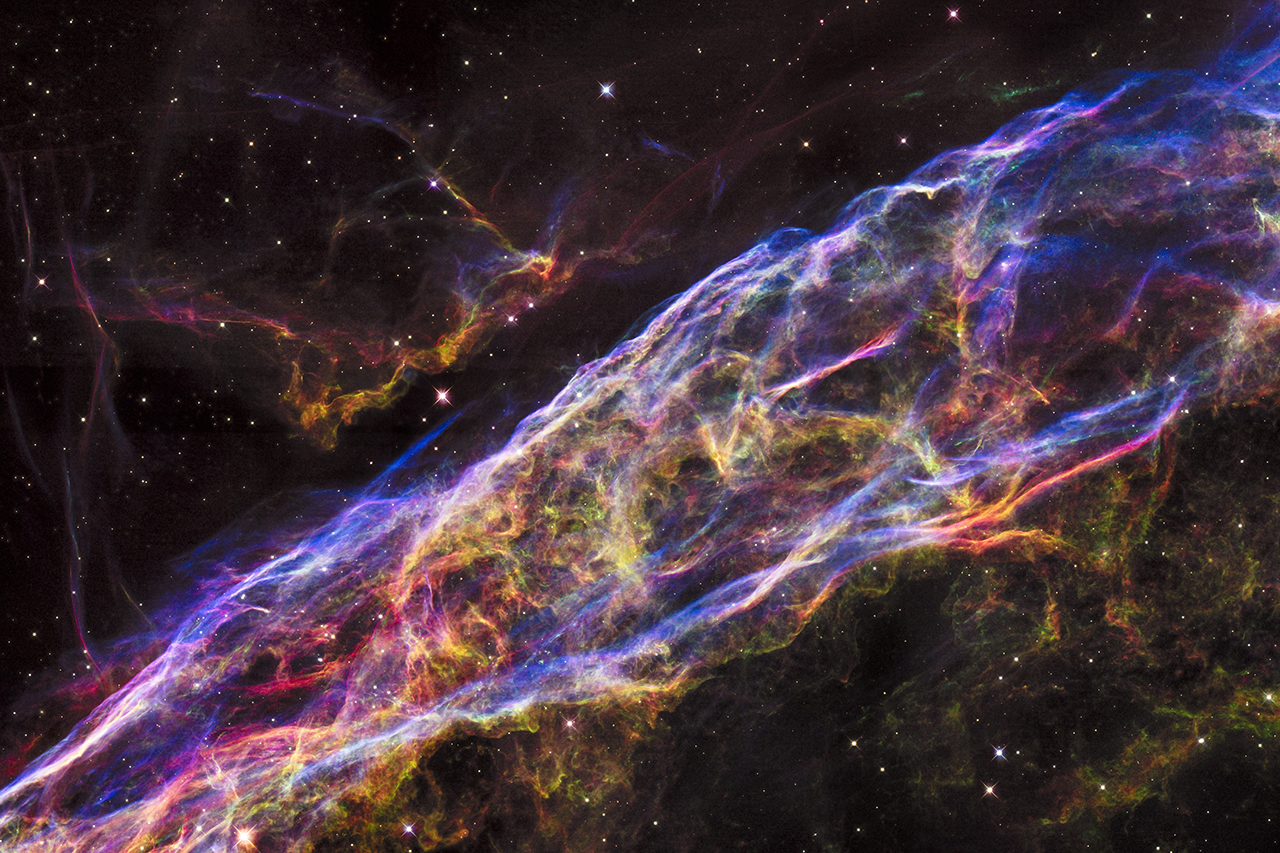
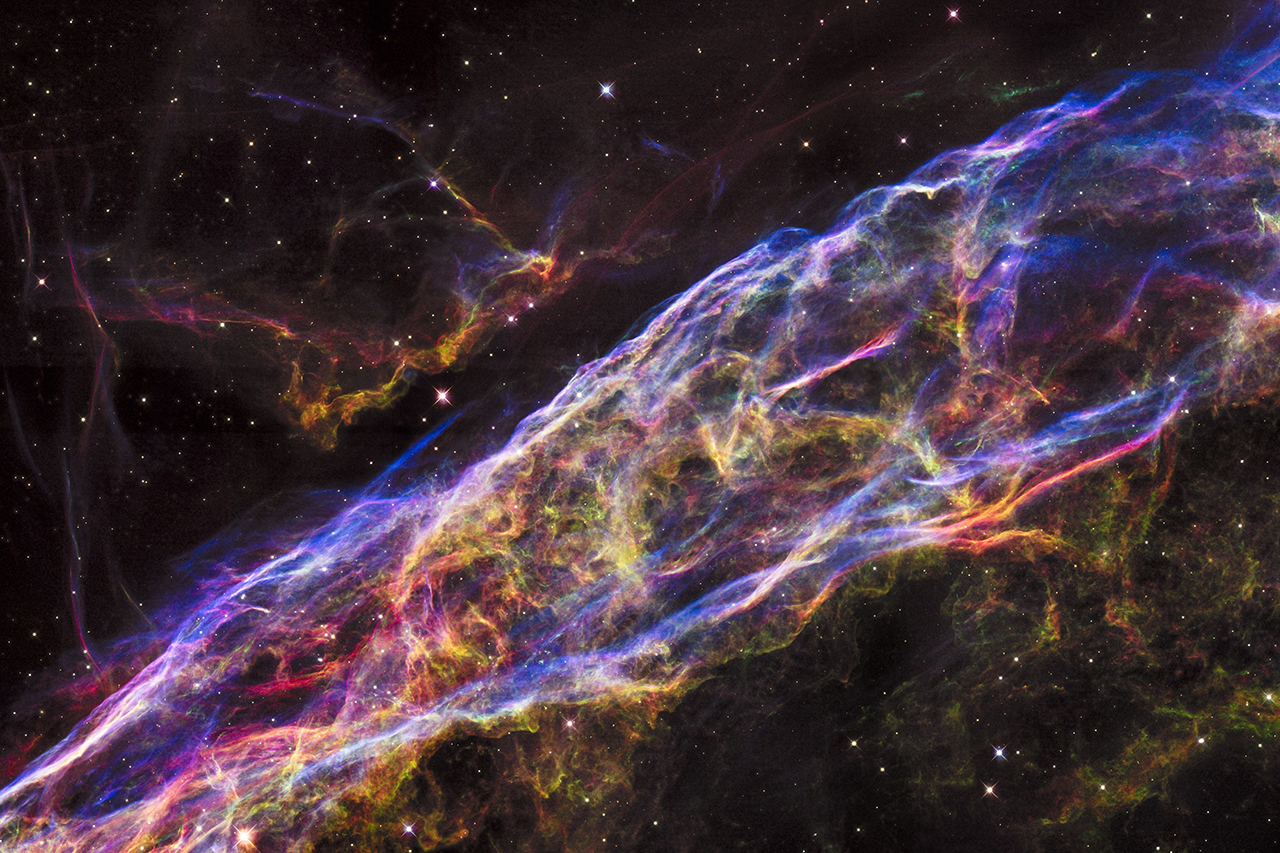
This Hubble image captures a small but exquisitely detailed section of the western arc of the Veil Nebula, the visible remnant of a massive star that exploded as a supernova approximately 8,000 years ago. Located about 2,100 light-years away in the constellation Cygnus, the Veil Nebula is one of the best-known supernova remnants in the sky, spanning approximately 110 light-years across. The delicate wisps and filaments visible in this image are sheets of shocked gas, created as the supernova's blast wave — still traveling at roughly 930,000 miles per hour — plows into the surrounding interstellar medium. The stunning colors reveal different chemical elements: blue traces oxygen emission, green shows sulfur, and red indicates hydrogen. The original star was approximately 20 times more massive than our Sun, and its explosive death seeded the surrounding space with heavy elements forged in its core.
Scientific Significance
The Veil Nebula is one of the most scientifically valuable supernova remnants because its relatively close distance and large angular size allow astronomers to study the physics of supernova blast waves in extraordinary detail. The western arc captured in this image shows the interaction between the blast wave and the ambient interstellar medium at the highest resolution achievable. By measuring the proper motion of the filaments over time — comparing images taken years apart — astronomers have determined the expansion velocity, distance, and age of the remnant with high precision. The Veil Nebula also demonstrates how supernova explosions enrich the interstellar medium with heavy elements synthesized in the progenitor star's core, a process fundamental to the chemical evolution of galaxies and the creation of the raw materials for planets and life.
Observation Details
This image was captured using Hubble's Wide Field Camera 3 (WFC3) in 2015 with six different filters that span ultraviolet to visible wavelengths. The narrowband filters isolated emission from doubly ionized oxygen ([O III] at 5007 angstroms, shown in blue), ionized hydrogen (H-alpha at 6563 angstroms, shown in red), and ionized sulfur ([S II] at 6717/6731 angstroms, shown in green). This filter combination reveals the different temperature and ionization conditions within the shocked filaments. The exceptional depth and resolution of the WFC3 observations revealed details as small as a few billion miles across at the nebula's distance.
Location in the Universe
Constellation
Cygnus
Distance from Earth
2,100 light-years
Fun Facts
- 1
The Veil Nebula is so large on the sky that it spans about 3 degrees — six times the apparent diameter of the full Moon — but it is so faint that most of its structure is invisible without a telescope and special filters.
- 2
The blast wave from the original supernova is still expanding at over 900,000 miles per hour and will continue to sweep up interstellar material for tens of thousands of years before finally dissipating.
- 3
The heavy elements scattered by this supernova — including oxygen, carbon, silicon, and iron — will eventually be incorporated into new stars and planets, continuing the cosmic recycling process that produced the elements in our own bodies.
Image credit: NASA, ESA, Hubble Space Telescope