About This Image
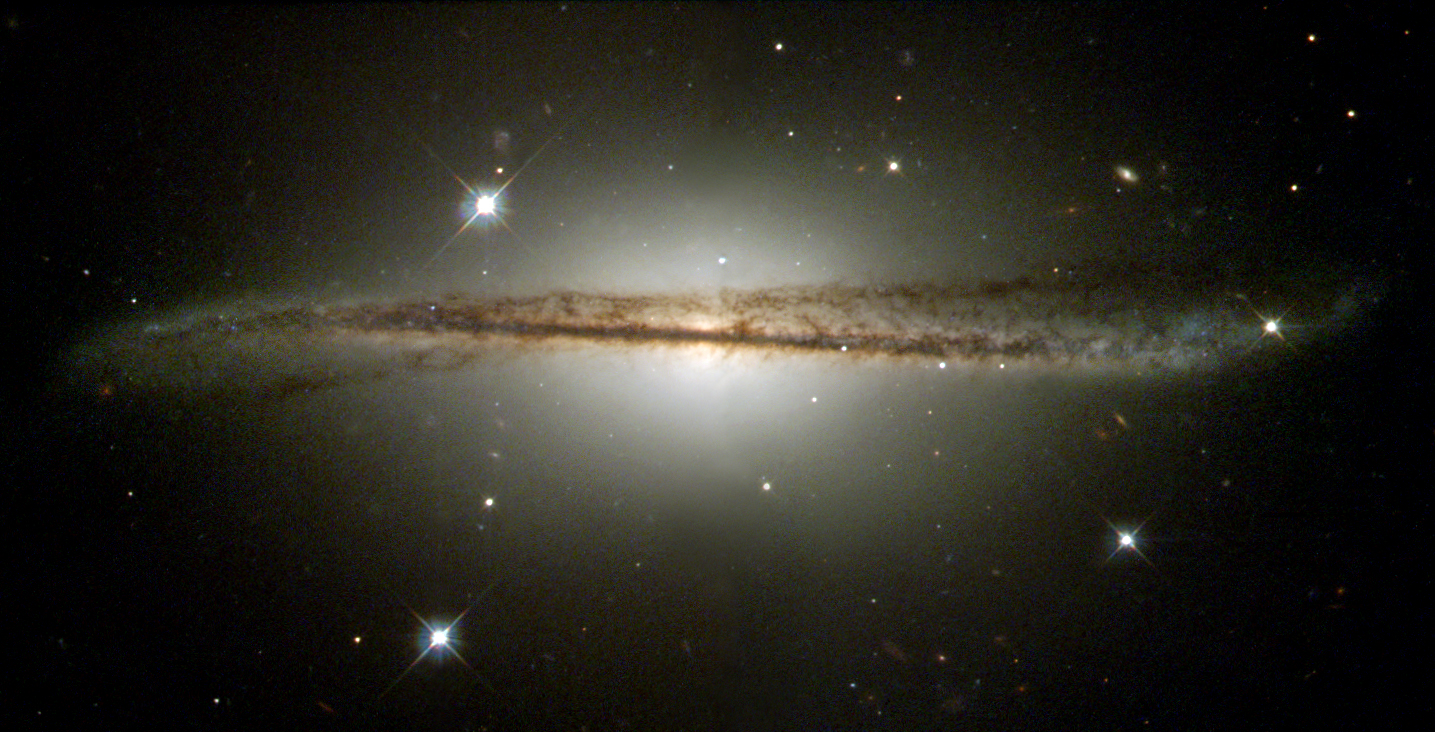
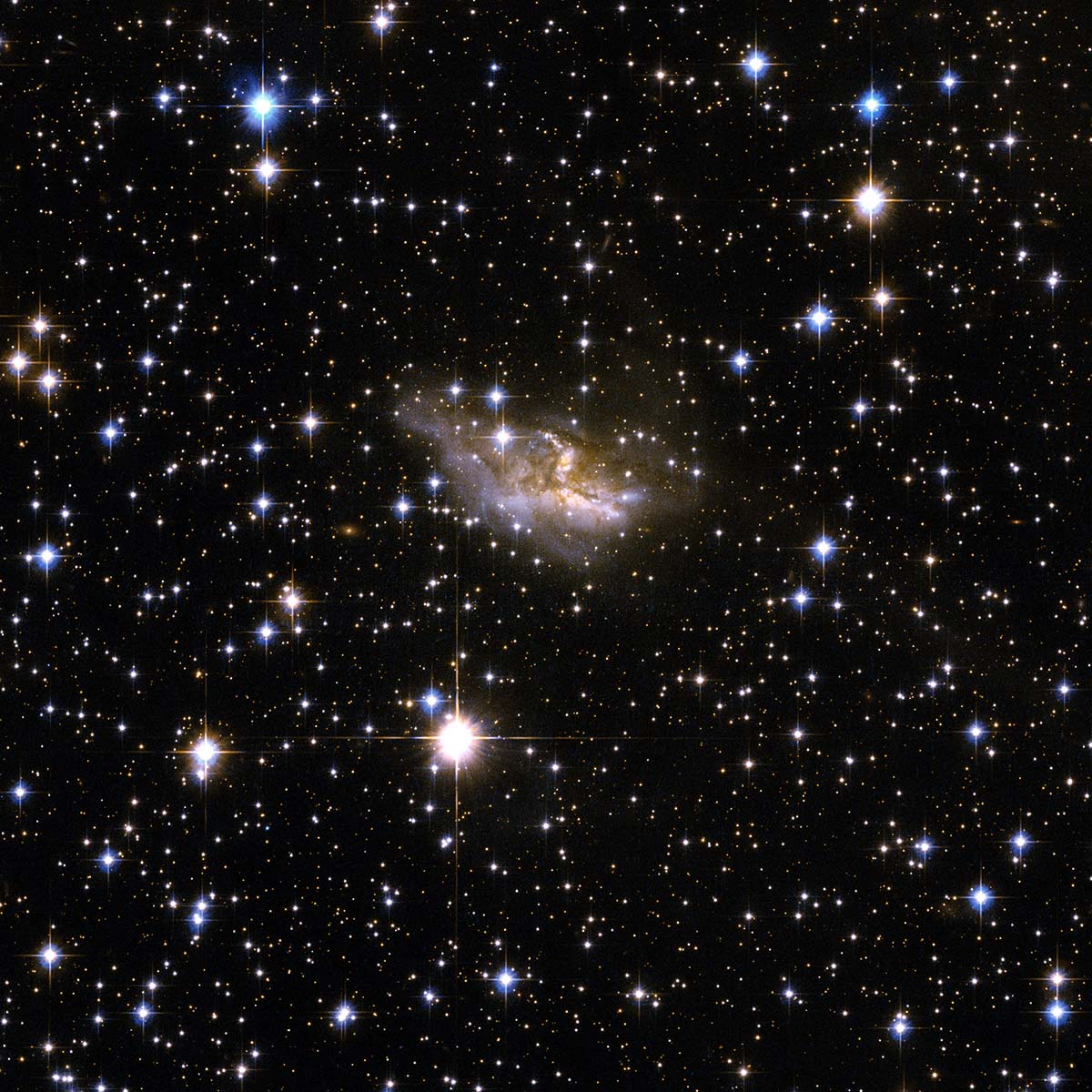
ESO 99-4 is a galaxy with a highly peculiar and disturbed morphology, located approximately 400 million light-years away in the constellation Triangulum Australe. Its bizarre shape is almost certainly the result of a galactic merger — a gravitational collision between two galaxies that has thoroughly disrupted the original structures of both participants. The main body of the galaxy is largely obscured by sweeping dark bands of interstellar dust that cut dramatically across the visible starlight, suggesting the merger has churned and redistributed vast quantities of dust and gas. Faint tidal tails and streams of stars extend outward from the central region, tracing the gravitational forces that tore material from the original galaxies during their encounter. Mergers like this are a fundamental mechanism of galaxy evolution, transforming orderly spiral galaxies into chaotic, irregular shapes before eventually settling into smooth elliptical galaxies over billions of years.
Scientific Significance
ESO 99-4 provides a window into the intermediate stages of galaxy mergers, a process central to the hierarchical model of galaxy formation. While many well-studied mergers show either the early interaction phase (with clearly separated galaxies and tidal bridges) or the late stage (a nearly relaxed elliptical galaxy), ESO 99-4 captures the chaotic middle phase where the two original galaxies have fully coalesced but the resulting structure has not yet dynamically relaxed. The prominent dust lanes provide information about how interstellar material is redistributed during mergers, which directly affects the distribution and rate of star formation in the remnant. Studies of the stellar populations in merger remnants like ESO 99-4 reveal distinct episodes of star formation triggered at different stages of the merger, creating a fossil record of the interaction history written in the ages and chemical compositions of the stars.
Observation Details
This image was captured using Hubble's Advanced Camera for Surveys (ACS) in broadband visible-light filters. The multi-color imaging reveals the contrast between the reddened starlight passing through the thick dust lanes and the bluer light from unobscured regions and young star-forming complexes. Hubble's resolution was essential for tracing the detailed morphology of the dust lanes and identifying compact star-forming regions embedded within the merger remnant. The observations also revealed faint tidal features in the galaxy's outskirts that trace the gravitational interaction history.
Location in the Universe
Constellation
Triangulum Australe
Distance from Earth
400 million light-years
Fun Facts
- 1
Galaxy mergers like the one that created ESO 99-4 typically take hundreds of millions to billions of years to complete, so what we see in this image is just a single frozen moment in a cosmic collision unfolding in extreme slow motion.
- 2
The dark dust bands that obscure much of ESO 99-4 would be nearly invisible if viewed face-on, but their edge-on orientation makes them stand out dramatically against the starlight behind them.
- 3
Our own Milky Way galaxy is on a collision course with the Andromeda Galaxy, and in about 4.5 billion years, the merged system may look similar to what we see in ESO 99-4 today.
Image credit: NASA, ESA, Hubble Space Telescope