About This Image
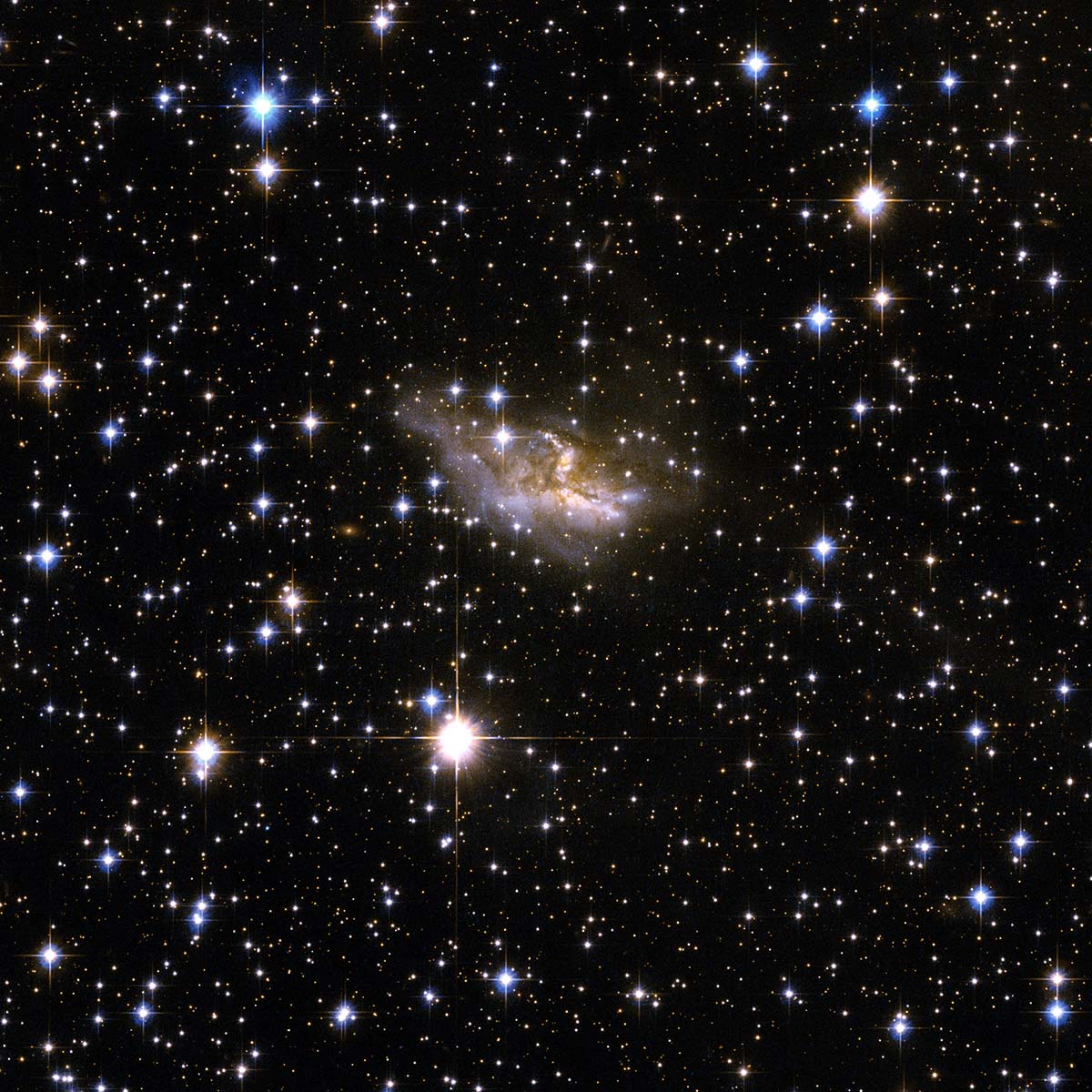
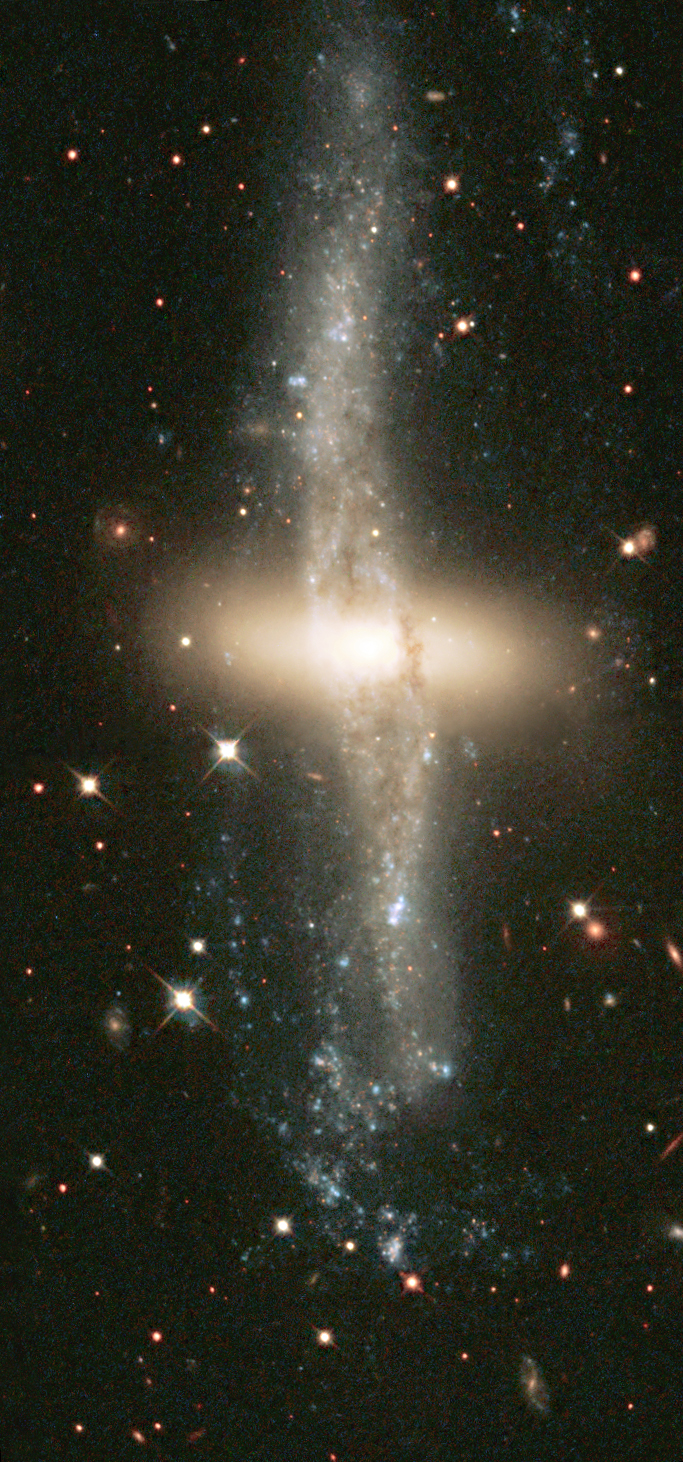
NGC 4650A is one of approximately 100 known polar-ring galaxies, a rare and visually striking class of objects in which a ring or disk of stars, gas, and dust orbits nearly perpendicular to the plane of the host galaxy's central disk. Located about 130 million light-years away in the constellation Centaurus, this peculiar galaxy features a central lenticular component surrounded by a dramatic ring of younger, bluer stars that extends far beyond the central body and orbits over the poles. The leading theory for polar ring formation involves the gravitational capture of material from a passing galaxy, or alternatively the merger of two galaxies oriented at right angles. The ring in NGC 4650A contains significant amounts of gas and young stars, indicating ongoing star formation, and extends to a diameter roughly three times that of the central galaxy.
Scientific Significance
NGC 4650A is one of the most scientifically important polar-ring galaxies because its geometry provides a unique way to probe the three-dimensional shape of dark matter halos. In a normal galaxy, stars and gas orbit in a single plane, so astronomers can only measure the gravitational potential along one axis. But in a polar-ring galaxy, material orbits along two nearly perpendicular planes simultaneously, allowing researchers to measure the dark matter halo's gravitational influence in two independent directions. Studies of NGC 4650A have revealed that its dark matter halo is more nearly spherical than oblate, a result with profound implications for cosmological models. These findings constrain the properties of dark matter particles themselves, since different dark matter candidates predict different halo shapes.
Observation Details
This image was captured using Hubble's Wide Field and Planetary Camera 2 (WFPC2) through broadband blue, visible, and infrared filters. The multi-color observations were essential for distinguishing the older, redder stellar population of the central lenticular galaxy from the younger, bluer stars in the polar ring. Hubble's angular resolution was critical for separating the structural components of this complex system, particularly where the polar ring crosses in front of the central disk. The observations enabled detailed surface photometry providing the kinematic and stellar population data needed to model the dark matter distribution.
Location in the Universe
Constellation
Centaurus
Distance from Earth
130 million light-years
Fun Facts
- 1
Polar-ring galaxies are among the rarest galaxy types known — out of the hundreds of billions of galaxies in the observable universe, only about 100 confirmed polar-ring galaxies have been identified.
- 2
The polar ring in NGC 4650A orbits at nearly 90 degrees to the central disk, essentially giving astronomers two different test orbits to probe the shape of the galaxy's dark matter halo from a single object.
- 3
The stars in NGC 4650A's polar ring are significantly younger and bluer than those in the central disk, suggesting the ring formed from a relatively recent event within the last one to two billion years.
Image credit: NASA, ESA, Hubble Space Telescope