About This Image
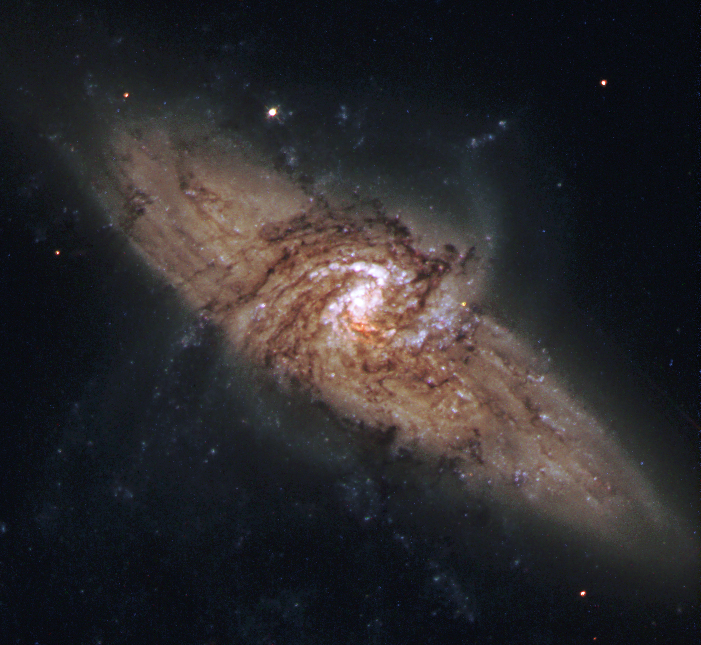
This remarkable image captures one of the most extraordinary cosmic alignments ever photographed: two unrelated spiral galaxies that happen to lie almost exactly along our line of sight. NGC 3314a, the foreground galaxy at about 117 million light-years distance, is seen face-on and is silhouetted against the more distant NGC 3314b at roughly 140 million light-years. This chance superposition creates a unique natural experiment: the dust lanes and spiral arms of the foreground galaxy are strikingly backlit by the glow of the galaxy behind it, allowing astronomers to map the distribution of dark interstellar dust in NGC 3314a with extraordinary precision. This backlit configuration reveals dust structures that would ordinarily be invisible against the dark background of empty space, providing an unparalleled view of the interstellar medium within a spiral galaxy.
Scientific Significance
NGC 3314 is one of the most scientifically valuable galaxy pairs for studying interstellar dust, the fine particles of carbon and silicate that pervade the space between stars. Normally, astronomers must infer the properties of dust indirectly — through its infrared emission or its reddening effect on starlight. But NGC 3314's unique backlit geometry allows direct measurement of dust absorption by comparing the light of the background galaxy in regions with and without foreground dust. This technique has yielded some of the most precise maps of dust distribution in any external galaxy. The observations revealed that dust in NGC 3314a extends significantly beyond the visible spiral arms, indicating that the interstellar medium is more extensive than optical images alone would suggest. These findings have important implications for understanding how dust affects distance measurements to supernovae and other cosmological standard candles.
Observation Details
This image was captured using Hubble's Wide Field and Planetary Camera 2 (WFPC2) through multiple broadband filters spanning ultraviolet, visible, and near-infrared wavelengths. The multi-wavelength approach was critical for measuring the wavelength dependence of dust absorption, which reveals the size distribution of dust grains. Careful subtraction of the foreground galaxy's own starlight from the combined image was required to isolate the pure absorption signature of the dust. Hubble's sharp resolution was essential for resolving individual dust lanes and structures within NGC 3314a against the smooth background illumination provided by NGC 3314b.
Location in the Universe
Constellation
Hydra
Distance from Earth
117 million light-years (foreground)
Fun Facts
- 1
Despite appearing to overlap, NGC 3314a and NGC 3314b are actually separated by tens of millions of light-years and are not gravitationally interacting — their overlap is purely a line-of-sight coincidence.
- 2
The chance of finding two large spiral galaxies aligned this precisely from our vantage point is astronomically small, making NGC 3314 one of the most unusual galaxy pairings ever observed.
- 3
By studying the dimming of the background galaxy's light as it passes through the foreground galaxy's dust, astronomers can measure the optical depth and grain properties of interstellar dust far more accurately than with any other technique.
Image credit: NASA, ESA, Hubble Space Telescope