About This Image
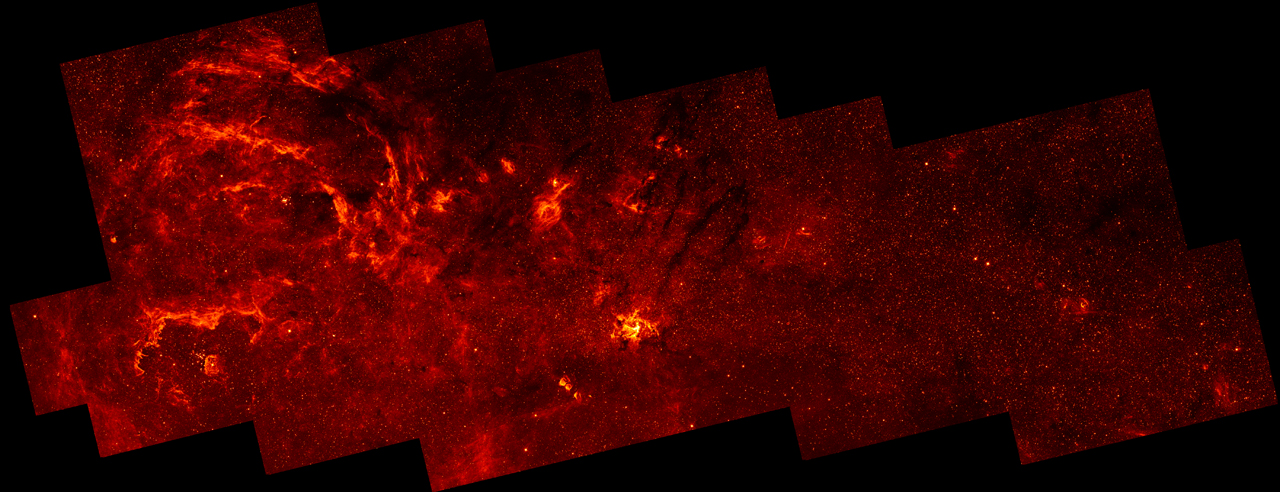
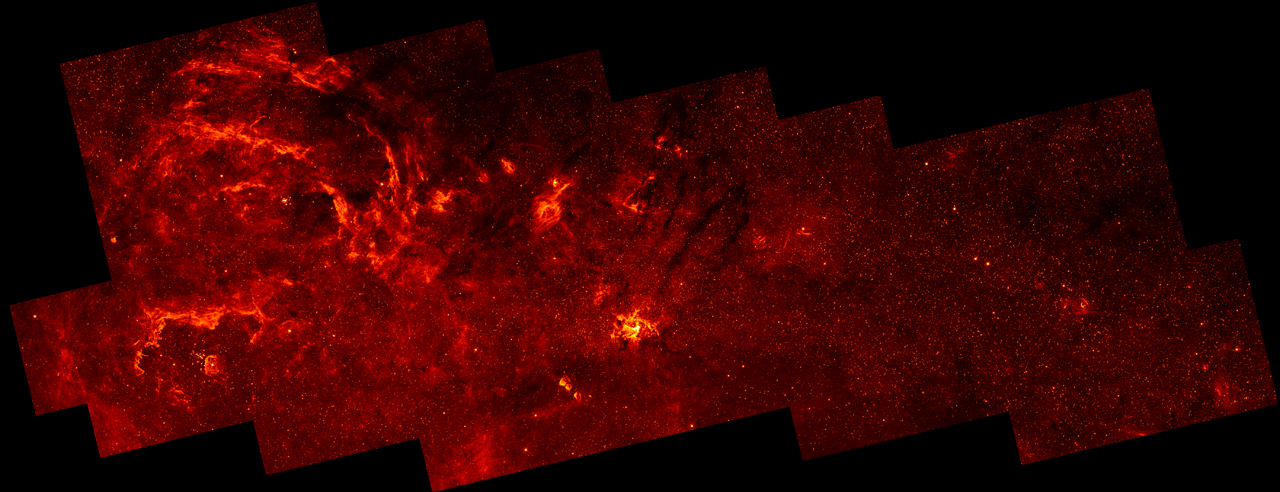
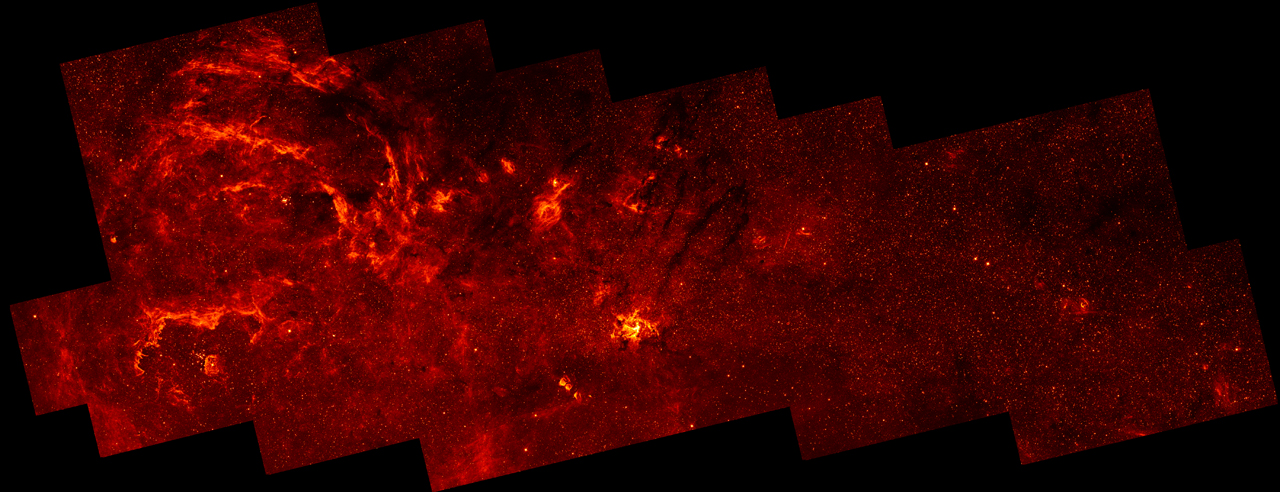
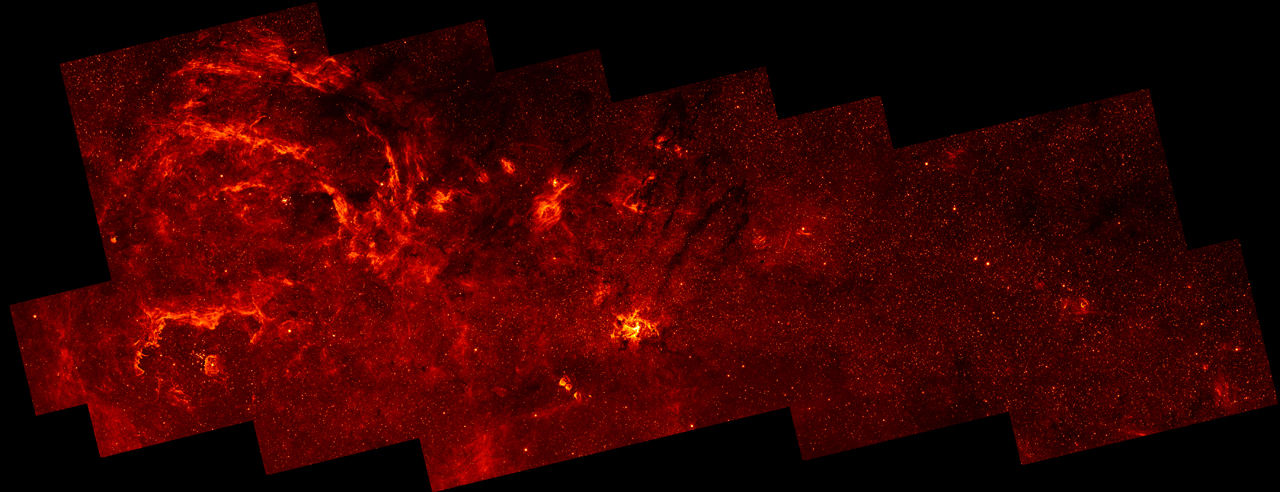
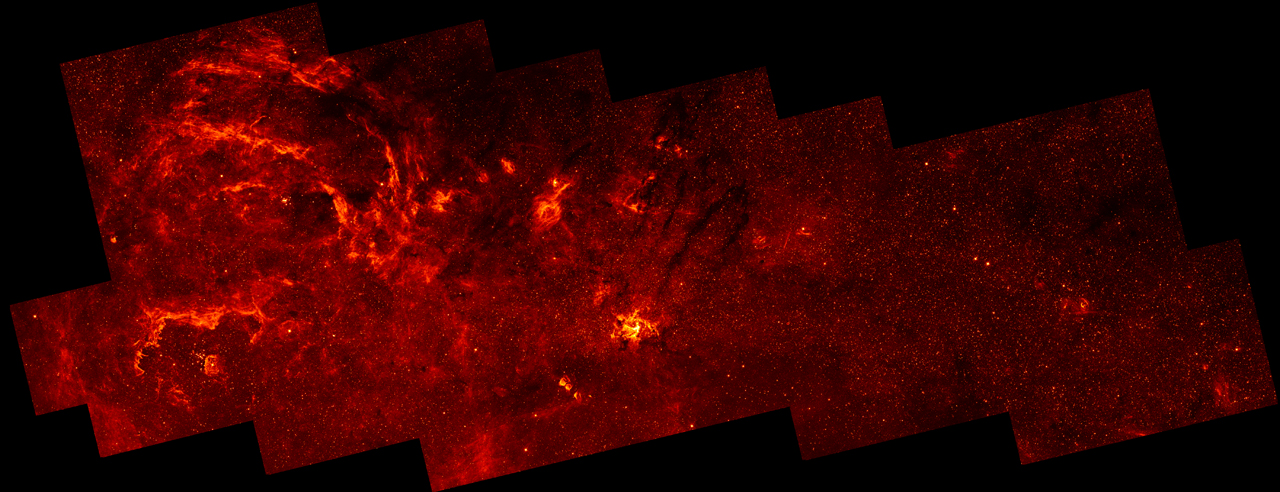
This stunning infrared image peers through the dense clouds of gas and dust that shroud the center of our Milky Way galaxy, revealing the Arches Cluster and its surrounding environment approximately 26,000 light-years from Earth. In visible light, the galactic center is completely obscured by intervening dust along the line of sight, but infrared wavelengths penetrate this veil to expose a crowded and turbulent region teeming with massive stars, hot ionized gas, and complex filamentary structures. The Arches Cluster, one of the densest known stellar clusters in the Milky Way, contains roughly 150 of the brightest stars in the galaxy packed into a region only a few light-years across. These stars generate intense stellar winds and ultraviolet radiation fields that sculpt the surrounding interstellar medium into intricate arcs and streamers of glowing gas.
Scientific Significance
The galactic center is one of the most extreme environments in the Milky Way, and Hubble's infrared observations have been instrumental in understanding the stellar populations and physical conditions in this region. The Arches Cluster provides a laboratory for studying massive star formation and evolution in a high-density, high-radiation environment very different from the solar neighborhood. Its proximity to the supermassive black hole Sagittarius A* (only about 100 light-years away) raises fundamental questions about how such a dense star cluster could form and survive in the intense tidal field near a four-million-solar-mass black hole. Observations of the cluster's stellar mass function suggest that the extreme environment may favor the formation of unusually massive stars. The Arches Cluster is also slowly dissolving due to tidal stripping by the galaxy's gravitational field, providing a window into the life cycle of massive star clusters near galactic nuclei.
Observation Details
This image was obtained using Hubble's Near Infrared Camera and Multi-Object Spectrometer (NICMOS), which operates at wavelengths from 0.8 to 2.5 micrometers where interstellar dust becomes increasingly transparent. Multiple infrared filters were used to construct a composite image that distinguishes between different stellar populations and gas emission features. The NICMOS observations required careful correction for the highly variable infrared background and the crowded stellar field. Hubble's angular resolution in the near-infrared was critical for resolving individual stars within the extremely dense core of the Arches Cluster.
Location in the Universe
Constellation
Sagittarius
Distance from Earth
26,000 light-years
Fun Facts
- 1
The Arches Cluster is the densest known star cluster in the Milky Way, packing the equivalent of 10,000 suns into a volume only about 3 light-years across — if it were located where our Sun is, it would fill the night sky with thousands of stars brighter than any we see today.
- 2
The stars in the Arches Cluster are estimated to be only 2 to 2.5 million years old, making them extremely young by cosmic standards, yet many are already among the most massive and luminous stars in the entire galaxy.
- 3
The galactic center is so obscured by dust that for every trillion visible-light photons emitted by stars there, only one makes it to Earth — infrared observations like this one are the only way to study these regions.
Image credit: NASA, ESA, Hubble Space Telescope