About This Image
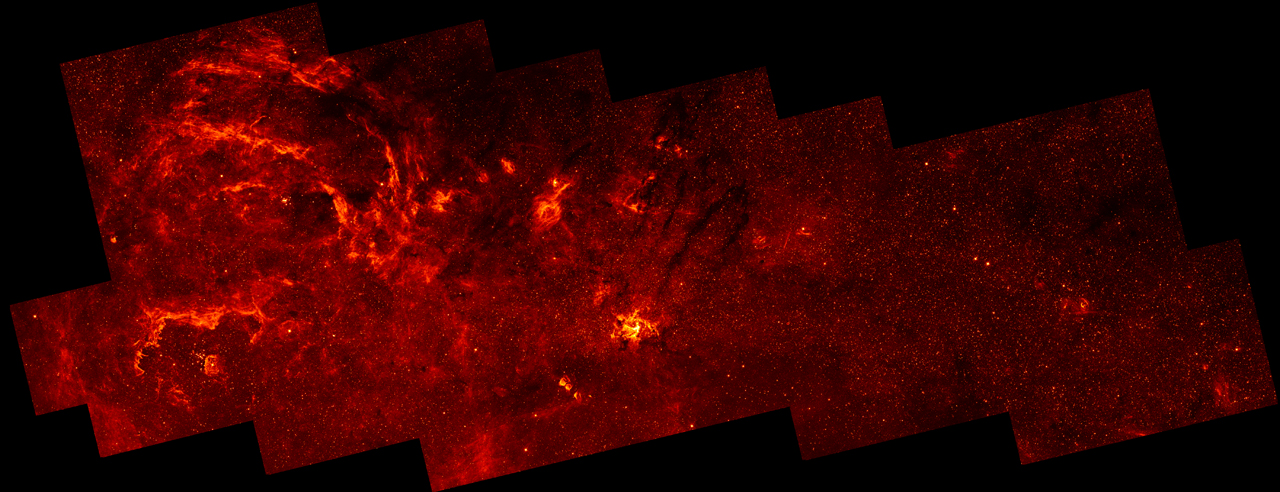
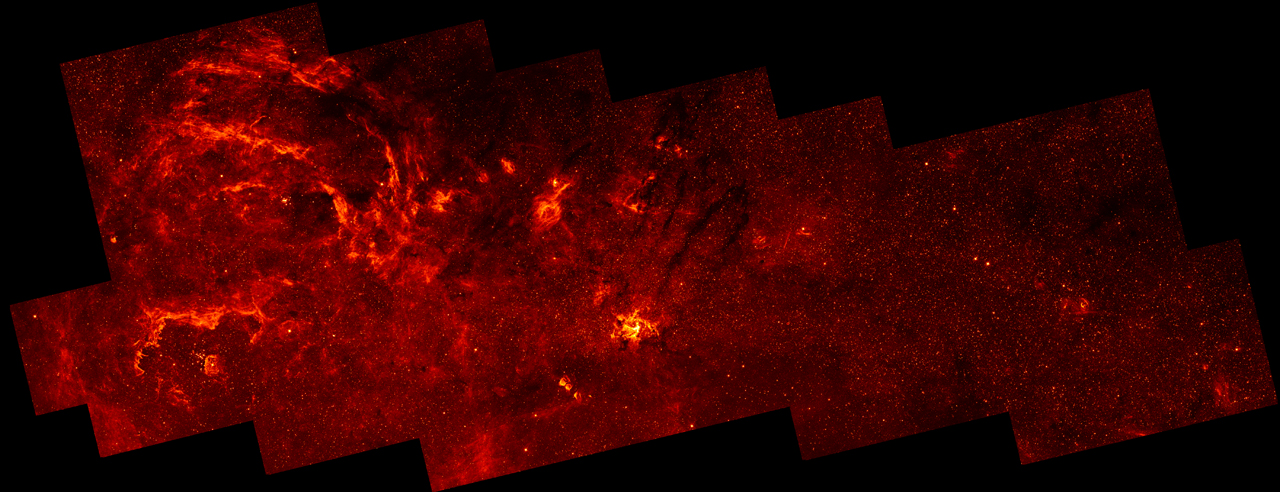
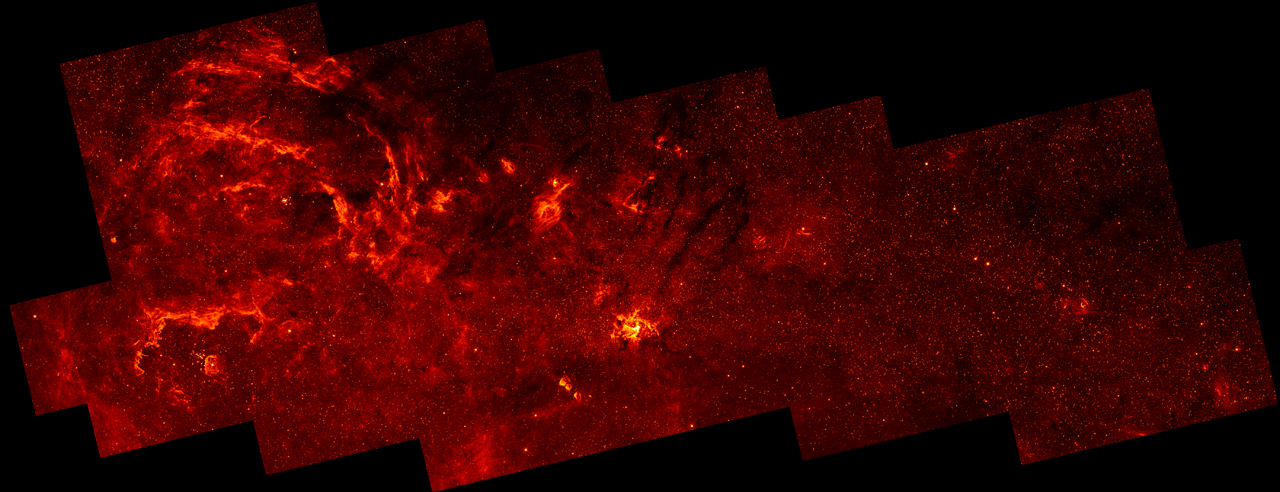
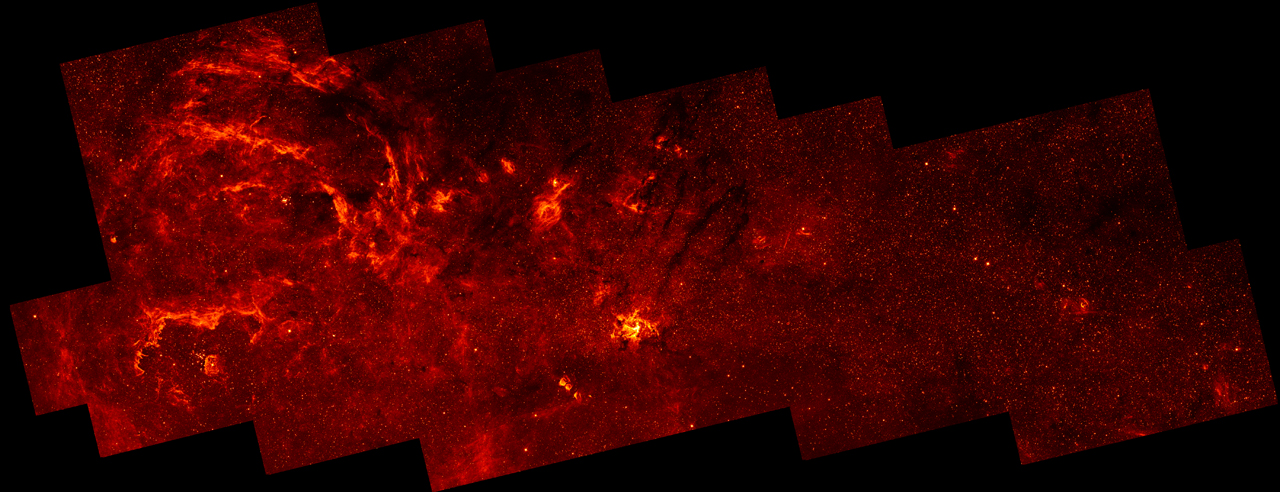
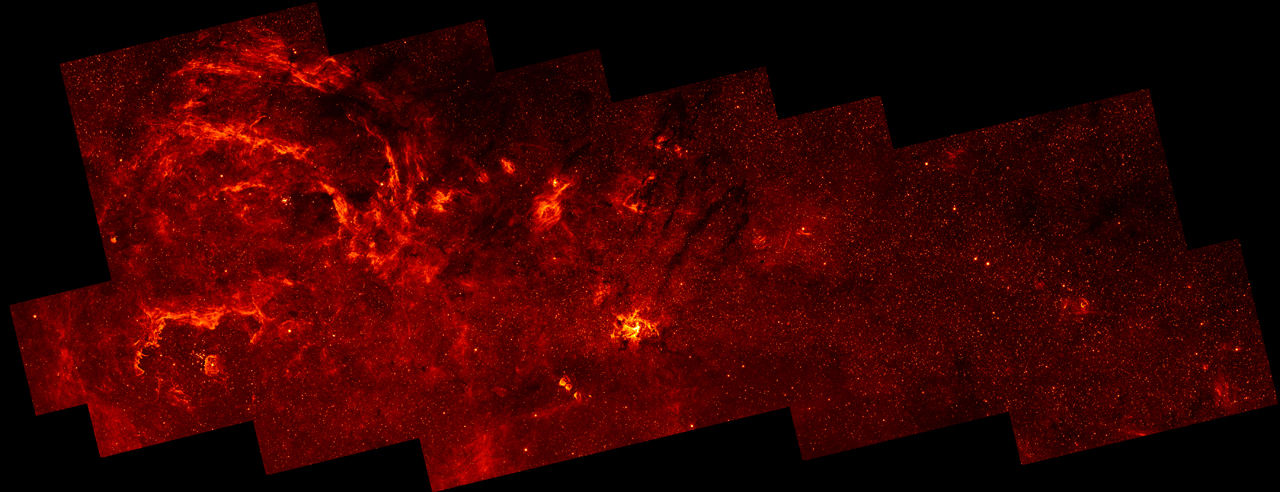
This infrared panorama of the Milky Way's central region highlights the extraordinary Pistol Star and its surrounding nebula, among the most remarkable stellar objects in our galaxy. The Pistol Star, buried deep within the Quintuplet Cluster near the galactic center, is one of the most luminous stars known, blazing with the energy of nearly 10 million Suns. It is surrounded by the Pistol Nebula, an enormous cloud of gas that the star ejected in violent outbursts over the past several thousand years. The nebula spans about four light-years across, large enough to stretch from our Sun to the nearest neighboring star system. This hostile region near the galactic center harbors some of the most extreme conditions for star formation anywhere in the Milky Way, with intense radiation fields, strong magnetic fields, and powerful tidal forces from the nearby supermassive black hole shaping the environment.
Scientific Significance
The Pistol Star and its nebula are key objects for understanding the upper limits of stellar mass and luminosity. When discovered by Hubble in the 1990s, the Pistol Star appeared to be the most luminous star in the galaxy, challenging theoretical models that predicted such extreme stars should tear themselves apart through radiation pressure. The massive eruptions that created the Pistol Nebula resemble those of Eta Carinae, another hypergiant star, and studying both objects helps astronomers understand the eruptive mass-loss mechanisms that govern the final stages of the most massive stars' lives. The extreme environment near the galactic center, with its elevated gas densities, strong magnetic fields, and intense tidal forces, also provides insights into how massive star formation can proceed under conditions very different from those in the solar neighborhood.
Observation Details
This image was captured using Hubble's Near Infrared Camera and Multi-Object Spectrometer (NICMOS) at wavelengths between 1.1 and 2.2 microns, which can penetrate the roughly 25,000 light-years of dust between Earth and the galactic center. At visible wavelengths, this entire region is completely obscured. The infrared observations revealed individual massive stars in the Quintuplet Cluster and resolved the structure of the Pistol Nebula for the first time, enabling measurements of the nebula's expansion rate and identification of the Pistol Star as its central illuminating source.
Location in the Universe
Constellation
Sagittarius
Distance from Earth
26,000 light-years
Fun Facts
- 1
The Pistol Star is so luminous that it emits in 20 seconds the same amount of energy our Sun produces in an entire year, yet it is completely invisible to the naked eye because of the thick dust between us and the galactic center.
- 2
The Pistol Nebula was ejected by the Pistol Star in giant eruptions roughly 4,000 to 6,000 years ago, and it contains enough material to build almost 10 solar-mass stars from scratch.
- 3
The Quintuplet Cluster, home to the Pistol Star, gets its name from five bright infrared sources first detected in 1990, and it contains several other stars that rival the Pistol Star in luminosity.
Image credit: NASA, ESA, Hubble Space Telescope