About This Image
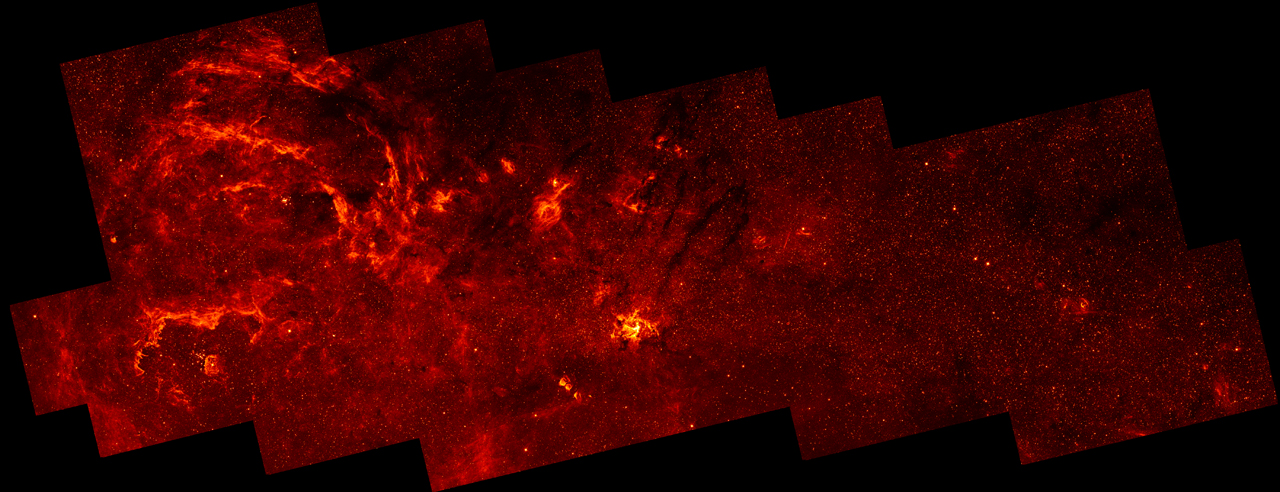
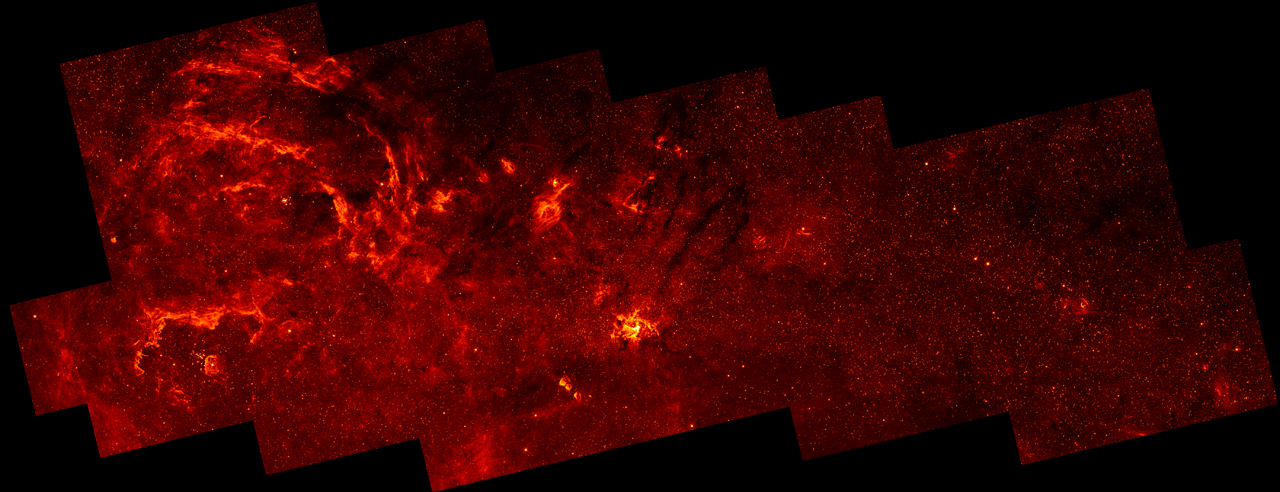
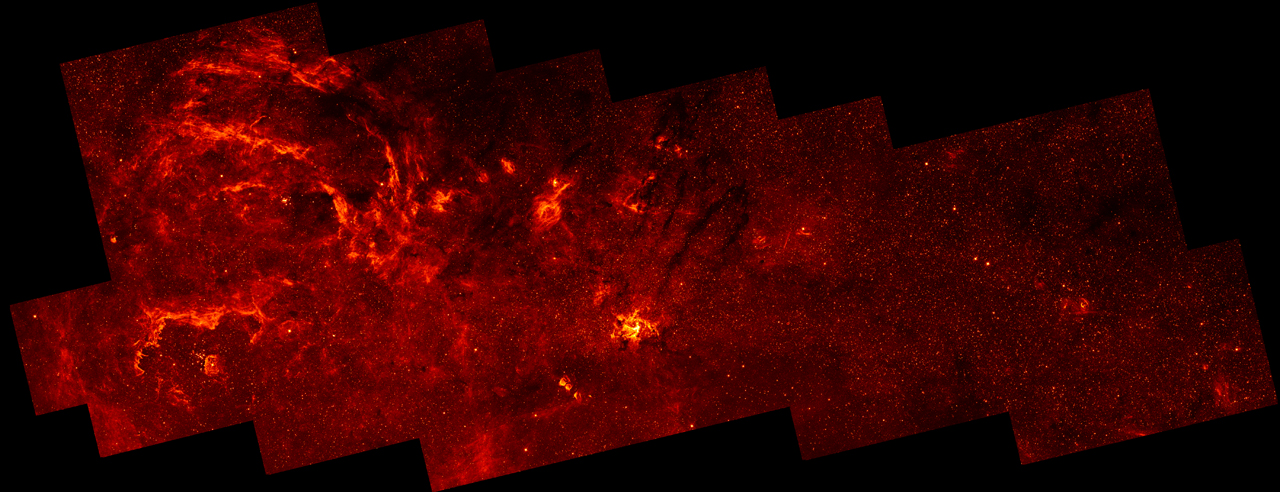
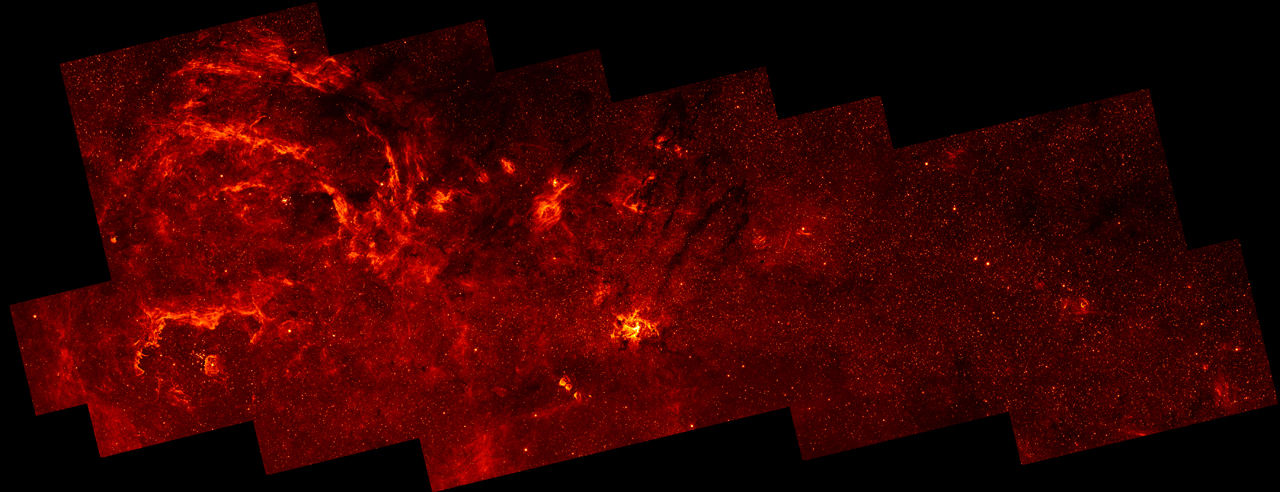
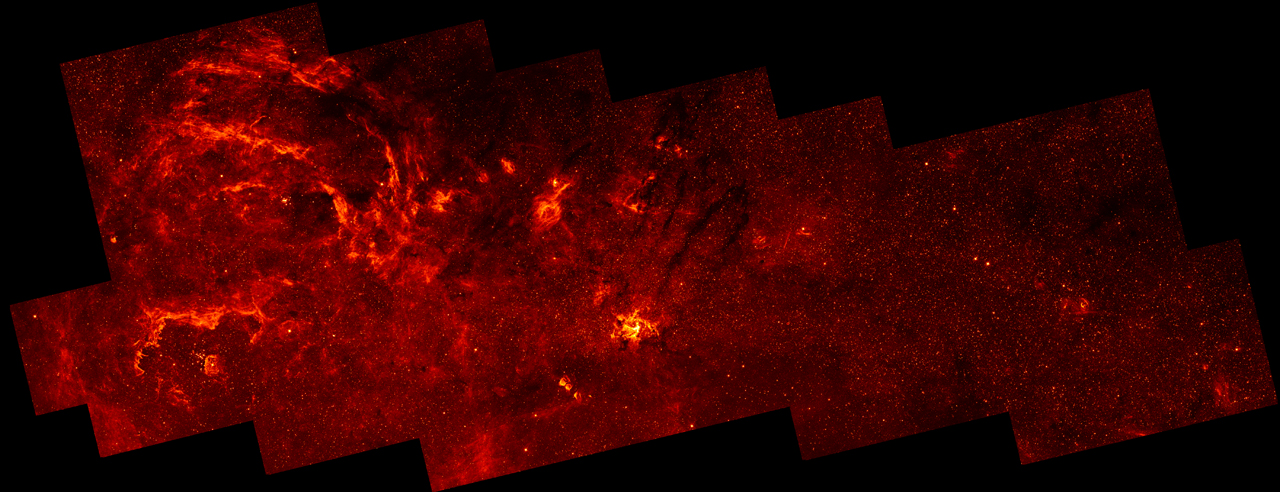
This infrared image of the Milky Way's central region reveals the turbulent environment where powerful stellar winds from massive Wolf-Rayet stars and blue supergiants collide and interact, heating surrounding gas to millions of degrees. These winds carry material outward at speeds exceeding a million miles per hour, sculpting the interstellar medium into arcs, filaments, and bubbles of glowing plasma. Hubble's infrared vision penetrates the dense curtains of dust that obscure the center in visible light, unveiling a crowded stellar nursery where stars are born and die in dramatic fashion. The complex structures of hot ionized gas trace the energetic interactions between the galaxy's most massive stars and their surroundings, revealing a chaotic but dynamic environment profoundly shaped by the extreme stellar activity at the heart of our galaxy.
Scientific Significance
The galactic center serves as a unique astrophysical laboratory for studying extreme stellar environments and the interplay between massive stars and the interstellar medium. The region hosts the densest concentration of massive stars in the Milky Way, including several of the most luminous and massive stars known. Their powerful stellar winds, which eject material at velocities exceeding 1,000 kilometers per second, create a complex network of shocked gas and ionized plasma. These winds play a critical role in regulating star formation by simultaneously compressing gas to trigger new stellar birth and dispersing material to halt it. Understanding these feedback mechanisms is essential for modeling star formation in galactic nuclei across the universe. The galactic center also provides the closest analog to conditions found in starburst galaxies and active galactic nuclei.
Observation Details
This image was captured using Hubble's Near Infrared Camera and Multi-Object Spectrometer (NICMOS), which observes in infrared wavelengths capable of penetrating the heavy dust extinction along the line of sight to the galactic center. At visible wavelengths, the dust dims starlight by a factor of more than a trillion, making infrared observations essential. The NICMOS observations revealed individual massive stars and the structure of ionized gas features. Multiple infrared filters were used to distinguish thermal emission from hot gas and reflected starlight from dust, providing a comprehensive view of the stellar populations and their environments.
Location in the Universe
Constellation
Sagittarius
Distance from Earth
26,000 light-years
Fun Facts
- 1
The stellar winds near the galactic center are so powerful that they create superheated bubbles of gas reaching temperatures of tens of millions of degrees, hot enough to emit X-rays detectable by space observatories.
- 2
Despite being home to millions of stars, the galactic center is completely invisible to the naked eye because thick clouds of interstellar dust block over 99.999% of visible light from reaching us.
- 3
The massive stars near the galactic center live fast and die young — some burn through their nuclear fuel in just a few million years, compared to the Sun's expected 10-billion-year lifespan.
Image credit: NASA, ESA, Hubble Space Telescope