About This Image
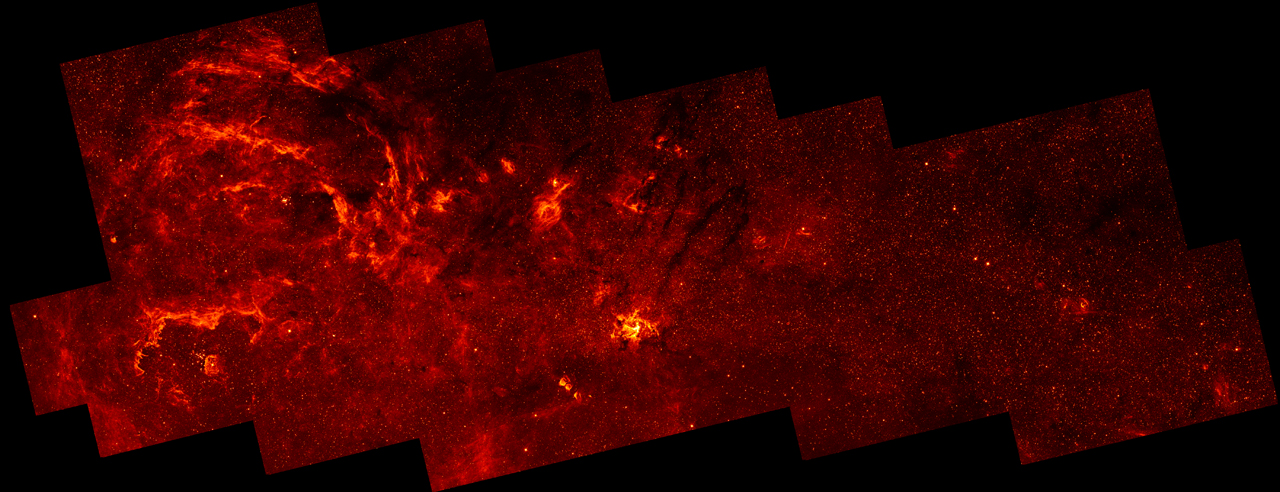
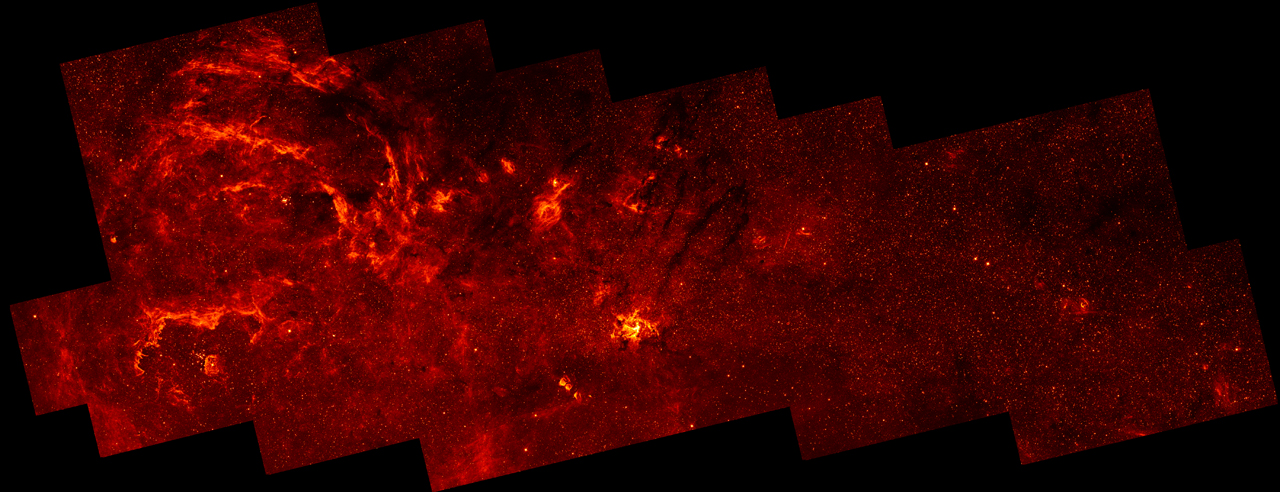
This infrared view of the Milky Way's center reveals the chaotic environment surrounding Sagittarius A* (Sgr A*), the supermassive black hole lurking at the heart of our galaxy. With a mass of approximately four million Suns compressed into a region smaller than Mercury's orbit, Sgr A* exerts a profound gravitational influence on everything in its vicinity. Hubble's infrared observations penetrate the thick veil of interstellar dust to reveal the dense stellar cluster orbiting the black hole, along with streamers of ionized gas that trace the complex magnetic field and radiation environment near the galactic nucleus. Stars in the central parsec orbit Sgr A* at velocities exceeding 1,000 miles per second, and the fastest known star, S2, completes an orbit around the black hole in just 16 years, passing within 17 light-hours of the event horizon at its closest approach.
Scientific Significance
Sgr A* is the closest supermassive black hole to Earth and provides the best opportunity to study the physics of these extraordinary objects in detail. The stellar orbits around Sgr A* have provided the most precise measurement of any supermassive black hole mass, and have been used to test general relativity in the strong-field regime. In 2018, the detection of gravitational redshift in S2's spectrum as it passed close to the black hole confirmed Einstein's predictions in the strongest gravitational field ever tested with a star. Hubble's infrared observations have contributed to understanding the stellar population surrounding Sgr A*, revealing that young, massive stars exist surprisingly close to the black hole — a paradox because the extreme tidal forces should prevent normal star formation. These stars may have formed in a now-disrupted accretion disk or migrated inward from larger distances. The relatively quiescent state of Sgr A* also raises fundamental questions about why some supermassive black holes are dormant while others power brilliant quasars.
Observation Details
This image was obtained using Hubble's Near Infrared Camera and Multi-Object Spectrometer (NICMOS) at wavelengths between 1.1 and 2.2 micrometers. At these wavelengths, the approximately 25 magnitudes of visual extinction toward the galactic center are reduced to roughly 3 magnitudes, allowing detection of the stellar population in the central cluster. The NICMOS observations complemented ground-based adaptive optics observations from the VLT and Keck telescopes, which achieve higher angular resolution but over smaller fields of view. Hubble's wider field provided the broader context needed to understand the stellar population and gas dynamics in the region surrounding Sgr A*.
Location in the Universe
Constellation
Sagittarius
Distance from Earth
26,000 light-years
Fun Facts
- 1
The supermassive black hole Sagittarius A* was confirmed through decades of tracking individual stars orbiting an invisible point — work that earned Reinhard Genzel and Andrea Ghez the 2020 Nobel Prize in Physics.
- 2
Despite being four million times the mass of the Sun, Sgr A* is remarkably quiet compared to active galactic nuclei in other galaxies, consuming material at a rate millions of times lower than its theoretical maximum.
- 3
Stars orbit Sgr A* so quickly that astronomers can watch their orbits change in real time over years — the star S2 reached a velocity of over 15 million miles per hour at its closest approach to the black hole.
Image credit: NASA, ESA, Hubble Space Telescope