About This Image
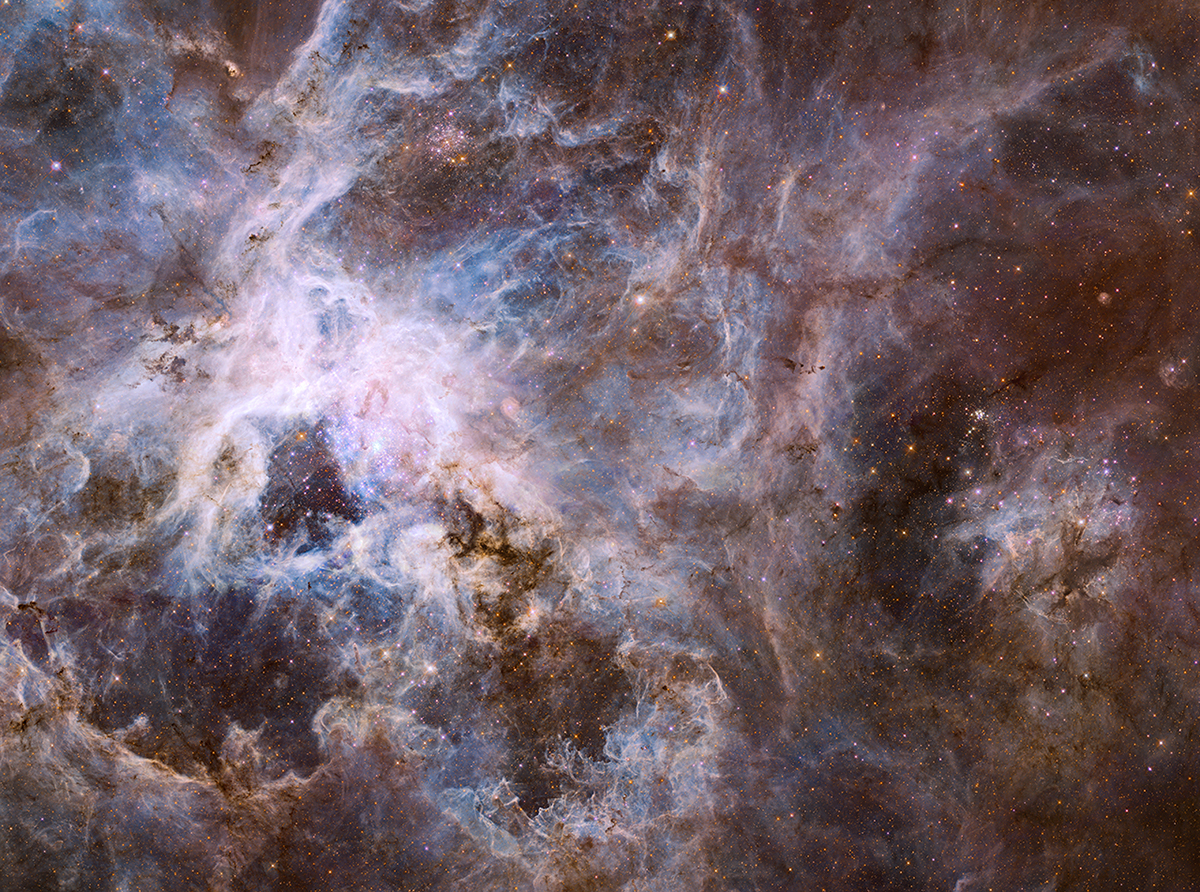
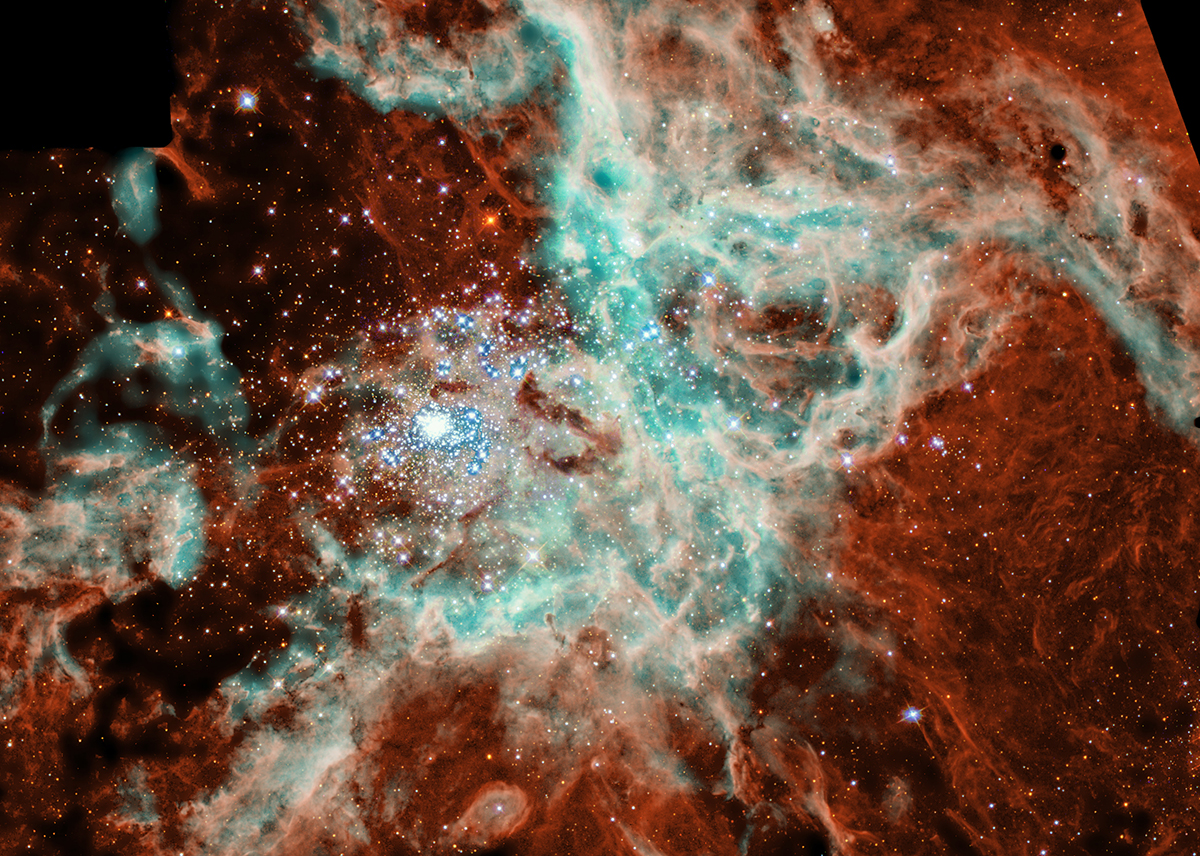
This Hubble image reveals the turbulent inner core of the 30 Doradus Nebula (Tarantula Nebula) in the Large Magellanic Cloud, centered on the extraordinary star cluster R136. This compact cluster, visible as the brilliant concentration of stars at left, is one of the most remarkable stellar assemblages ever discovered. R136 contains dozens of stars exceeding 50 solar masses, including several that rank among the most massive and luminous stars known anywhere in the universe. The intense ultraviolet radiation and stellar winds from these stellar titans have carved enormous cavities in the surrounding gas, creating a landscape of towering gas pillars, glowing ridges, and dark dust globules. The nebula's appearance changes dramatically depending on wavelength: in visible light the ionized hydrogen glows a characteristic pinkish-red, while in ultraviolet the hot massive stars blaze with extraordinary brightness.
Scientific Significance
R136 and the inner 30 Doradus region are of paramount importance for understanding the formation and properties of the most massive stars in the universe. The cluster's resolved stellar population has enabled direct measurement of the upper initial mass function — revealing stars well above the previously assumed 150-solar-mass limit. These measurements have fundamental implications for understanding the earliest generations of stars in the universe, which are thought to have been predominantly very massive. The cluster's influence on its environment demonstrates the concept of stellar feedback on a grand scale: the combined radiation and winds of R136's massive stars have created a superbubble of hot, low-density gas surrounded by shells of compressed, star-forming material. This feedback loop — where massive stars simultaneously destroy their birth cloud and trigger new star formation at its edges — is a fundamental process governing the evolution of galaxies.
Observation Details
This image was captured using Hubble's Wide Field and Planetary Camera 2 (WFPC2) in both broadband and narrowband visible-light filters. The broadband observations resolved individual massive stars within R136's dense core, while narrowband hydrogen-alpha and oxygen emission-line filters mapped the structure of the ionized gas. Hubble's angular resolution was essential for separating the closely packed stars in R136, which appear blended into a single source from the ground. Multiple exposures with different integration times were combined to capture both the brilliant cluster stars and the faint nebular emission without saturation.
Location in the Universe
Constellation
Dorado
Distance from Earth
170,000 light-years
Fun Facts
- 1
R136 contains the most massive star currently known — R136a1, with an estimated mass of over 170 times that of our Sun — so massive that it challenges theoretical predictions about the maximum possible stellar mass.
- 2
If R136 were located at the center of the Orion Nebula (about 1,300 light-years away), its brightest stars would be visible to the naked eye and would cast shadows at night on Earth.
- 3
The 30 Doradus region is forming stars at such an extraordinary rate that it qualifies as a 'starburst' region — it produces more stars per unit area than almost any other region in the Local Group of galaxies.
Image credit: NASA, ESA, Hubble Space Telescope