About This Image
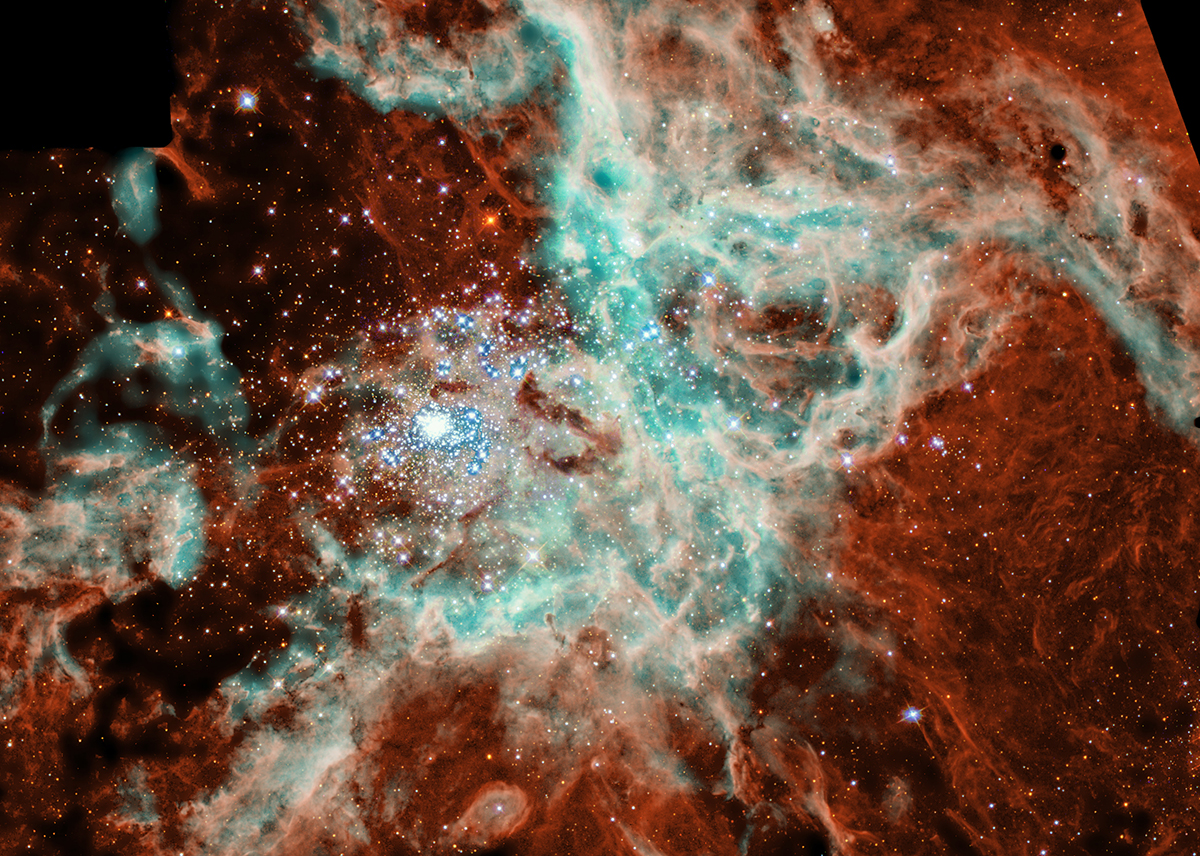
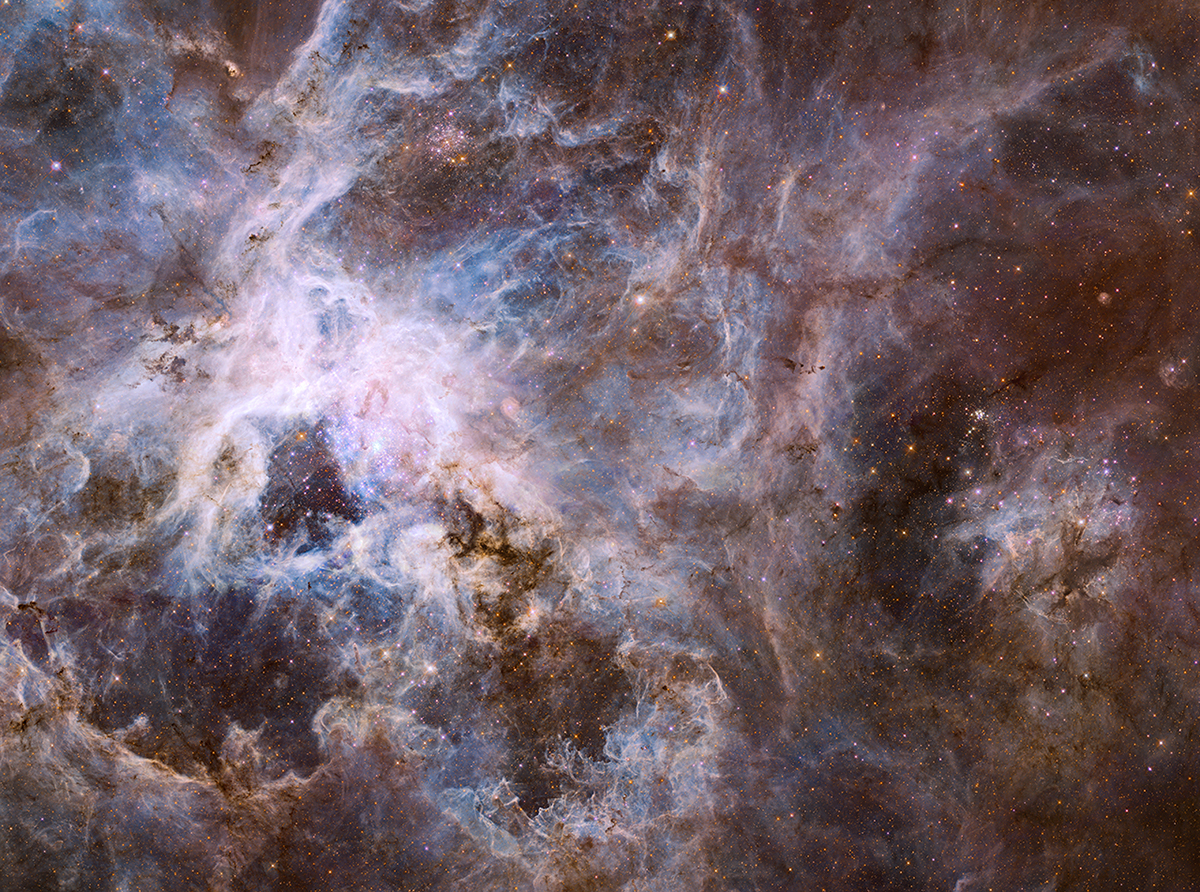
This breathtaking close-up captures the heart of the 30 Doradus Nebula, also known as the Tarantula Nebula, the largest and most prolific star-forming region in the entire Local Group of galaxies. Located 170,000 light-years away in the Large Magellanic Cloud, a satellite galaxy of the Milky Way, this colossal stellar nursery spans nearly 600 light-years across and contains some of the most massive and luminous stars ever observed. The image reveals an intricate tapestry of glowing hydrogen gas sculpted into ridges, pillars, and cavities by the fierce radiation and stellar winds of hundreds of young, massive stars. Dark filamentary structures of dust weave through the luminous clouds, marking regions of dense molecular gas where future generations of stars are beginning to coalesce. The central star cluster, R136, alone contains dozens of stars exceeding 50 solar masses.
Scientific Significance
The 30 Doradus Nebula is arguably the most important star-forming region accessible to detailed study, serving as the closest analog to the extreme starburst regions found in distant galaxies during the peak epoch of cosmic star formation. Its central cluster R136 provides the premier laboratory for studying the upper end of the stellar mass function — how massive a star can become. The discovery of stars exceeding 150 solar masses in R136 overturned the long-held theoretical limit on stellar mass and forced revisions to models of stellar structure and evolution. The nebula's rich population of massive stars at various evolutionary stages allows astronomers to trace the complete lifecycle from formation through main-sequence evolution to supernova. Additionally, the region's lower metallicity compared to similar Milky Way regions makes it a better proxy for star formation conditions in the early universe.
Observation Details
This mosaic was assembled from observations taken with Hubble's Wide Field Camera 3 (WFC3) and the Advanced Camera for Surveys (ACS), combining both visible and near-infrared exposures. Narrowband filters isolating the emission of ionized hydrogen, oxygen, and sulfur revealed the intricate structure of the ionized gas and mapped the physical conditions within the nebula. The near-infrared observations penetrated the dusty regions to expose embedded protostars and young stellar objects still forming within the densest cloud cores. The resulting composite spans approximately 650 light-years across.
Location in the Universe
Constellation
Dorado
Distance from Earth
170,000 light-years
Fun Facts
- 1
The Tarantula Nebula is so luminous that if it were located at the same distance as the Orion Nebula (about 1,300 light-years away), it would cast visible shadows on Earth and cover a quarter of the sky.
- 2
The central cluster R136 contains the most massive star known — R136a1, estimated at over 170 solar masses — which shines nearly 10 million times brighter than the Sun.
- 3
When a supernova exploded in the Large Magellanic Cloud in 1987 (SN 1987A), it was located on the outskirts of the Tarantula Nebula, making it the closest observed supernova since the invention of the telescope.
Image credit: NASA, ESA, Hubble Space Telescope