About This Image
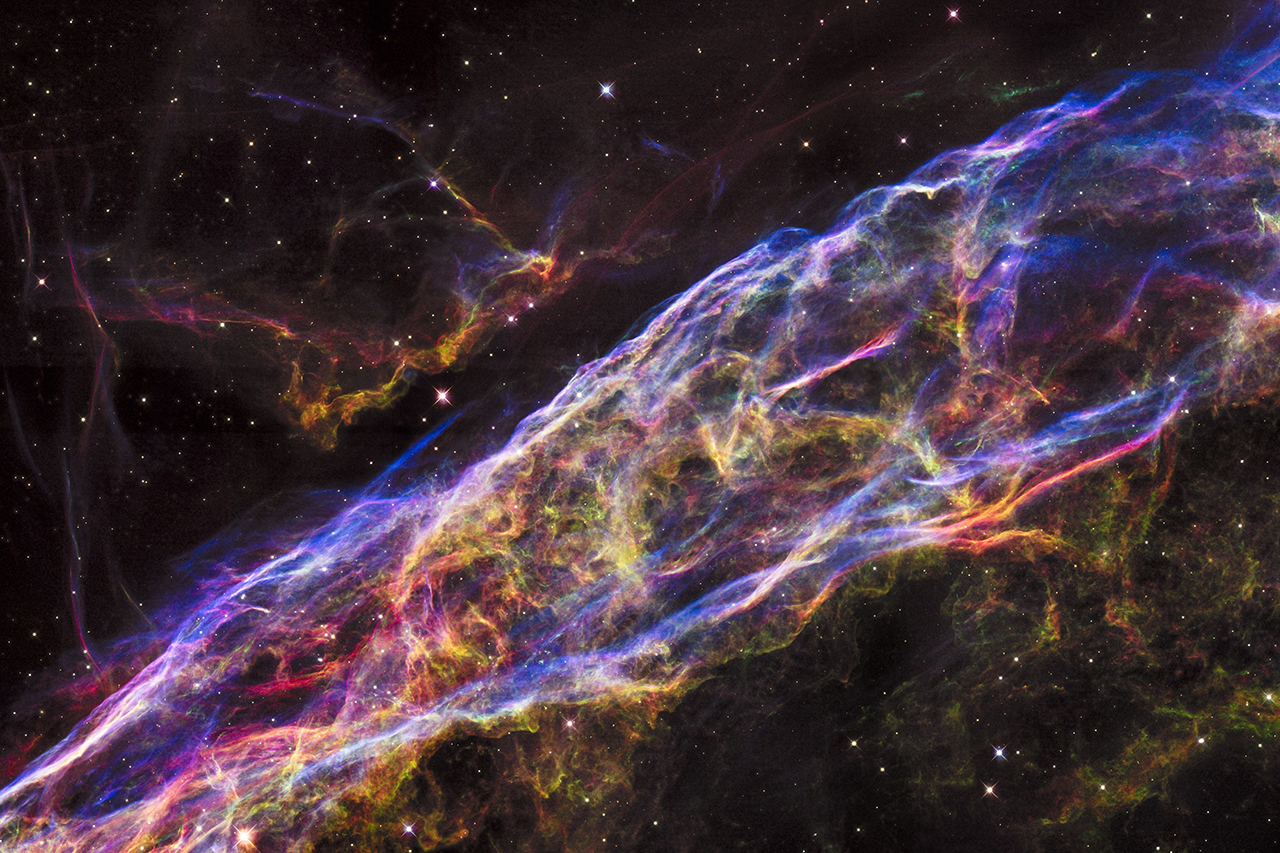
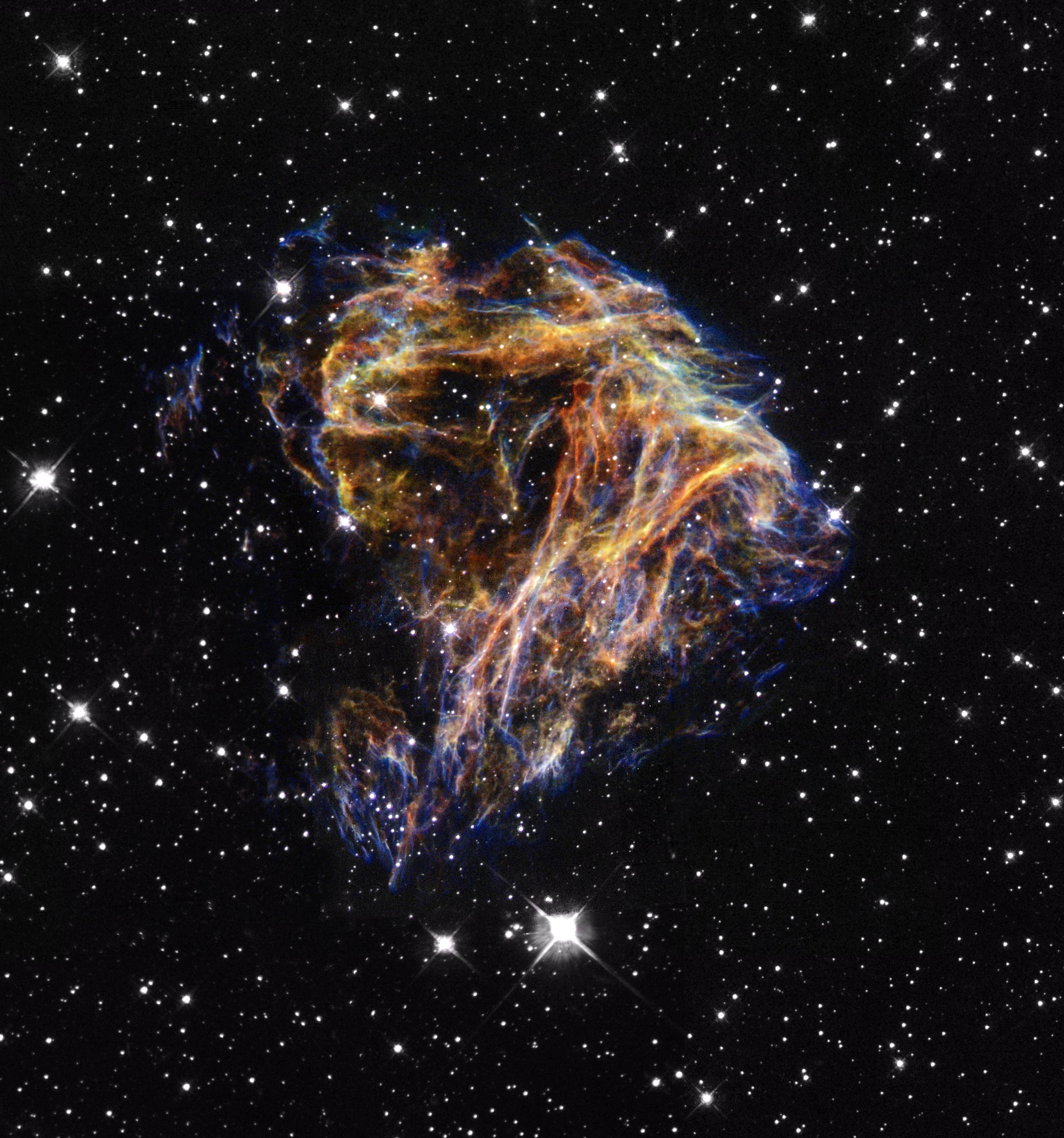
N 49 is the brightest supernova remnant in the Large Magellanic Cloud, a neighboring dwarf galaxy visible from the Southern Hemisphere approximately 160,000 light-years away. This Hubble image reveals an intricate web of luminous filaments — sheets of stellar debris hurtling outward at hundreds of miles per second from a catastrophic explosion that occurred roughly 5,000 years ago. The delicate tendrils glow as the fast-moving ejecta collide with the surrounding interstellar medium, heating the gas to millions of degrees and causing it to radiate across the electromagnetic spectrum. N 49 is also notable for harboring a soft gamma-ray repeater, SGR 0526-66, a magnetar that produced the most powerful burst of gamma rays and X-rays ever detected from beyond our solar system on March 5, 1979. The complex, asymmetric shape suggests the original explosion was itself asymmetric, or that the surrounding interstellar medium has a highly uneven density.
Scientific Significance
N 49 occupies a unique position in astrophysics as both a well-resolved supernova remnant and the host of one of the most extreme compact objects known. The soft gamma-ray repeater SGR 0526-66 was the source of the famous March 5, 1979 event, which fundamentally changed our understanding of neutron stars by demonstrating that magnetars could produce bursts of energy rivaling the luminosity of an entire galaxy for brief instants. Studying the remnant reveals how supernova blast waves interact with the interstellar medium in a galaxy with lower metallicity than the Milky Way, providing insights into how supernovae would have behaved in the early universe when heavy elements were scarce. The asymmetric morphology has been used to constrain models of core-collapse supernova explosions and the natal kicks imparted to neutron stars at birth.
Observation Details
This image was captured using Hubble's Wide Field and Planetary Camera 2 (WFPC2) through multiple narrowband filters that isolate emission from hydrogen, oxygen, and sulfur in the expanding filaments. The different filters reveal distinct physical conditions within the remnant: oxygen emission traces the hottest, most recently shocked gas, while hydrogen and sulfur emission highlight cooler, denser regions. Hubble's resolution was critical for disentangling the complex web of overlapping filaments and identifying the precise location of the magnetar relative to the geometric center of the expanding debris.
Location in the Universe
Constellation
Dorado
Distance from Earth
160,000 light-years
Fun Facts
- 1
N 49 is home to a magnetar — a neutron star with an extraordinarily powerful magnetic field — that on March 5, 1979, unleashed a gamma-ray burst so intense it ionized Earth's upper atmosphere from 160,000 light-years away.
- 2
The filaments in N 49 are moving at different speeds in different directions, indicating that the original supernova explosion was not perfectly spherical but was likely lopsided, ejecting more material in some directions than others.
- 3
Despite being in another galaxy entirely, N 49 is bright enough to be studied in remarkable detail by Hubble, making it one of the most thoroughly observed supernova remnants outside the Milky Way.
Image credit: NASA, ESA, Hubble Space Telescope