About This Image
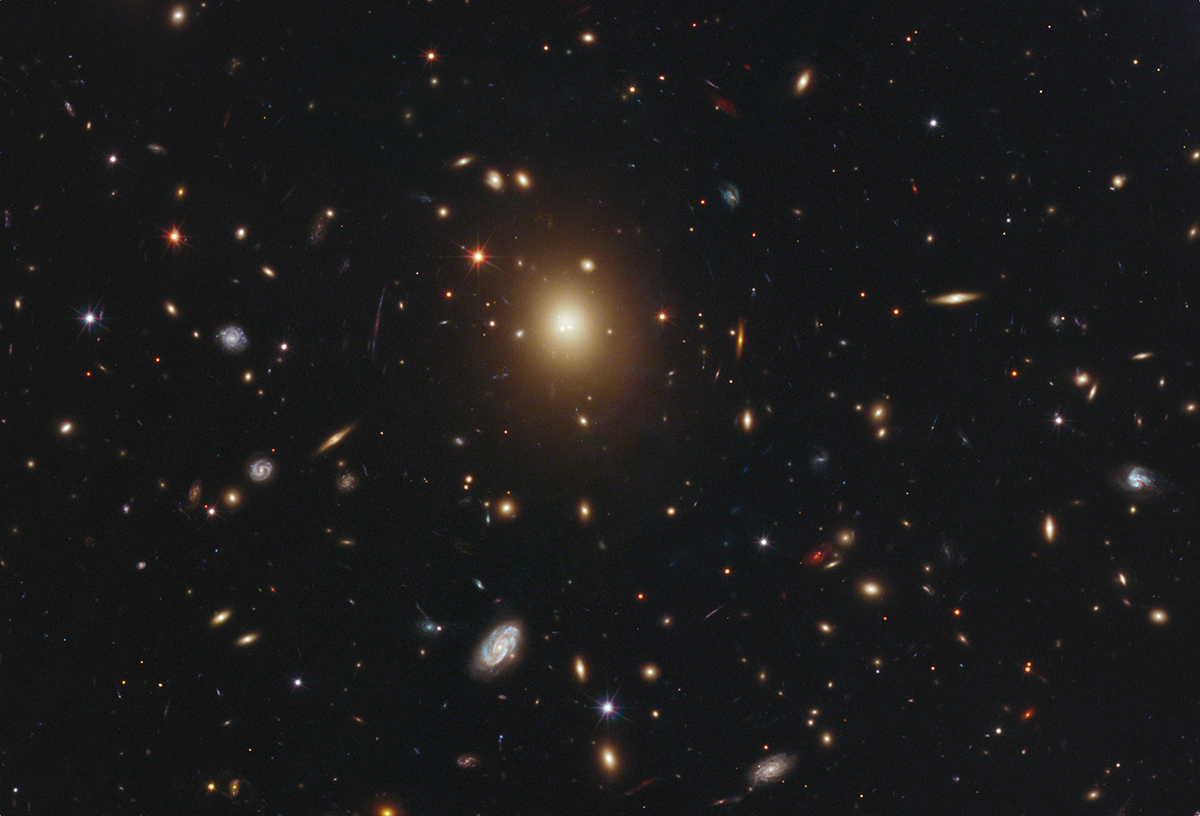
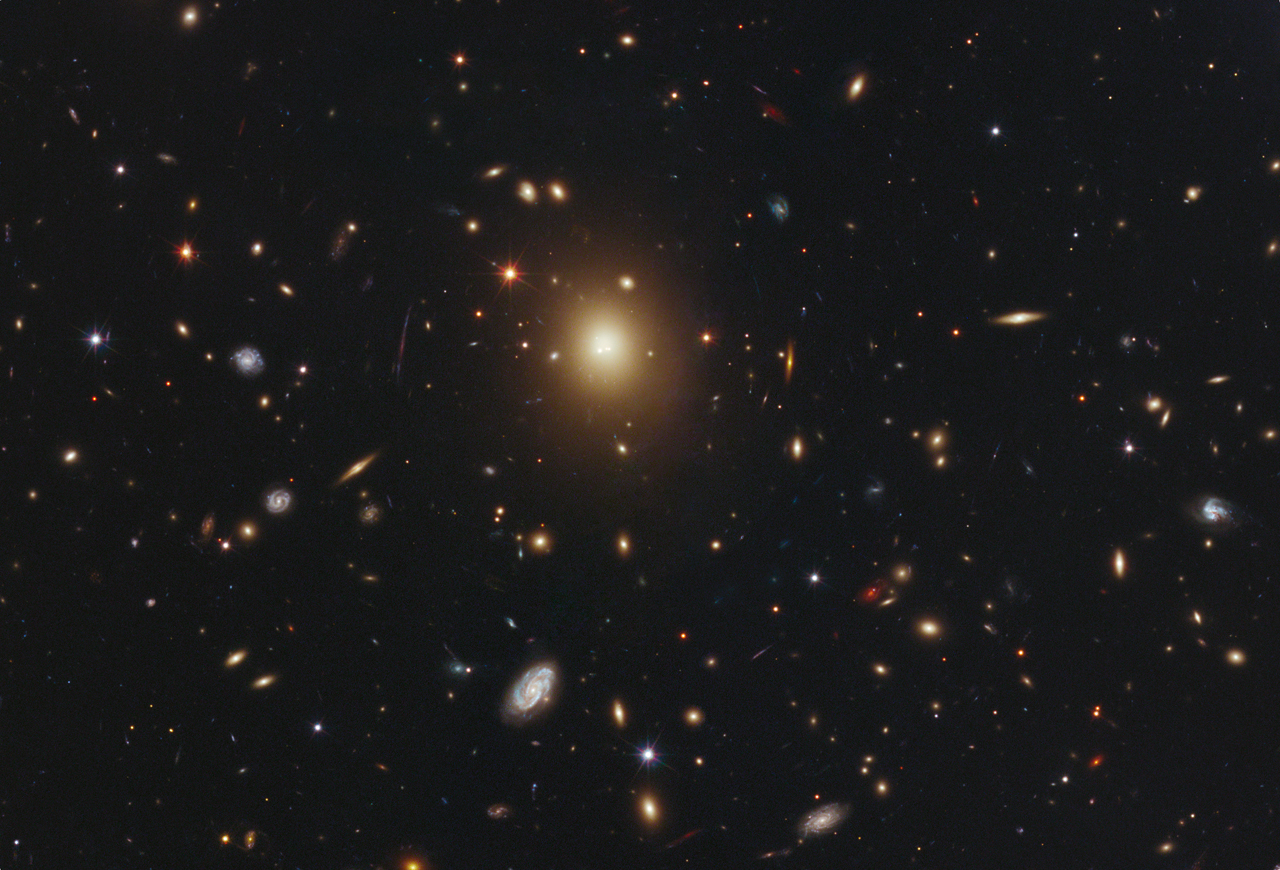
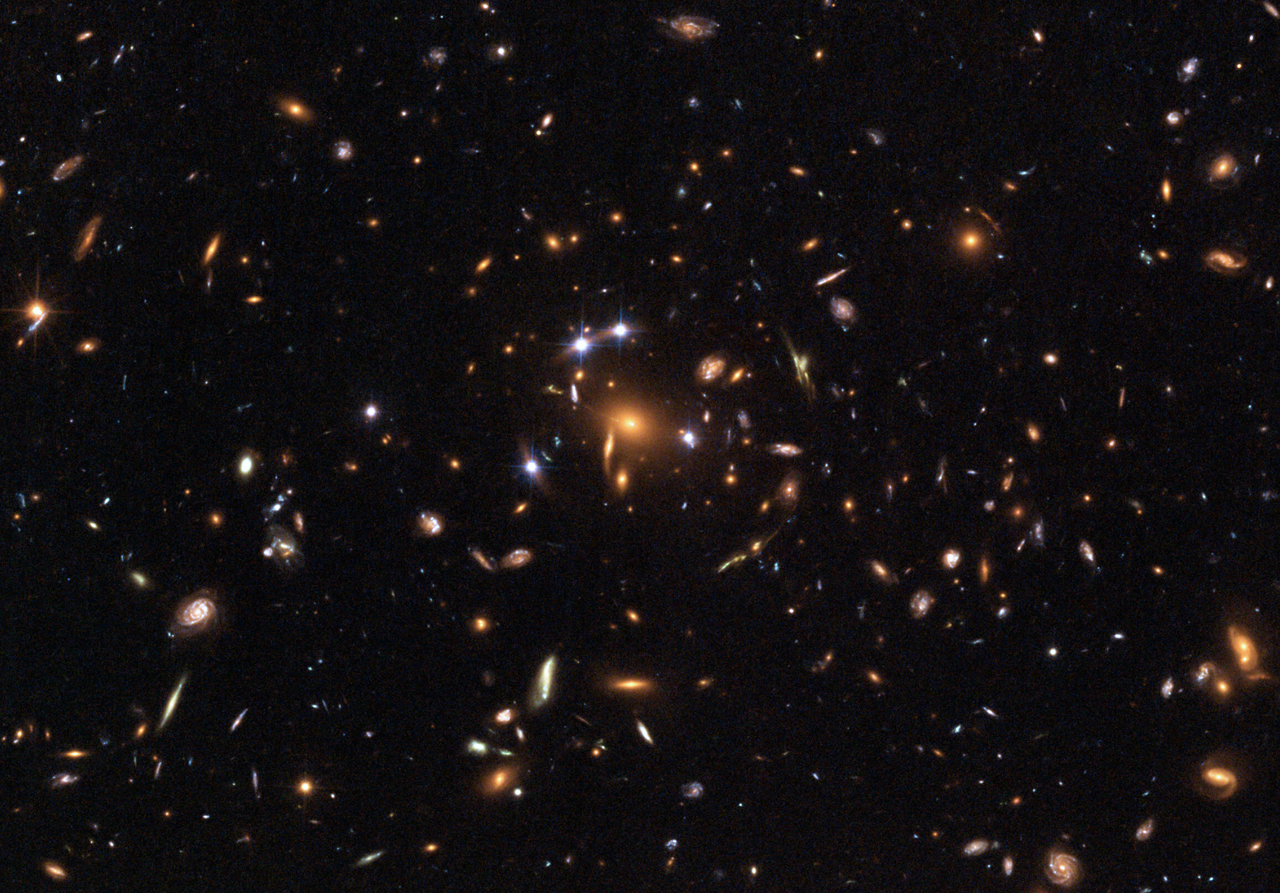
This image showcases one of the most dramatic demonstrations of Einstein's general relativity ever observed: the galaxy cluster SDSS J1004+4112, whose immense gravitational field warps the fabric of spacetime so severely that it bends and splits light from objects far behind it. Located approximately 7 billion light-years away in the constellation Leo Minor, the cluster acts as a cosmic magnifying glass, producing multiple distorted images of background galaxies and, most remarkably, splitting the light of a single distant quasar into five separate images arranged around the cluster's core. This five-image configuration was the first of its kind ever discovered to be produced by a galaxy cluster rather than a single galaxy, making this system a landmark in gravitational lensing research. Each quasar image shows the same object at a slightly different time in its history, since light follows paths of different lengths around the cluster.
Scientific Significance
SDSS J1004+4112 is a cornerstone system for gravitational lensing science because its five-image quasar configuration provides unusually strong constraints on the mass distribution within the cluster. The time delays between the multiple quasar images can be used to measure the Hubble constant independently of other methods like supernovae or the cosmic microwave background. This makes the system valuable for resolving the current tension between different measurements of cosmic expansion. The precise arrangement of the five images reveals the detailed shape of the dark matter halo, including substructure that traces individual galaxies within the cluster. Such measurements are essential for testing cosmological models and understanding how dark matter clumps on different scales. The gravitational magnification also allows astronomers to study the distant background quasar in greater detail than would otherwise be possible.
Observation Details
This image was captured using Hubble's Advanced Camera for Surveys (ACS) in multiple broadband filters spanning visible to near-infrared wavelengths. Hubble's sharp angular resolution was essential for clearly separating the five closely spaced quasar images embedded within the diffuse light of the cluster's member galaxies. Careful photometric measurements of each quasar image enabled detection of brightness variations and establishment of time delays between the images. Additional spectroscopic observations confirmed that all five point sources share identical spectral signatures, verifying they are multiple images of the same background quasar.
Location in the Universe
Constellation
Leo Minor
Distance from Earth
7 billion light-years
Fun Facts
- 1
The five images of the background quasar arrive at Earth at different times because each light path has a different length — the time delays between them can be years, allowing astronomers to literally see the same cosmic event replay at different times.
- 2
SDSS J1004+4112 was the first galaxy cluster ever found to produce five distinct images of a single background quasar, a configuration requiring extraordinarily precise alignment between the quasar, the cluster, and Earth.
- 3
By measuring the positions and brightnesses of the five quasar images, astronomers can map the distribution of dark matter in the cluster, essentially using light from the distant universe as a probe of invisible matter.
Image credit: NASA, ESA, Hubble Space Telescope