About This Image
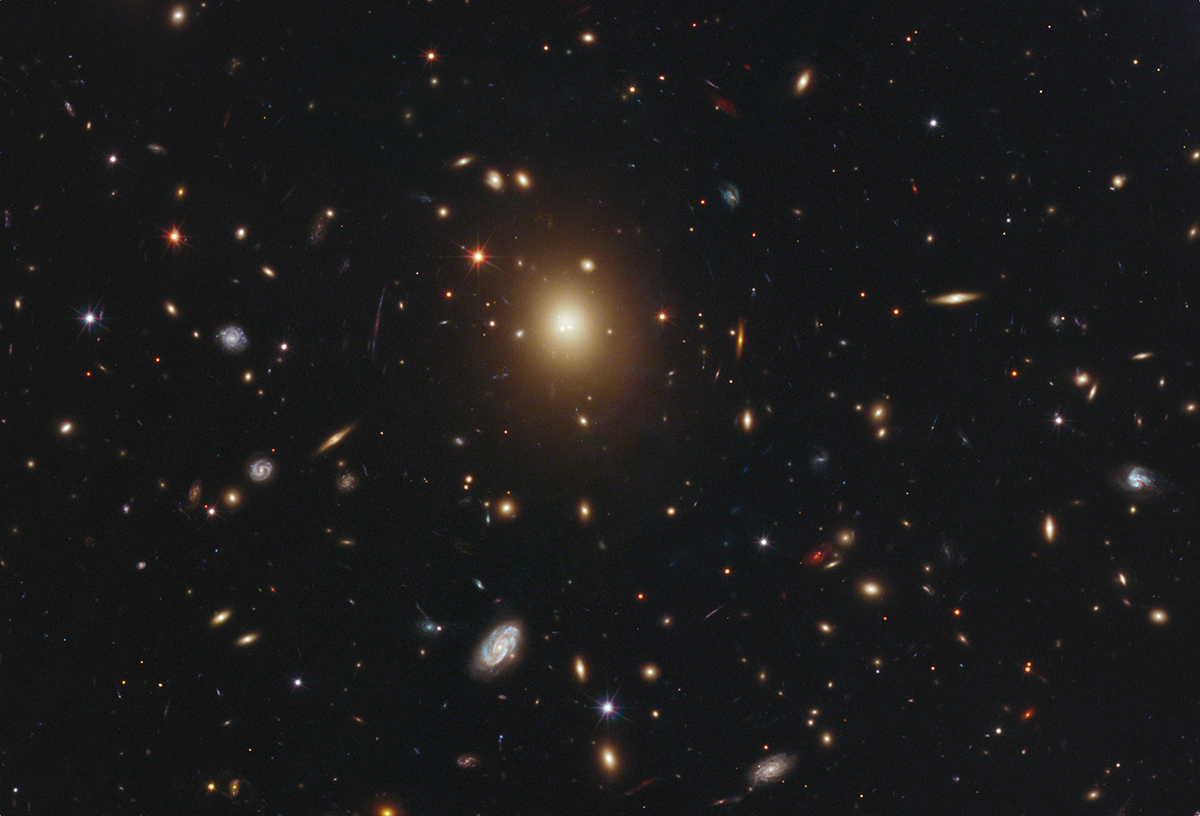
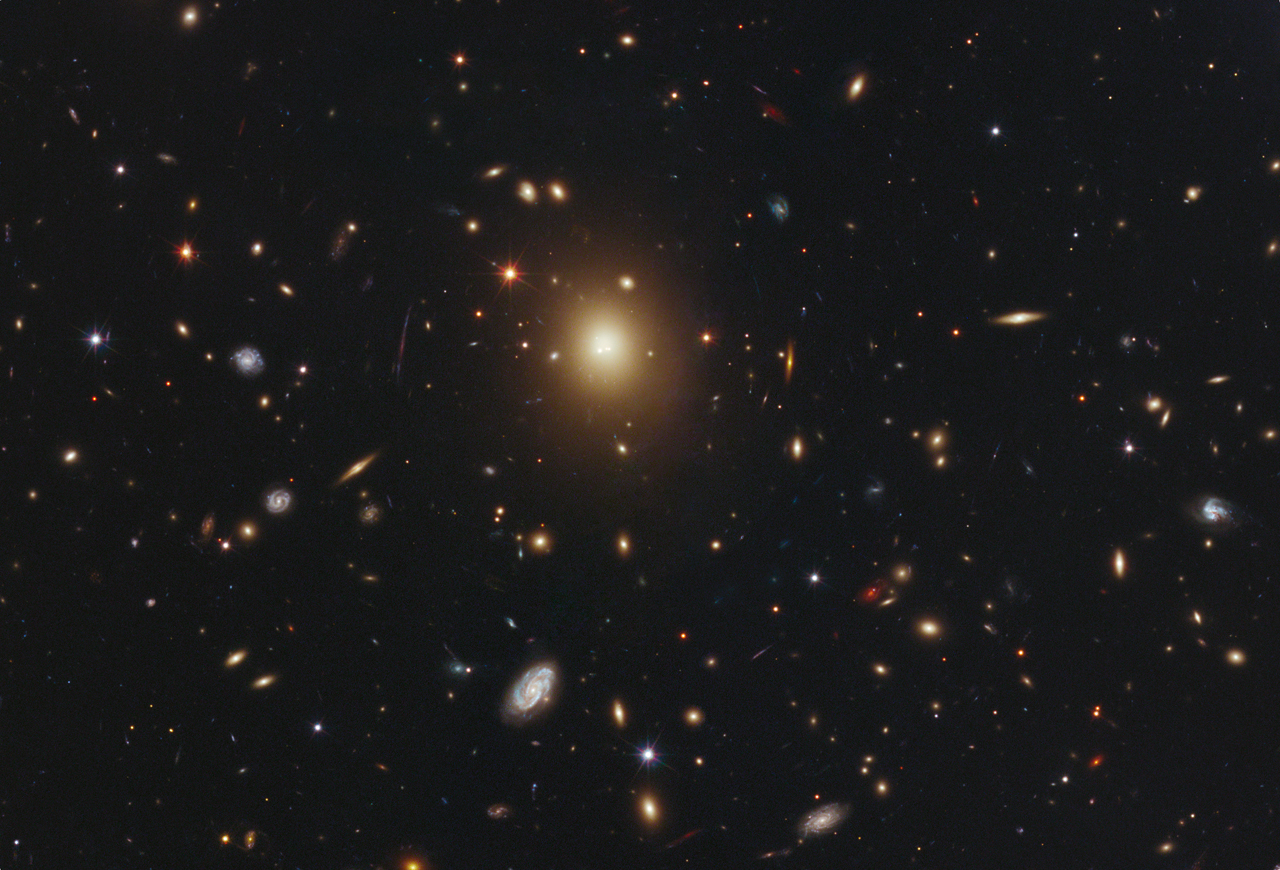
This Hubble image provides a detailed view of A2261-BCG, the colossal brightest cluster galaxy at the heart of Abell 2261, one of the most massive galaxy clusters known at approximately 3 billion light-years from Earth. A2261-BCG is extraordinary even by the standards of giant elliptical galaxies: it spans over a million light-years in diameter and possesses one of the largest and most diffuse stellar cores ever measured, extending roughly 10,000 light-years across. This unusually bloated core has puzzled astronomers because it lacks the concentrated central brightness peak found in most giant elliptical galaxies, which is typically maintained by the gravitational influence of a resident supermassive black hole. The galaxy's smooth, featureless envelope glows with the combined light of hundreds of billions of old, red-giant stars, while surrounding cluster galaxies appear as smaller, fainter objects scattered throughout the field.
Scientific Significance
A2261-BCG has become one of the most important objects for testing theories of supermassive black hole dynamics. Its anomalously large, diffuse core can be explained by a process called core scouring, where a pair of merging supermassive black holes ejects stars from the galaxy's center through gravitational slingshot interactions as they spiral together. If the resulting merged black hole received a gravitational wave recoil kick exceeding the galaxy's escape velocity, it would have been ejected entirely — a scenario predicted by general relativity but never conclusively observed. Searches for the missing black hole using Chandra X-ray observations and Hubble imaging have examined several candidate locations, including dense knots of stars in the galaxy's outskirts that might harbor a displaced black hole. The resolution of this mystery would have major implications for our understanding of galaxy evolution, gravitational wave astrophysics, and the co-evolution of galaxies and their central black holes.
Observation Details
This image was captured using Hubble's Wide Field Camera 3 (WFC3) in near-infrared filters as part of the CLASH (Cluster Lensing And Supernova survey with Hubble) program. The infrared observations were essential for characterizing the stellar populations of the central galaxy and for detecting faint gravitational arcs from lensed background galaxies. Surface brightness profile analysis of A2261-BCG required careful modeling and subtraction of the diffuse intracluster light that pervades the core of the cluster. The observations achieved sufficient depth to identify compact stellar knots in the galaxy's envelope that were investigated as potential hiding places for a displaced supermassive black hole.
Location in the Universe
Constellation
Hercules
Distance from Earth
3 billion light-years
Fun Facts
- 1
A2261-BCG's core is about 10 times larger than expected for a galaxy of its mass, making it one of the most extreme outliers in the observed relationship between galaxy mass and core size.
- 2
One theory suggests that A2261-BCG's supermassive black hole was kicked out of the galaxy center by gravitational waves produced during a binary black hole merger, leaving the core without its gravitational anchor.
- 3
The hot gas pervading the Abell 2261 cluster reaches temperatures of over 100 million degrees — far hotter than the center of the Sun — and is visible only in X-ray light.
Image credit: NASA, ESA, Hubble Space Telescope