About This Image
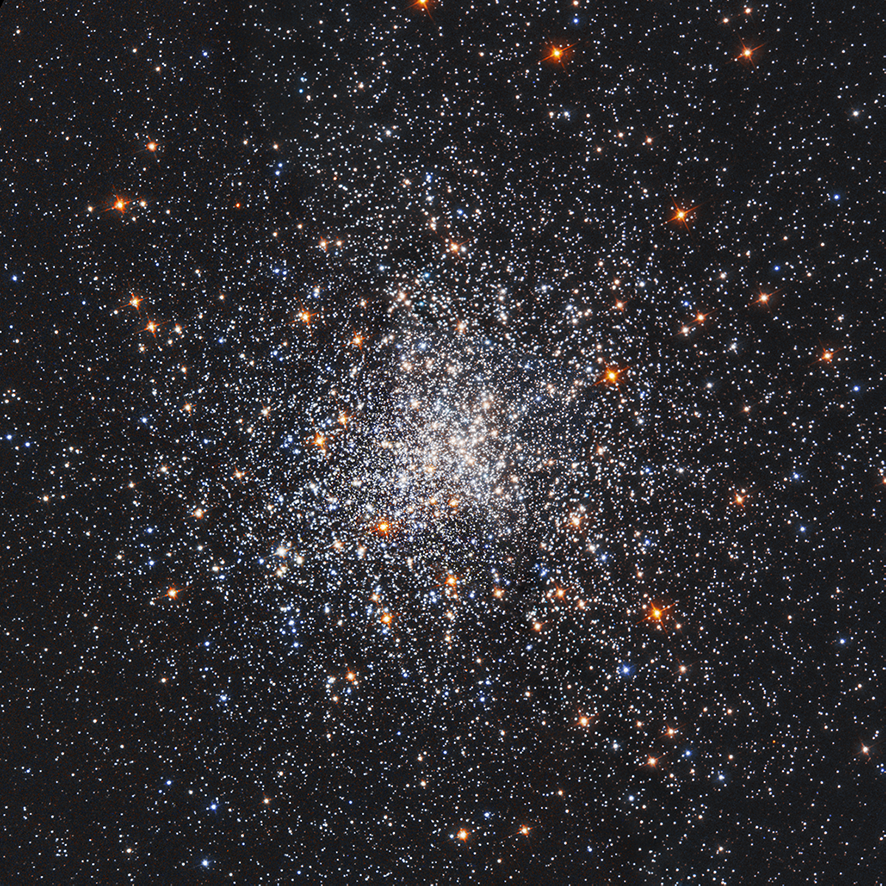
The globular star cluster M79, also known as NGC 1904, is a dense spherical collection of approximately 150,000 ancient stars packed into a volume only 118 light-years across. Located 41,000 light-years from Earth in the constellation Lepus, M79 is unusual among the Milky Way's globular clusters because it lies in the opposite direction from the galactic center, where most globular clusters are concentrated. This peculiarity has led astronomers to suggest that M79 may not have originally belonged to the Milky Way at all, but was instead captured from the Canis Major Dwarf Galaxy, a small satellite being tidally disrupted and absorbed by our own galaxy. Hubble's image resolves individual stars, revealing a stunning tapestry of hot blue stragglers, yellow Sun-like stars, and cool red giants, all held together by mutual gravitational attraction over billions of years.
Scientific Significance
M79 occupies a special place in the study of globular clusters and galactic accretion history. Its unusual position in the constellation Lepus, far from the galactic center where the majority of the Milky Way's approximately 150 known globular clusters reside, strongly suggests an extragalactic origin. Kinematic and chemical abundance studies support the hypothesis that M79 was originally associated with the Canis Major Dwarf Galaxy, a nearby satellite galaxy in the process of being tidally disrupted. If confirmed, M79 would be a direct fossil of hierarchical galaxy assembly — the process by which large galaxies grow by accreting smaller ones. The cluster's ancient stellar population, with metallicities well below solar values, provides a window into the chemical enrichment history of the early universe. The presence of blue straggler stars — anomalously hot, bright stars thought to result from stellar mergers or mass transfer — makes M79 an important laboratory for studying stellar dynamics in dense environments.
Observation Details
This image was captured with Hubble's Wide Field Planetary Camera 2 (WFPC2) in 1997, resolving tens of thousands of individual stars down to its dense core. Multiple broadband filters in blue, visual, and red wavelengths were used to construct a color-magnitude diagram enabling precise age and metallicity determinations. The color information distinguishes the different stellar populations: blue stars are hot blue stragglers and horizontal branch stars, yellow-white stars are similar to our Sun, and red stars are evolved red giants. Hubble's resolution was critical for separating individual stars in the crowded central regions where ground-based telescopes see only a blurred glow.
Location in the Universe
Constellation
Lepus
Distance from Earth
41,000 light-years
Fun Facts
- 1
M79 may be an immigrant from another galaxy — astronomers believe it was originally part of the Canis Major Dwarf Galaxy, which is being torn apart and consumed by the Milky Way's gravitational pull.
- 2
The stars in M79 are approximately 11.7 billion years old, meaning they formed when the universe was less than 2 billion years old — making them living fossils from a time when galaxies were still in their infancy.
- 3
Despite its extreme stellar density, stellar collisions in M79 are still rare, though gravitational interactions do fling stars into unusual orbits and create exotic objects called blue stragglers.
Image credit: NASA, ESA, Hubble Space Telescope