About This Image
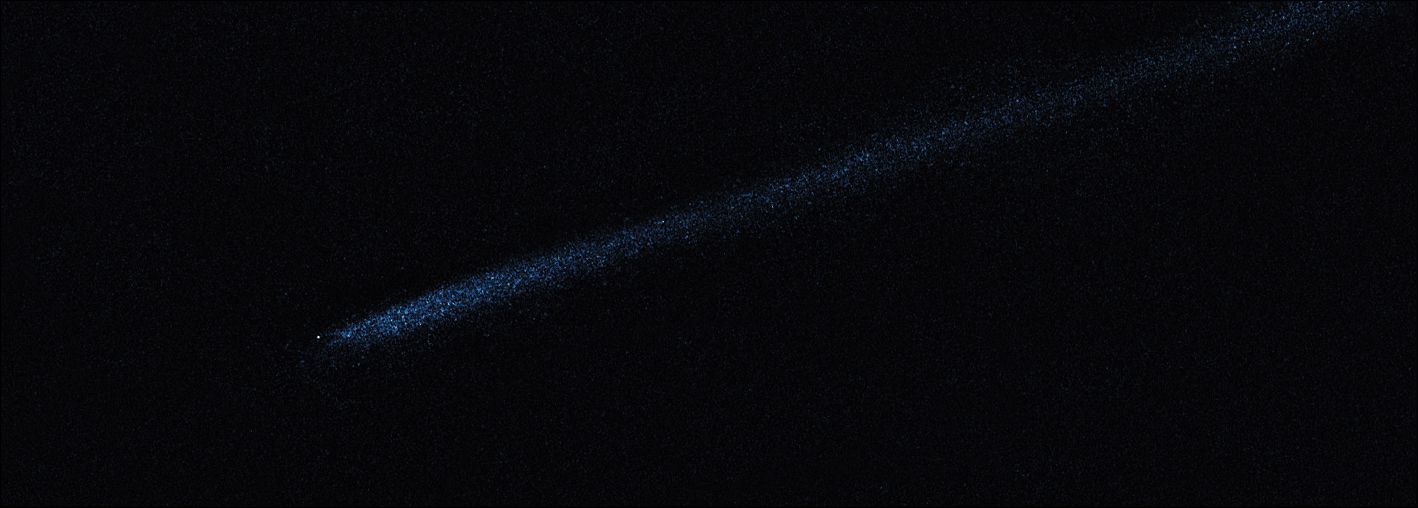
Hubble captured this remarkable image of P/2010 A2, a bizarre object in the asteroid belt that initially bewildered astronomers with its comet-like tail of debris. Unlike a comet, whose tail is produced by solar heating of ices, P/2010 A2's debris trail was created by a violent hypervelocity collision between two asteroids. The impact, which likely occurred in early 2009, shattered parts of the smaller asteroid and ejected a stream of dust and rocky fragments forming a distinctive X-shaped pattern visible in Hubble's images. The surviving nucleus of P/2010 A2, a roughly 120-meter-wide rocky body, is visible as a point-like object separated from the main debris cloud. This was the first time astronomers directly observed the aftermath of a collision between two asteroids, providing unprecedented insights into a process that has shaped the solar system for billions of years.
Scientific Significance
P/2010 A2 represents a watershed moment in planetary science: the first direct observation of debris from a collision between two asteroids. While asteroid collisions have long been understood as a fundamental process shaping the solar system — grinding large bodies into smaller fragments, generating dust, and altering orbits — they had never been caught in the act before. Hubble's observations allowed astronomers to study the collision's aftermath in unprecedented detail, revealing how debris is distributed and what structures form in the ejected material. The distinctive X-shaped debris pattern provided constraints on the geometry and velocity of the impact. These observations have important implications for understanding the collisional evolution of the asteroid belt, the generation of interplanetary dust, the delivery of meteorites to Earth, and the threat that asteroid collisions may pose by redirecting fragments toward the inner solar system.
Observation Details
Hubble observed P/2010 A2 using the Wide Field Camera 3 (WFC3) in visible light over multiple epochs between January and May 2010, allowing astronomers to track the evolution of the debris trail over time. The initial observations revealed the X-shaped debris pattern and the separated point-like nucleus, immediately distinguishing this object from a normal comet. Subsequent observations showed the trail slowly expanding and fading as particles dispersed under solar radiation pressure. The multi-epoch imaging enabled measurements of the debris expansion velocity, which was used to estimate the collision occurred around February 2009.
Location in the Universe
Constellation
N/A (Solar System)
Distance from Earth
180 million miles (at time of observation)
Fun Facts
- 1
P/2010 A2 was initially mistaken for a comet when ground-based telescopes spotted its tail, but Hubble revealed the X-shaped debris pattern that proved it was the aftermath of an asteroid-on-asteroid collision — something never before witnessed in real time.
- 2
The collision that created this debris trail released energy equivalent to detonating a small nuclear weapon, yet by solar system standards it was a relatively minor event — similar impacts occur in the asteroid belt roughly once a year.
- 3
The debris trail from P/2010 A2 stretched over 100,000 kilometers at the time of Hubble's observation, demonstrating how asteroid collisions generate fine dust that creates the zodiacal light visible from Earth.
Image credit: NASA, ESA, Hubble Space Telescope