About This Image
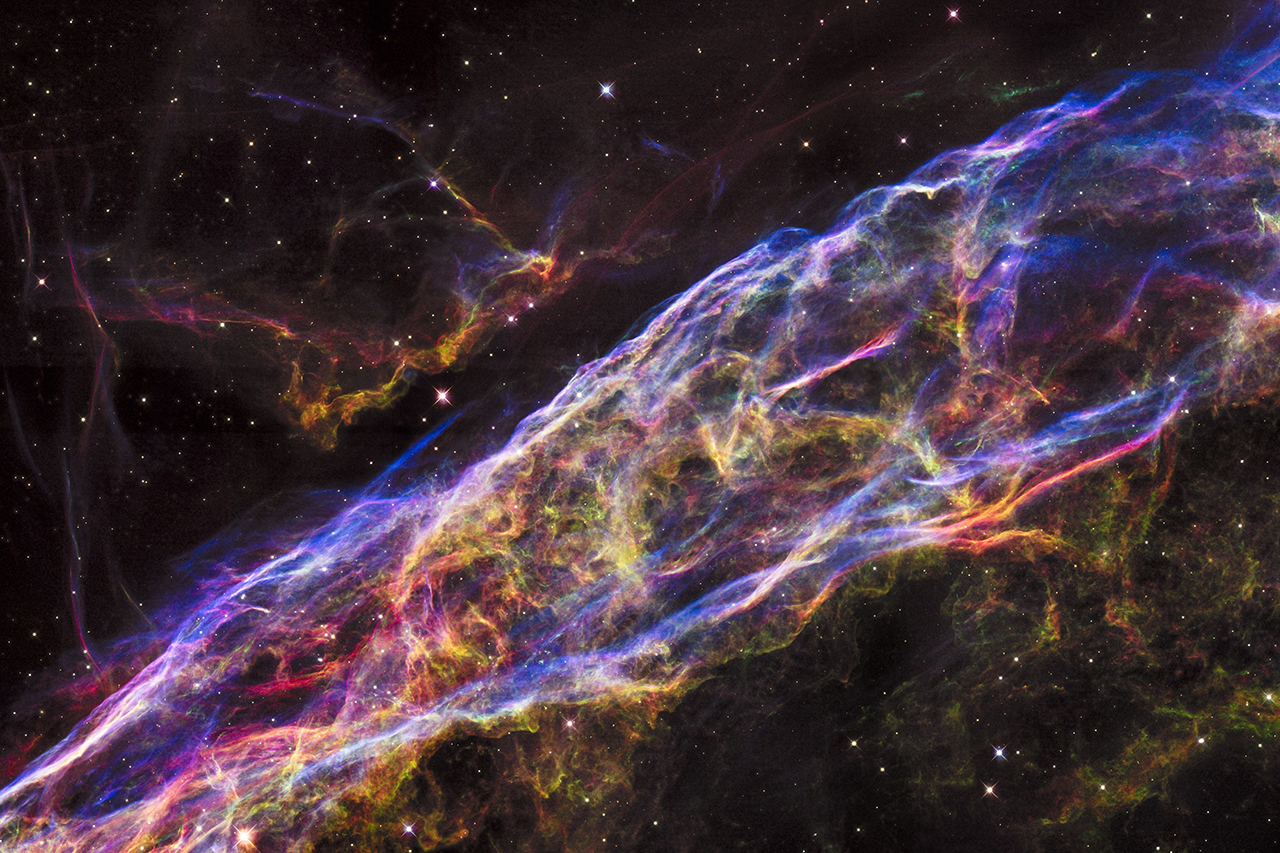
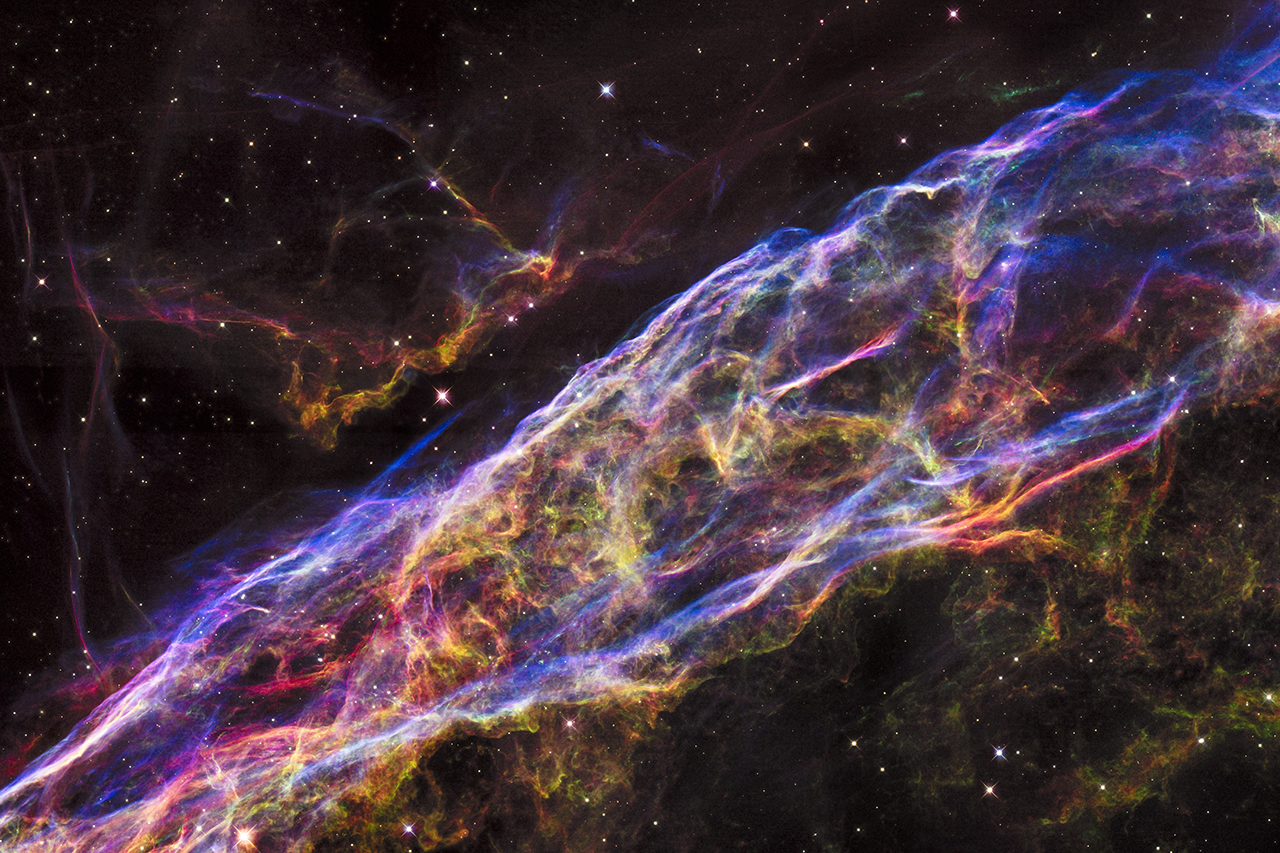
This Hubble view focuses on the intricate eastern filaments of the Veil Nebula, where the ancient supernova blast wave encounters varying densities of interstellar gas and dust. The result is a spectacular tapestry of luminous threads and knots, each tracing a different interaction between the high-speed shock front and the surrounding medium. Where the blast wave strikes denser clumps of gas, it decelerates and creates brighter, more complex structures; in regions of lower density, the filaments are thinner and more widely spaced. The entire Veil Nebula complex, also known as the Cygnus Loop, covers an area of sky six times the diameter of the full Moon, though only a small fraction of its delicate beauty is captured in any single Hubble pointing. The remnant continues to expand and will eventually merge into the general interstellar medium over the next hundred thousand years.
Scientific Significance
The eastern filaments of the Veil Nebula provide a textbook illustration of how supernova blast waves interact with an inhomogeneous interstellar medium. The varying brightness, thickness, and morphology of the filaments directly map the pre-existing density structure of the gas into which the shock is propagating. This allows astronomers to reconstruct the three-dimensional structure of the interstellar medium in the vicinity of the explosion. X-ray observations reveal that the gas immediately behind the shock front reaches temperatures of millions of degrees, while the optical emission captured by Hubble comes from the cooler, denser gas further downstream where the shocked material has had time to radiate and cool. Comparing the eastern and western sections of the Veil Nebula reveals asymmetries that constrain the properties of the original explosion and the distribution of circumstellar material deposited by the progenitor star's winds before it exploded.
Observation Details
This image was captured using Hubble's Wide Field Camera 3 (WFC3) with narrowband and broadband filters tuned to emission from ionized hydrogen, oxygen, and sulfur. The narrowband imaging isolates specific emission lines that trace different physical conditions within the post-shock gas. The observations were designed to complement the western arc imaging and provide a complete picture of the blast wave's interaction with the interstellar medium from two different perspectives within the same remnant. Multi-epoch observations allow measurement of the filaments' proper motion, directly revealing the expansion velocity of the remnant.
Location in the Universe
Constellation
Cygnus
Distance from Earth
2,100 light-years
Fun Facts
- 1
The Veil Nebula was first discovered by astronomer William Herschel in 1784, but it took nearly two centuries of technological advancement before Hubble could reveal the exquisite filamentary detail visible in this image.
- 2
The Cygnus Loop (the Veil Nebula's parent structure) has been expanding for about 8,000 years and has swept up roughly 20 times the mass of the Sun in interstellar gas, creating a vast bubble of hot, enriched material.
- 3
Supernova remnants like the Veil Nebula are the primary mechanism by which heavy elements — forged inside massive stars and in the supernova explosion itself — are distributed throughout the galaxy for incorporation into future generations of stars and planets.
Image credit: NASA, ESA, Hubble Space Telescope