About This Image
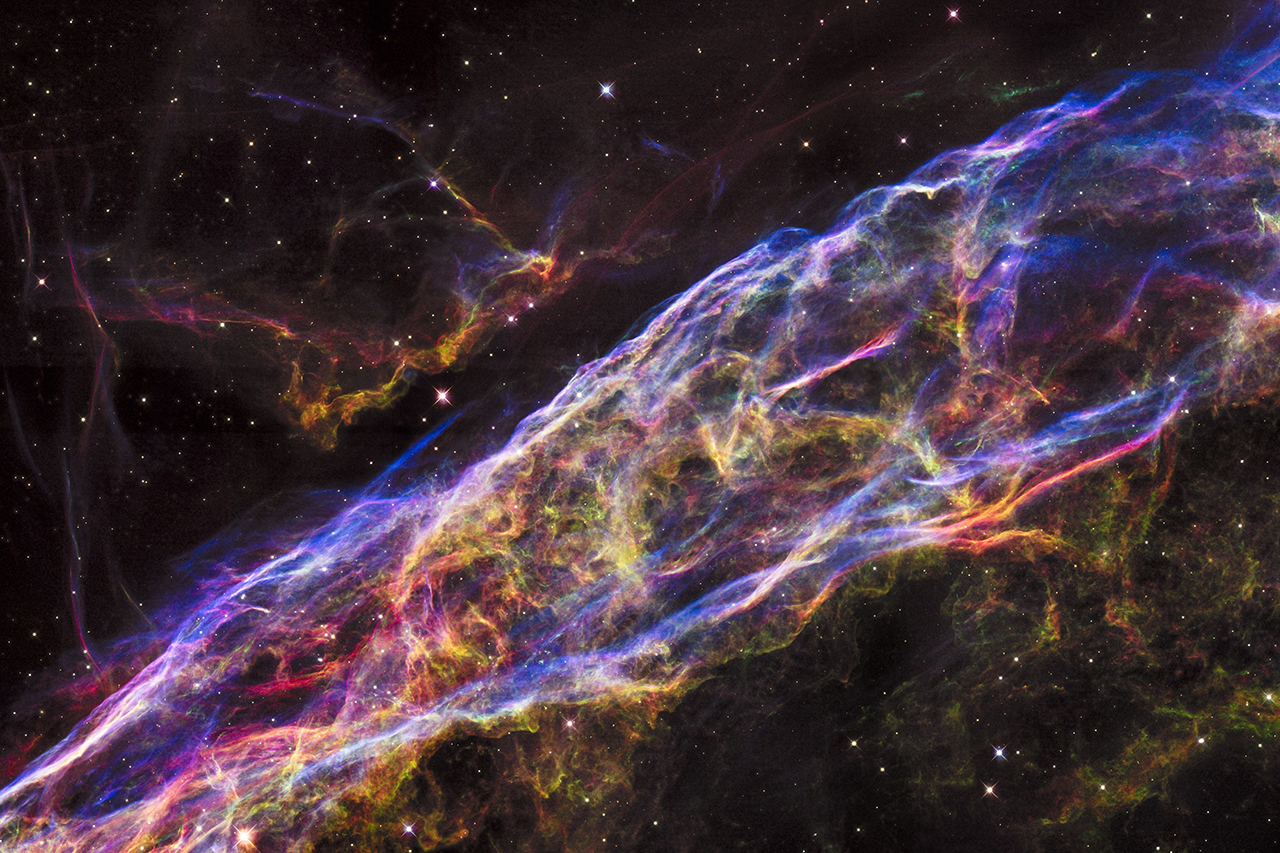
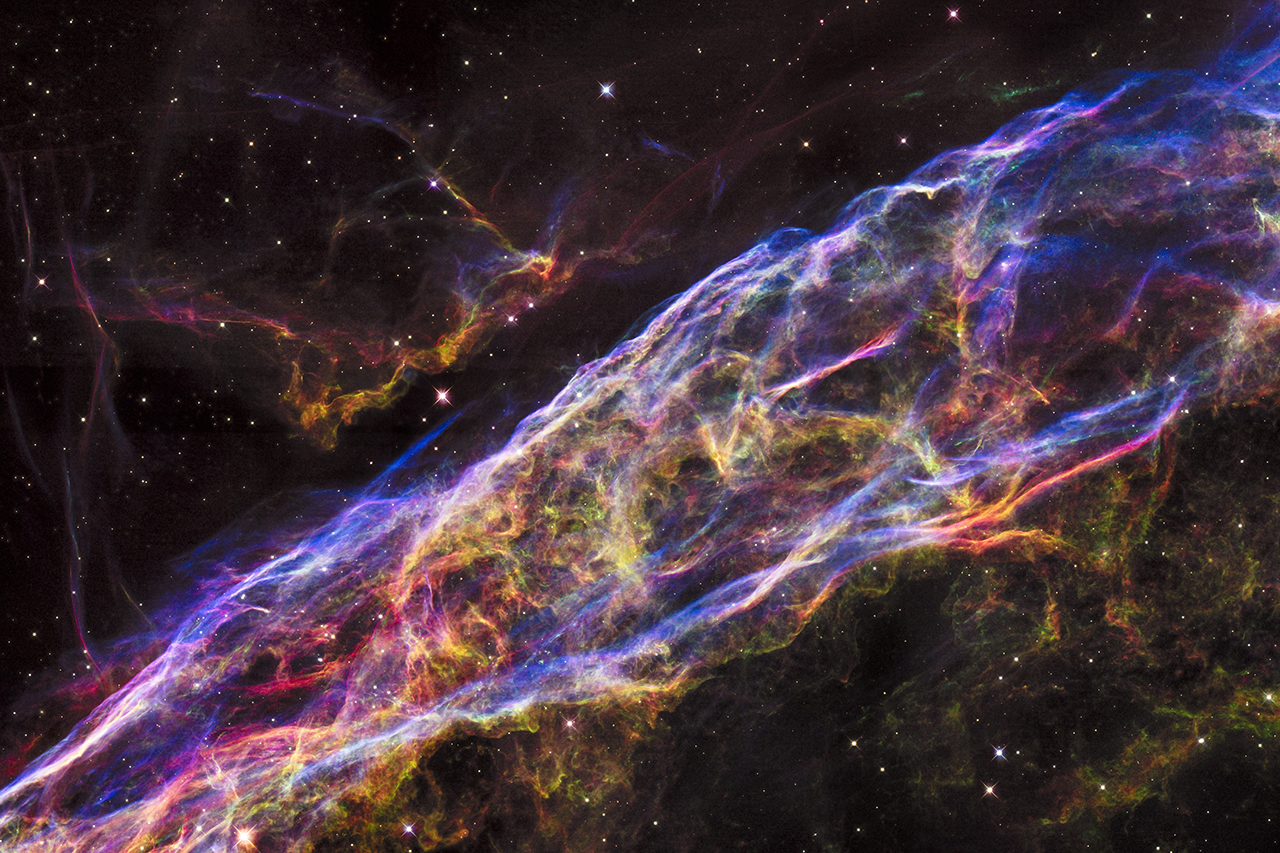
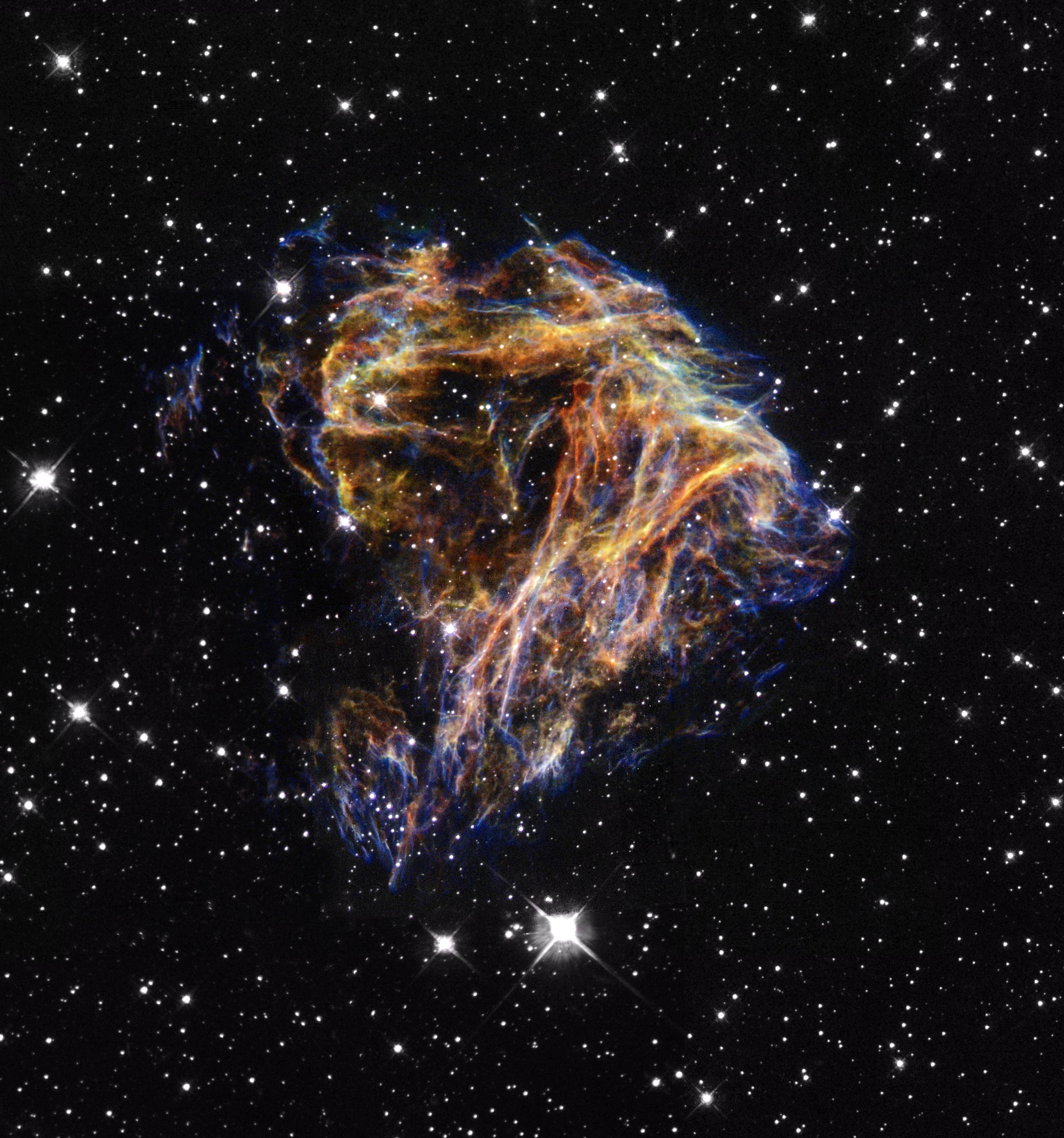
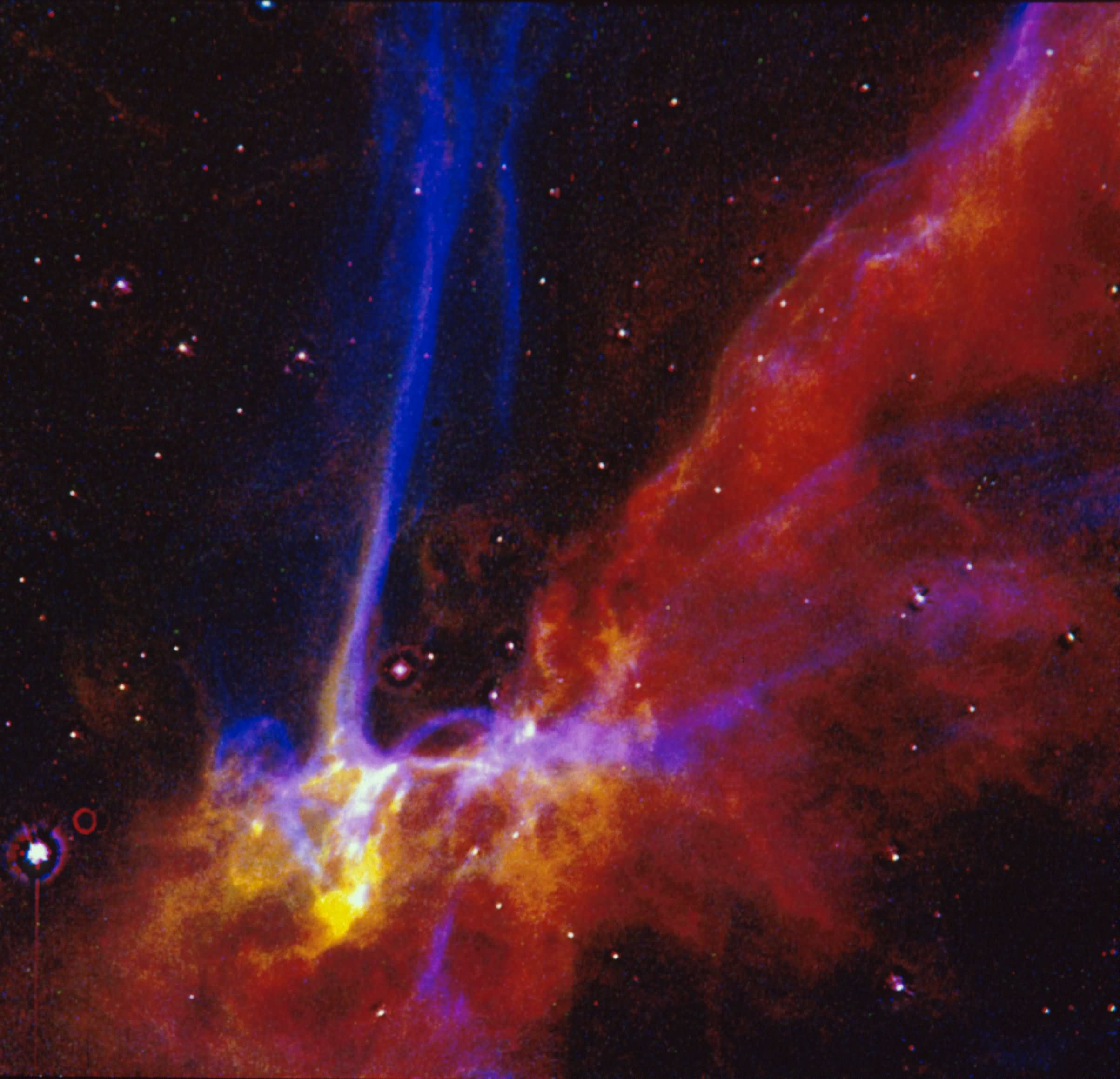
This Hubble image captures a small but exquisitely detailed portion of the Cygnus Loop, the expanding blast wave from a colossal stellar explosion that occurred approximately 15,000 years ago. Located about 2,600 light-years away in the constellation Cygnus, the Cygnus Loop is one of the largest supernova remnants visible from Earth, spanning roughly 120 light-years across — an area covering about 36 times the apparent size of the full Moon on the sky. The blast wave, still racing outward at over 200 miles per second, creates the luminous filaments visible in this image as it slams into stationary clouds of interstellar gas and heats them to temperatures of hundreds of thousands of degrees. The original star that produced this remnant was likely 15 to 25 times more massive than our Sun and ended its life in a catastrophic core-collapse supernova, scattering its enriched material into the surrounding interstellar medium.
Scientific Significance
The Cygnus Loop holds a distinguished place in the history of space-based astronomy as one of Hubble's earliest targets, and its study has provided foundational insights into the physics of supernova remnants and their interaction with the interstellar medium. As one of the nearest large supernova remnants, the Cygnus Loop can be studied at a level of detail impossible for more distant remnants. The resolved filamentary structure reveals the microphysics of astrophysical shock waves, including how kinetic energy is converted to thermal energy and radiation. By measuring the optical emission at different wavelengths, astronomers can determine the temperature, density, and velocity of the shocked gas at each point along the blast wave. The Cygnus Loop also demonstrates how supernovae enrich the interstellar medium with heavy elements and inject turbulent energy that influences the structure and evolution of the galaxy's gaseous disk.
Observation Details
This image was captured using Hubble's Wide Field and Planetary Camera (WF/PC, the original camera before its 1993 replacement) shortly after Hubble's launch in 1990. The observation utilized narrowband filters to isolate emission from ionized hydrogen and oxygen, which glow at characteristic wavelengths in the hot post-shock gas. Despite the well-documented spherical aberration affecting Hubble's primary mirror at the time, the image still revealed unprecedented detail in the filamentary structure of the shock front. Later observations with the corrected optics provided even sharper views of these structures.
Location in the Universe
Constellation
Cygnus
Distance from Earth
2,600 light-years
Fun Facts
- 1
The Cygnus Loop was one of the very first targets observed by Hubble after its launch in 1990, making this image among the earliest scientific results from the telescope that would go on to revolutionize astronomy.
- 2
The entire Cygnus Loop is so enormous that it covers an area of sky roughly 36 times larger than the full Moon, though it is far too faint to see without a telescope and specialized filters.
- 3
At its current expansion rate, the Cygnus Loop blast wave has swept up approximately 20 times the mass of our Sun in interstellar gas, creating a vast hot bubble surrounded by a thin shell of compressed, luminous material.
Image credit: NASA, ESA, Hubble Space Telescope