About This Image
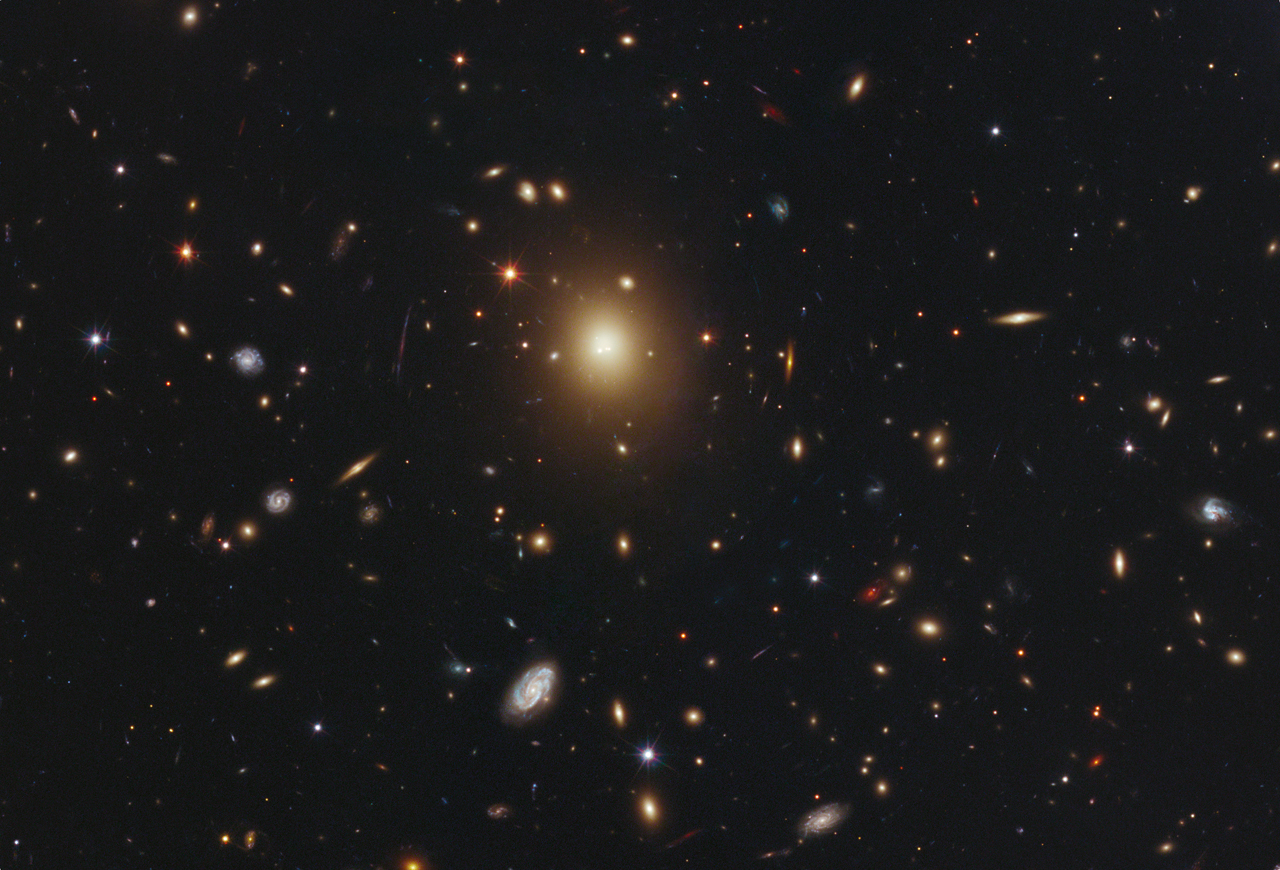
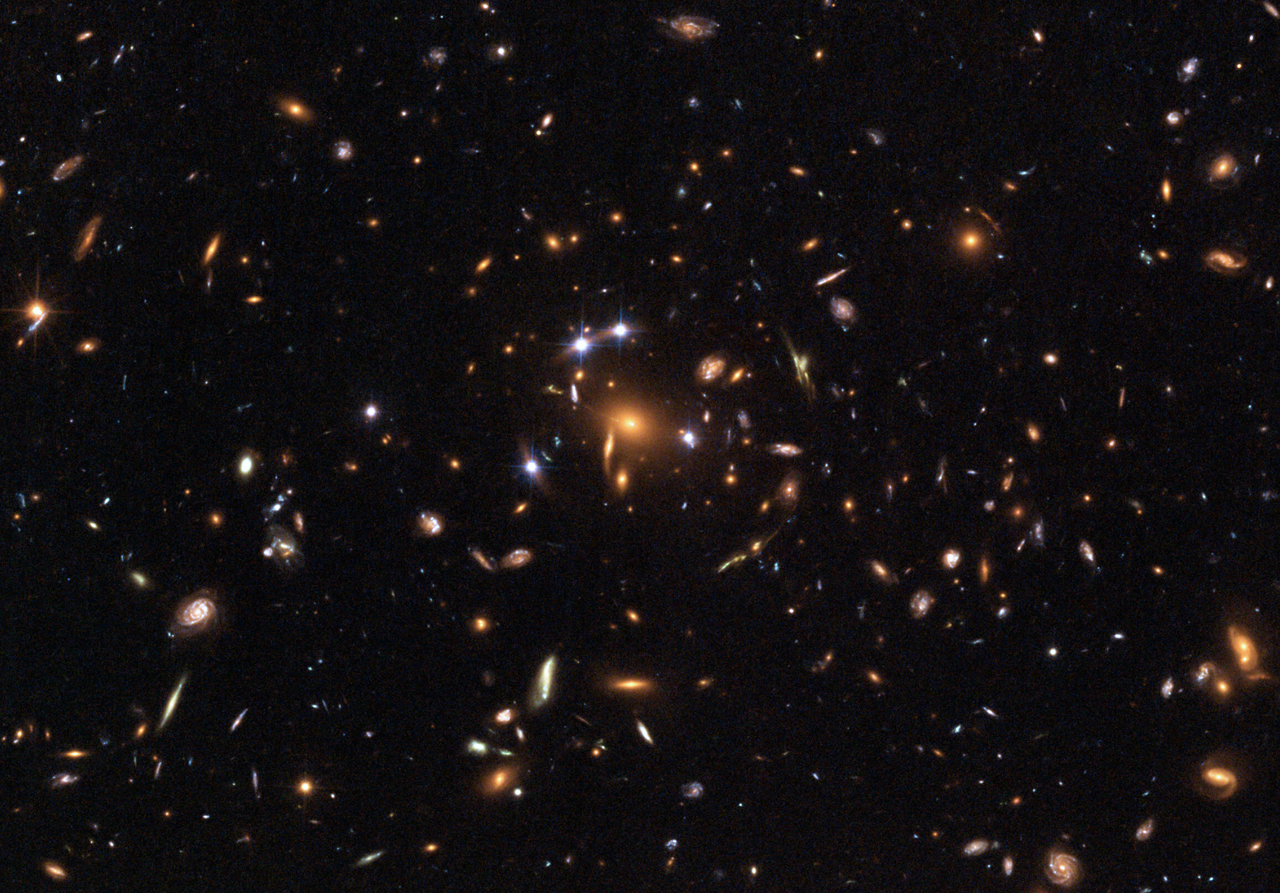
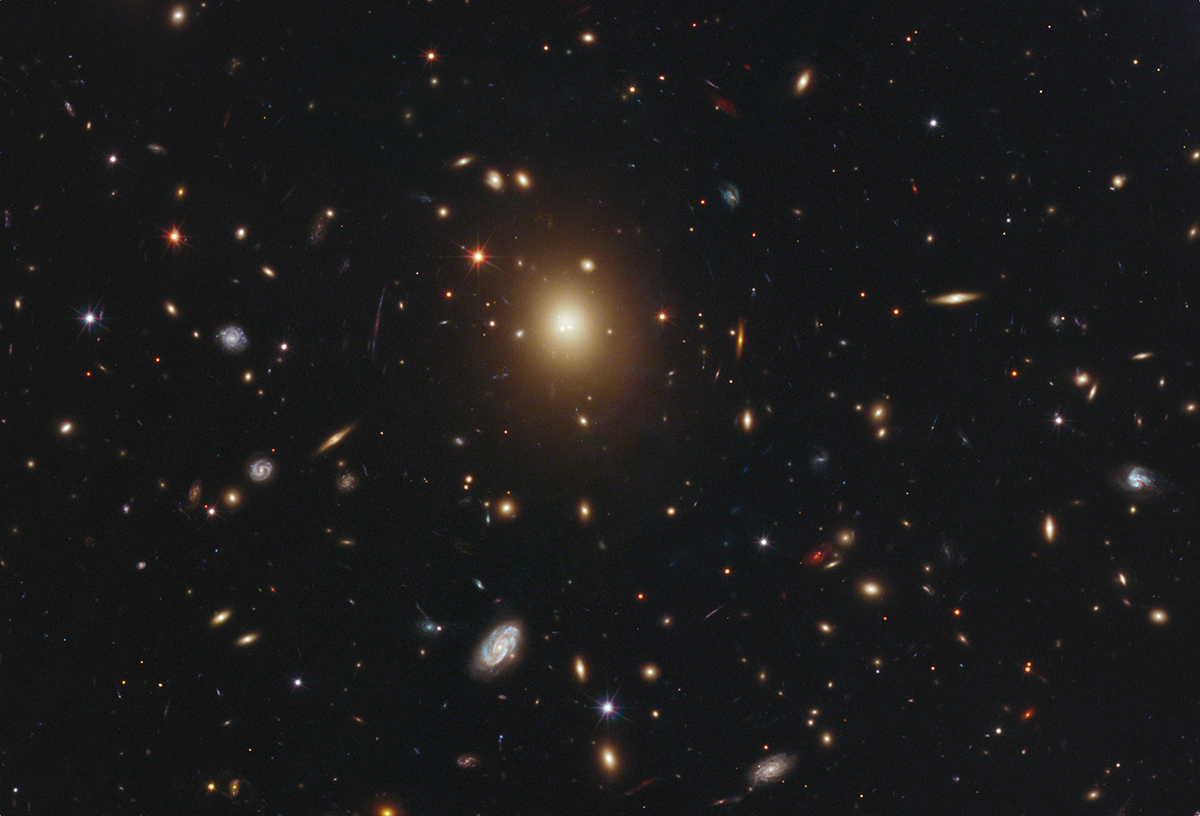
This Hubble image captures the massive galaxy cluster Abell 2261, located approximately 3 billion light-years away in the constellation Hercules. The dominant feature is the brightest cluster galaxy (BCG) at the center — A2261-BCG — an enormous elliptical galaxy spanning more than a million light-years across, making it roughly ten times the diameter of our Milky Way. This cosmic giant is surrounded by hundreds of smaller galaxies gravitationally bound within the cluster's enormous dark matter halo. Galaxy clusters like Abell 2261 are the largest gravitationally bound structures in the universe, containing trillions of solar masses of galaxies, hot intracluster gas, and dark matter. The sheer scale of this system warps the fabric of spacetime, bending light from more distant galaxies behind the cluster through gravitational lensing.
Scientific Significance
Abell 2261 has become a focus of intense scientific scrutiny due to the mystery of its central galaxy's missing supermassive black hole. In most giant elliptical galaxies, a supermassive black hole resides at the center, surrounded by a dense cusp of stars. But A2261-BCG has an unusually large, diffuse core without the expected stellar density peak, suggesting the black hole may have been ejected through gravitational wave recoil following the merger of two supermassive black holes — an event predicted by general relativity but never directly confirmed. If verified, this would be the first observational evidence of a recoiling supermassive black hole, with profound implications for our understanding of galaxy evolution and gravitational wave physics. The cluster also serves as an important calibrator for measuring the mass of galaxy clusters through gravitational lensing, which is essential for constraining cosmological parameters.
Observation Details
This image was captured using Hubble's Wide Field Camera 3 (WFC3) in near-infrared wavelengths as part of the CLASH (Cluster Lensing And Supernova survey with Hubble) program. The multi-band photometry enabled precise measurements of the cluster's gravitational lensing effects on background galaxies. Deep X-ray observations from Chandra complemented the Hubble data by mapping the distribution of hot intracluster gas. The combined dataset allowed astronomers to construct detailed mass models of the cluster and search for the elusive supermassive black hole within the central galaxy.
Location in the Universe
Constellation
Hercules
Distance from Earth
3 billion light-years
Fun Facts
- 1
The central galaxy A2261-BCG has one of the largest galactic cores ever measured — its core alone spans about 10,000 light-years across, vastly larger than the cores of typical elliptical galaxies.
- 2
Despite extensive searches, astronomers have not been able to definitively locate a supermassive black hole at the center of A2261-BCG, leading to the intriguing possibility that the black hole was ejected during a galaxy merger through gravitational wave recoil.
- 3
Galaxy clusters like Abell 2261 are so massive that they act as cosmic magnifying glasses, bending and amplifying light from galaxies billions of light-years farther away through gravitational lensing.
Image credit: NASA, ESA, Hubble Space Telescope