About This Image
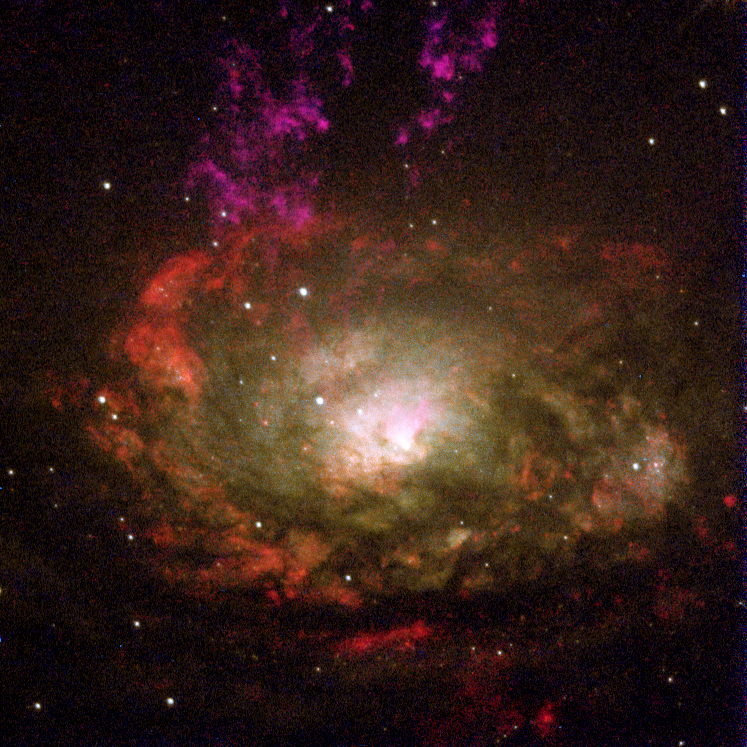
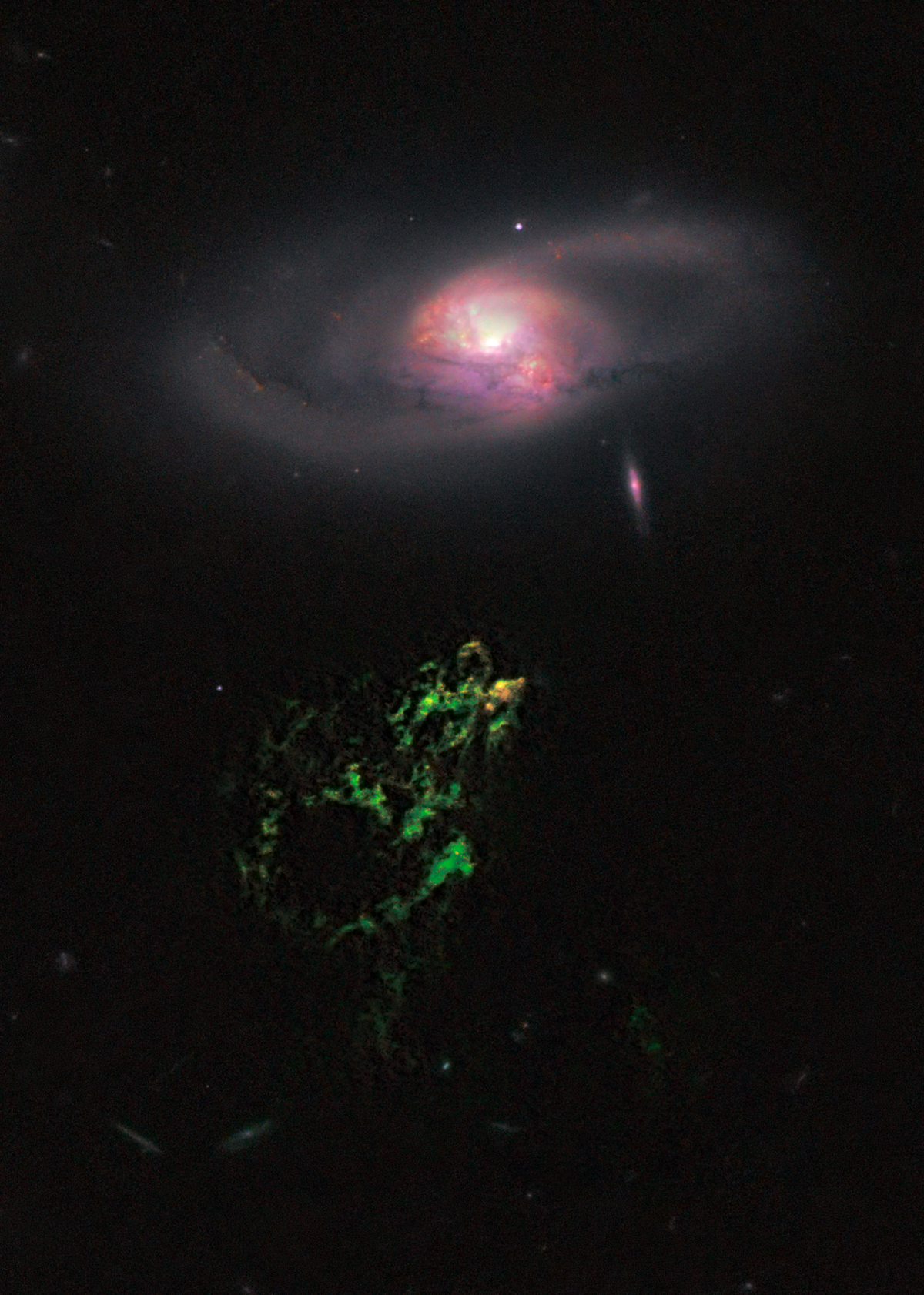
This image reveals one of the most unusual objects in modern astronomy: a ghostly green blob of gas that appears to float near the spiral galaxy IC 2497, approximately 650 million light-years away in the constellation Leo Minor. Dubbed "Hanny's Voorwerp" (Dutch for "Hanny's Object") after Dutch schoolteacher Hanny van Arkel who discovered it in 2007 while participating in the Galaxy Zoo citizen science project, this bizarre green cloud is the visible portion of a 300,000-light-year-long streamer of gas stretching around the galaxy. The green glow comes from oxygen atoms ionized by a powerful beam of radiation that was once emitted by a now-dormant quasar at IC 2497's center. Essentially, Hanny's Voorwerp is a "light echo" of quasar activity — the quasar has since shut off, but the gas cloud continues to glow because the light that ionized it has not yet faded.
Scientific Significance
Hanny's Voorwerp is a landmark object for understanding quasar variability and the lifecycle of active galactic nuclei. The existence of this ionized gas cloud, still glowing from a quasar that has since turned off, demonstrates that quasars can switch on and off on timescales of tens to hundreds of thousands of years — much faster than previously thought. This has profound implications for models of black hole accretion, suggesting that the fuel supply to supermassive black holes can be interrupted or exhausted relatively quickly. Hanny's Voorwerp also provides a unique tool for measuring the luminosity of the past quasar by analyzing the ionization state of the gas at different distances from the galaxy, effectively creating a "light echo" that records the quasar's history. The discovery has inspired systematic searches for similar objects, leading to the identification of dozens of "Voorwerpje" candidates around other galaxies with evidence of fading AGN activity.
Observation Details
This image was captured using Hubble's Wide Field Camera 3 (WFC3) and the Advanced Camera for Surveys (ACS) in multiple filters including narrowband [O III] emission to highlight the ionized oxygen that gives the Voorwerp its distinctive green color. The observations revealed surprising detail within the gas cloud, including regions of active star formation and complex filamentary structures. Hubble's resolution was critical for separating the Voorwerp's internal structures and for identifying the compact star-forming regions embedded within the ionized gas. Complementary X-ray observations from Chandra confirmed the presence of a heavily obscured but weakened AGN at the center of IC 2497.
Location in the Universe
Constellation
Leo Minor
Distance from Earth
650 million light-years
Fun Facts
- 1
Hanny's Voorwerp was discovered by a Dutch schoolteacher named Hanny van Arkel in 2007 while she was classifying galaxy shapes as a volunteer for the Galaxy Zoo citizen science project — making it one of the most significant astronomical discoveries ever made by an amateur.
- 2
The quasar that once illuminated Hanny's Voorwerp has shut down within the last 200,000 years, but the gas cloud still glows because the light took that long to travel through the enormous streamer — we are essentially seeing a cosmic ghost light.
- 3
Hubble observations revealed that new stars are forming within Hanny's Voorwerp itself, likely triggered by the outflow of material from IC 2497's once-active nucleus compressing the surrounding gas.
Image credit: NASA, ESA, Hubble Space Telescope