About This Image
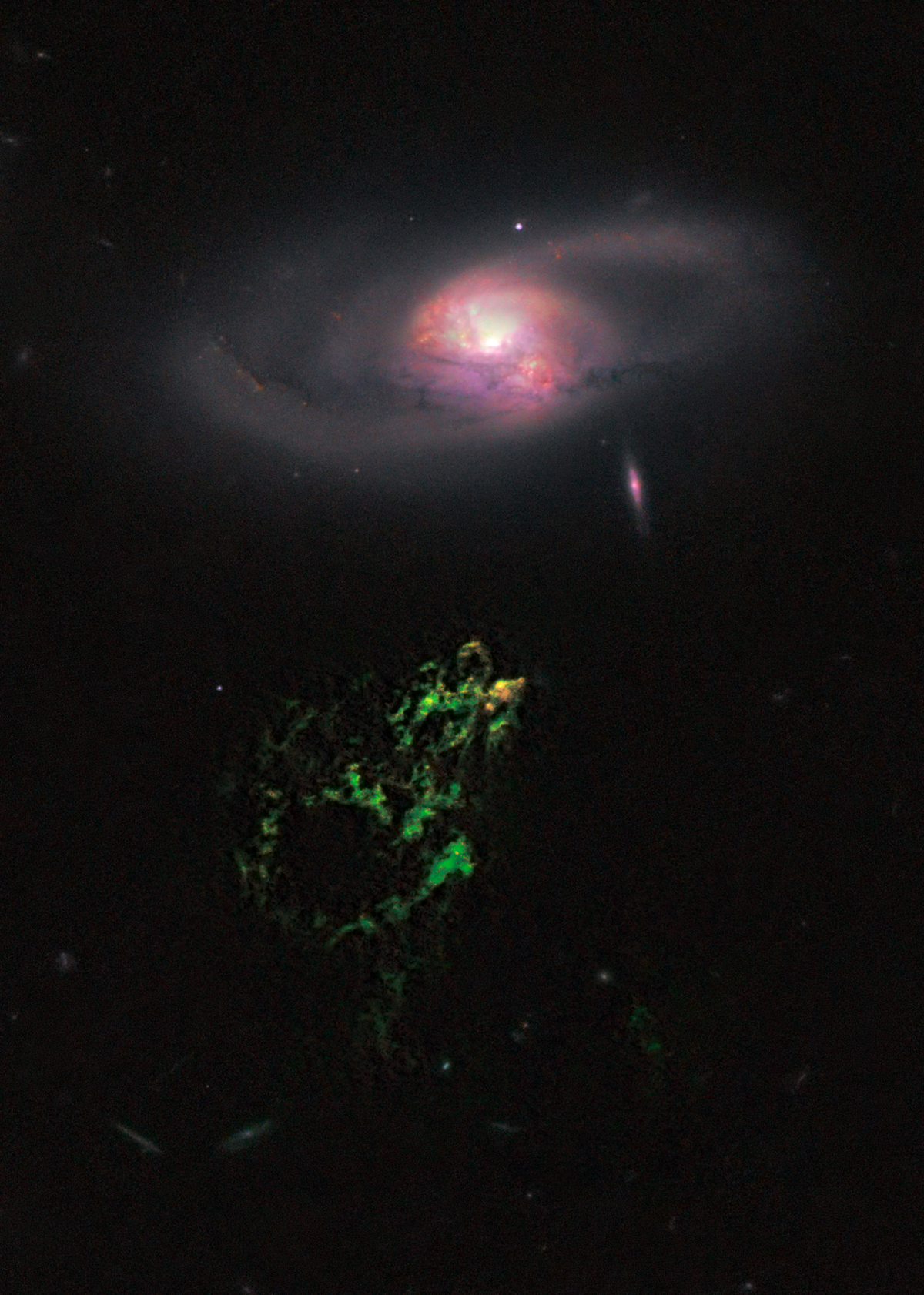
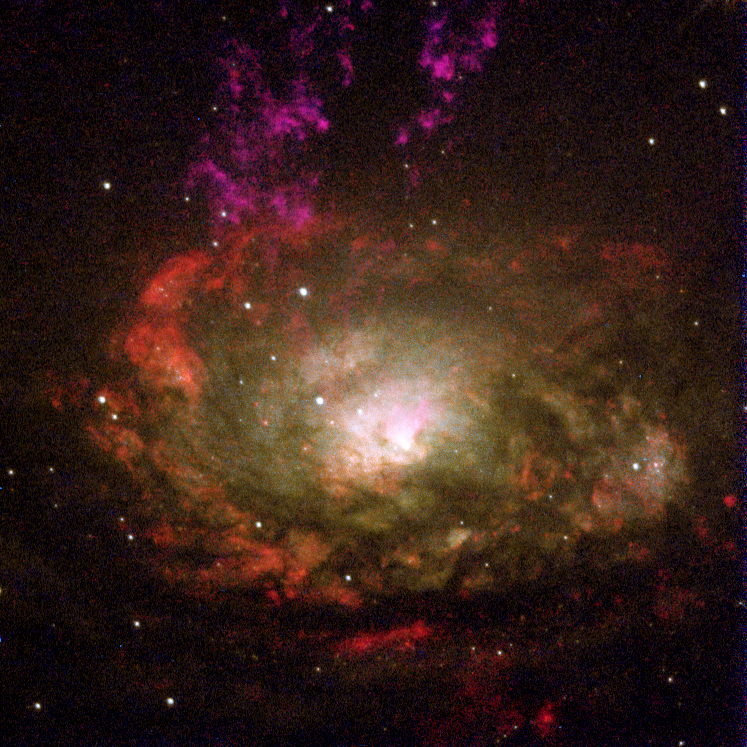
Resembling a swirling witch's cauldron of glowing vapors, this Hubble image reveals the black-hole-powered core of the Circinus Galaxy, one of the closest active galaxies to the Milky Way at only about 13 million light-years. Classified as a Type II Seyfert galaxy, its central supermassive black hole is actively devouring surrounding gas and dust while being partially obscured by a thick torus of material. The image reveals two distinct rings of gas: an outer ring approximately 700 light-years in diameter where vigorous star formation is taking place, and an inner ring only 130 light-years across where gas is being heated and ionized by the intense radiation from the active nucleus. Cone-shaped plumes of gas are being ejected from the nucleus, illuminated by the central engine's fierce ultraviolet and X-ray radiation.
Scientific Significance
The Circinus Galaxy is one of the nearest and most accessible examples of an active galactic nucleus (AGN), making it an invaluable laboratory for studying the physical processes that power these extraordinary objects. As a Type II Seyfert galaxy, its active nucleus is viewed through an obscuring torus of dust and gas, providing a natural experiment that tests the unified model of AGN — the theoretical framework proposing that different types of active galaxies are fundamentally the same objects viewed from different angles. Hubble observations of the ionization cones — V-shaped regions of gas illuminated by the central engine — have provided some of the clearest evidence for radiation collimation by the dusty torus. The galaxy's two-ring structure demonstrates the complex interplay between AGN activity and star formation, as radiation from the black hole can both trigger and suppress star formation in surrounding gas.
Observation Details
This image was captured using Hubble's Wide Field and Planetary Camera 2 (WFPC2) through a combination of narrowband emission-line filters and broadband continuum filters. The narrowband filters isolated emission from ionized hydrogen (H-alpha), doubly ionized oxygen ([O III]), and ionized nitrogen ([N II]), mapped to different colors to highlight various gas excitation mechanisms. The [O III] emission traces high-ionization gas in the radiation cones powered directly by the AGN, while H-alpha emission reveals star formation regions in the outer ring. Hubble's angular resolution was essential for separating the compact nuclear structures from surrounding star-forming regions.
Location in the Universe
Constellation
Circinus
Distance from Earth
13 million light-years
Fun Facts
- 1
The Circinus Galaxy was not discovered until 1977 because it lies close to the plane of the Milky Way, where dense foreground stars and dust make it difficult to spot — it was hiding in plain sight in our cosmic backyard.
- 2
The supermassive black hole at the center of the Circinus Galaxy is estimated to have a mass of about 1.7 million solar masses, roughly half the mass of the Milky Way's own central black hole.
- 3
The Circinus Galaxy is one of the brightest sources of water maser emission in the sky, with water molecules in its central region acting as a natural laser amplifying microwave radiation to extraordinary intensities.
Image credit: NASA, ESA, Hubble Space Telescope