About This Image
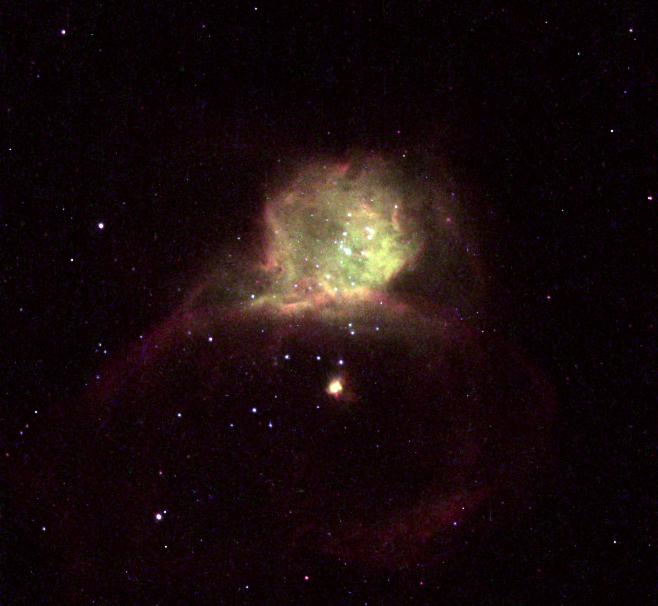
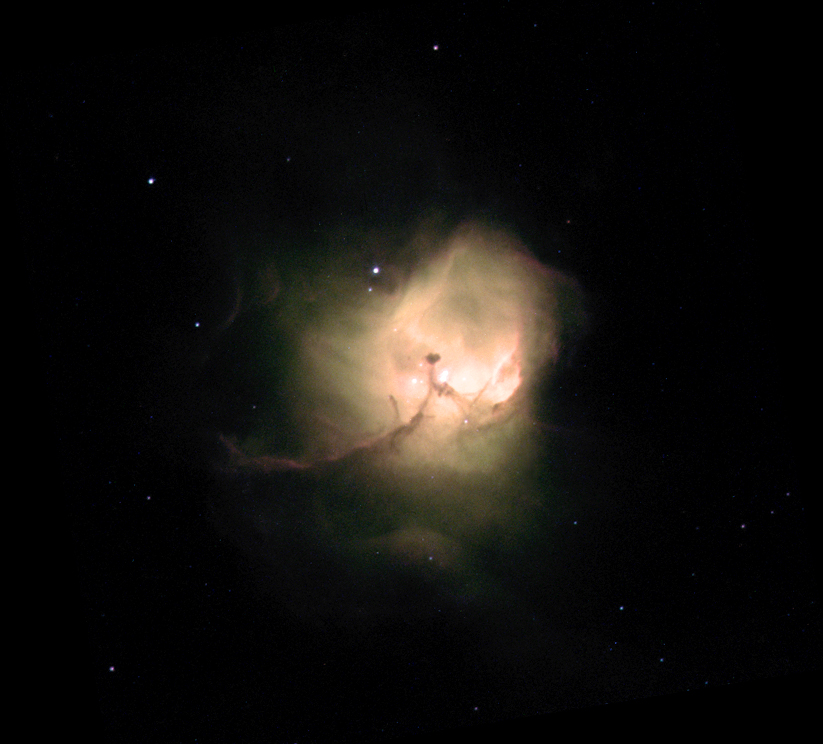
This image shows a newborn star cluster cradled within a nebula, or glowing cloud of gas, called N 81. This stellar nursery lies about 200,000 light-years away within the Small Magellanic Cloud, a small galaxy orbiting our own Milky Way.
Scientific Significance
N 81 is a compact laboratory for studying massive star formation in a low-metallicity galaxy. Its stellar population and ionized gas conditions help astronomers test how reduced heavy-element content changes stellar winds, ionization structure, and feedback strength. These effects matter for understanding the first generations of stars in the early universe, which also formed in chemically primitive gas. By measuring luminosities, temperatures, and nebular line properties in regions like N 81, researchers calibrate models of starburst regions and improve interpretation of unresolved star-forming galaxies at much larger distances.
Observation Details
Hubble observed N 81 with high-resolution optical imaging to resolve its central young cluster from surrounding nebular emission. Narrowband filters isolating strong hydrogen and oxygen lines were combined with broadband continuum exposures to map ionized gas morphology and embedded stellar sources. The data reveal bright knots, arcs, and cavities carved by radiation and stellar winds. Because the source is in the Small Magellanic Cloud, Hubble can resolve structural details that would blur together in more distant galaxies, making N 81 a benchmark target for feedback studies.
Location in the Universe
Constellation
Tucana
Distance from Earth
200,000 light-years
Fun Facts
- 1
N 81 sits in the Small Magellanic Cloud, a nearby dwarf galaxy that orbits the Milky Way.
- 2
The region hosts very hot young stars whose ultraviolet radiation ionizes surrounding hydrogen gas.
- 3
Because the Small Magellanic Cloud has lower heavy-element abundance than the Milky Way, N 81 is a useful analog for early-universe star-forming environments.
Image credit: NASA, ESA, Hubble Space Telescope