About This Image
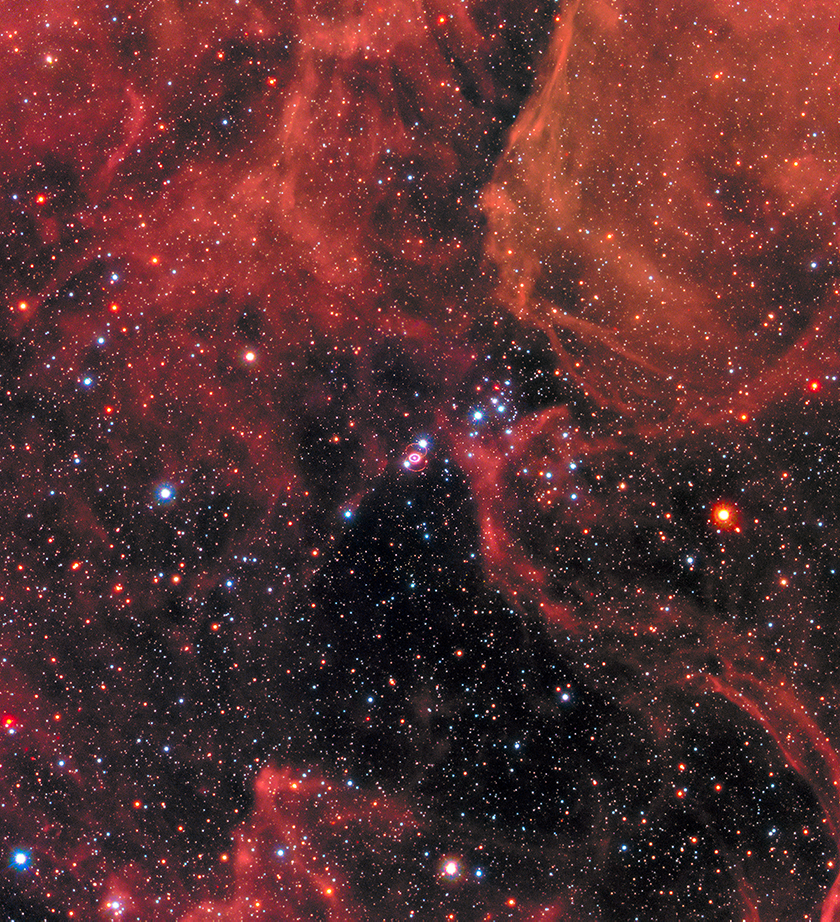
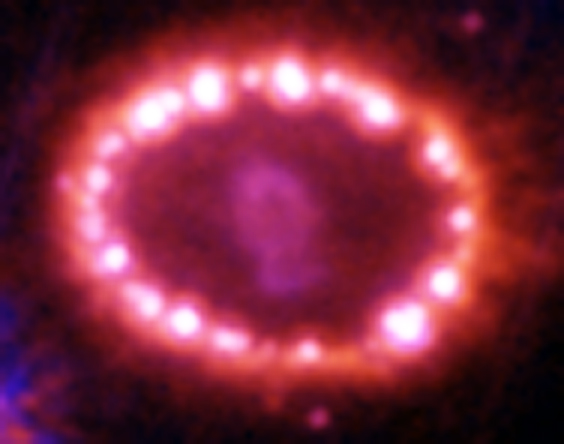
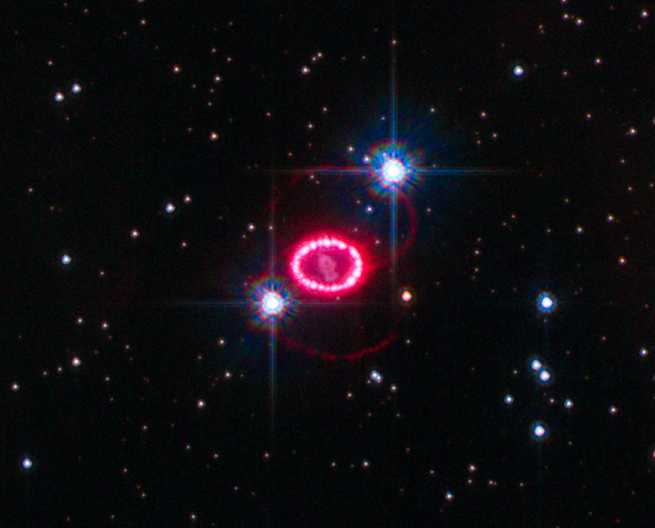
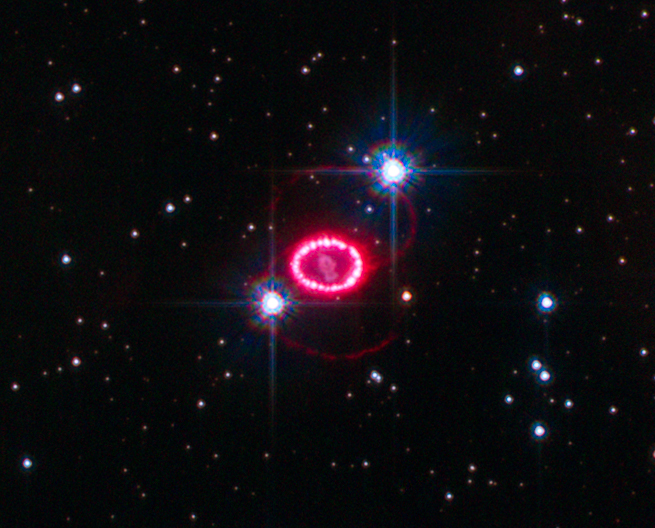
This image shows the remnant of Supernova 1987A, a stellar explosion in a nearby galaxy that astronomers witnessed in 1987. A shock wave of material unleashed by the stellar blast is slamming into a surrounding ring of gas, causing it to glow.
Scientific Significance
SN 1987A provides a rare real-time laboratory for supernova remnant evolution. Long-term monitoring reveals shock interactions, element dispersal, and geometry of the progenitor environment.
Observation Details
Hubble repeatedly imaged the remnant in optical and ultraviolet bands, tracking hotspot evolution around the ring and structural changes in expanding ejecta.
Location in the Universe
Constellation
Dorado (Large Magellanic Cloud)
Distance from Earth
160,000 light-years
Fun Facts
- 1
SN 1987A was the brightest nearby supernova seen in modern times.
- 2
Its equatorial ring brightened as the blast wave struck dense circumstellar gas.
- 3
Neutrinos detected from SN 1987A validated key core-collapse predictions.
Image credit: NASA, ESA, Hubble Space Telescope