About This Image
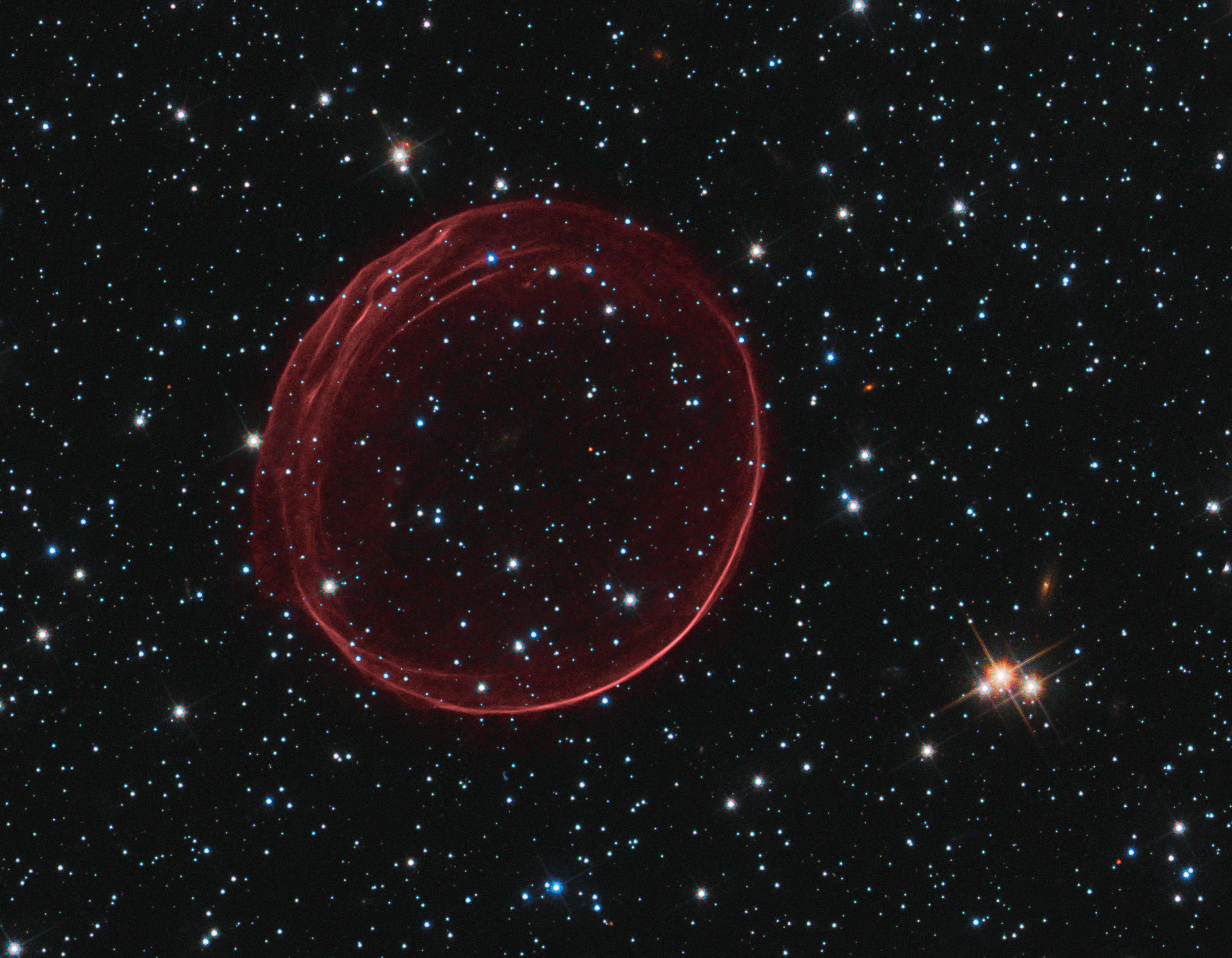
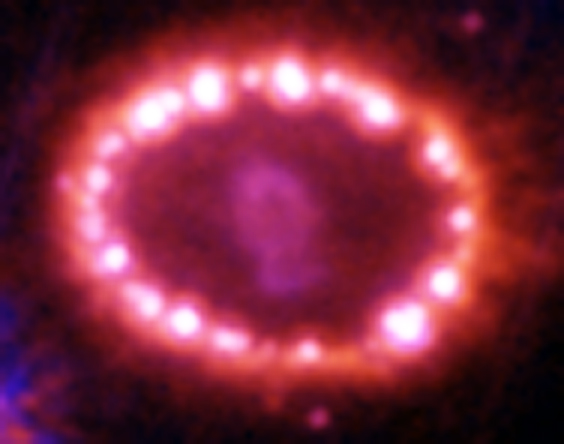
This stunning image reveals the cosmic aftermath of Supernova 1987A, the closest supernova observed since the invention of the telescope, illuminating a ring of gas like pearls strung on a celestial necklace. These brilliant 'hotspots' form where the supernova's blast wave, traveling at over a million miles per hour, slams into a ring of dense gas that the progenitor star expelled roughly 20,000 years before its explosive death. Each collision compresses and heats the gas to millions of degrees, causing it to emit intense radiation across the electromagnetic spectrum. The ring itself is a fossil record of the dying star's mass loss during its final evolutionary stages, when a fast stellar wind carved out a cavity in a previously ejected slow wind. Supernova 1987A, which exploded in the Large Magellanic Cloud on February 23, 1987, has been continuously monitored by Hubble since the telescope's launch, creating an unprecedented time-lapse movie of supernova remnant evolution.
Scientific Significance
Supernova 1987A is the most important supernova in modern astronomical history, providing the first opportunity to study a relatively nearby stellar explosion with modern instruments and to follow its evolution in detail over decades. The detection of neutrinos from the event confirmed theories of core-collapse supernovae and demonstrated that massive stars produce neutron stars (or black holes) when they explode. Hubble's multi-decade monitoring has revealed the progressive lighting-up of the equatorial ring as the blast wave expanded to reach denser material, with the number and brightness of hotspots increasing steadily through the 1990s and 2000s. The triple-ring structure visible in wider images — consisting of the inner equatorial ring and two outer rings forming an hourglass shape — reveals the complex pre-supernova mass-loss geometry and challenges stellar evolution models. The search for a surviving neutron star at the explosion center continues, with recent infrared observations suggesting a compact object may be hidden within the expanding debris. SN 1987A serves as a Rosetta Stone for interpreting observations of more distant supernovae.
Observation Details
Hubble has observed Supernova 1987A regularly since 1990 using successive generations of cameras, tracking the evolution of the ring's hotspots as the blast wave progressively lit up the circumstellar material. This image was captured using the Advanced Camera for Surveys (ACS) with filters sensitive to emission from hydrogen and other elements ionized by the shock. The time series of Hubble observations revealed that hotspots first appeared around 1995 when the blast wave began colliding with dense protrusions extending inward from the ring. Complementary observations with ground-based radio telescopes and the Chandra X-ray Observatory mapped the synchrotron and thermal X-ray emission from the shocked material, providing a complete picture of the shock physics.
Location in the Universe
Constellation
Dorado (Large Magellanic Cloud)
Distance from Earth
160,000 light-years
Fun Facts
- 1
SN 1987A was visible to the naked eye from the Southern Hemisphere for several months, reaching a peak brightness of magnitude 3 — about as bright as a moderately bright star.
- 2
The supernova was caused by the collapse and explosion of a blue supergiant star named Sanduleak -69° 202, which had a mass roughly 20 times that of the Sun.
- 3
Neutrino detectors on Earth registered a burst of particles from SN 1987A about three hours before the visible light arrived — the first-ever detection of neutrinos from outside our solar system.
Image credit: NASA, ESA, Hubble Space Telescope