About This Image
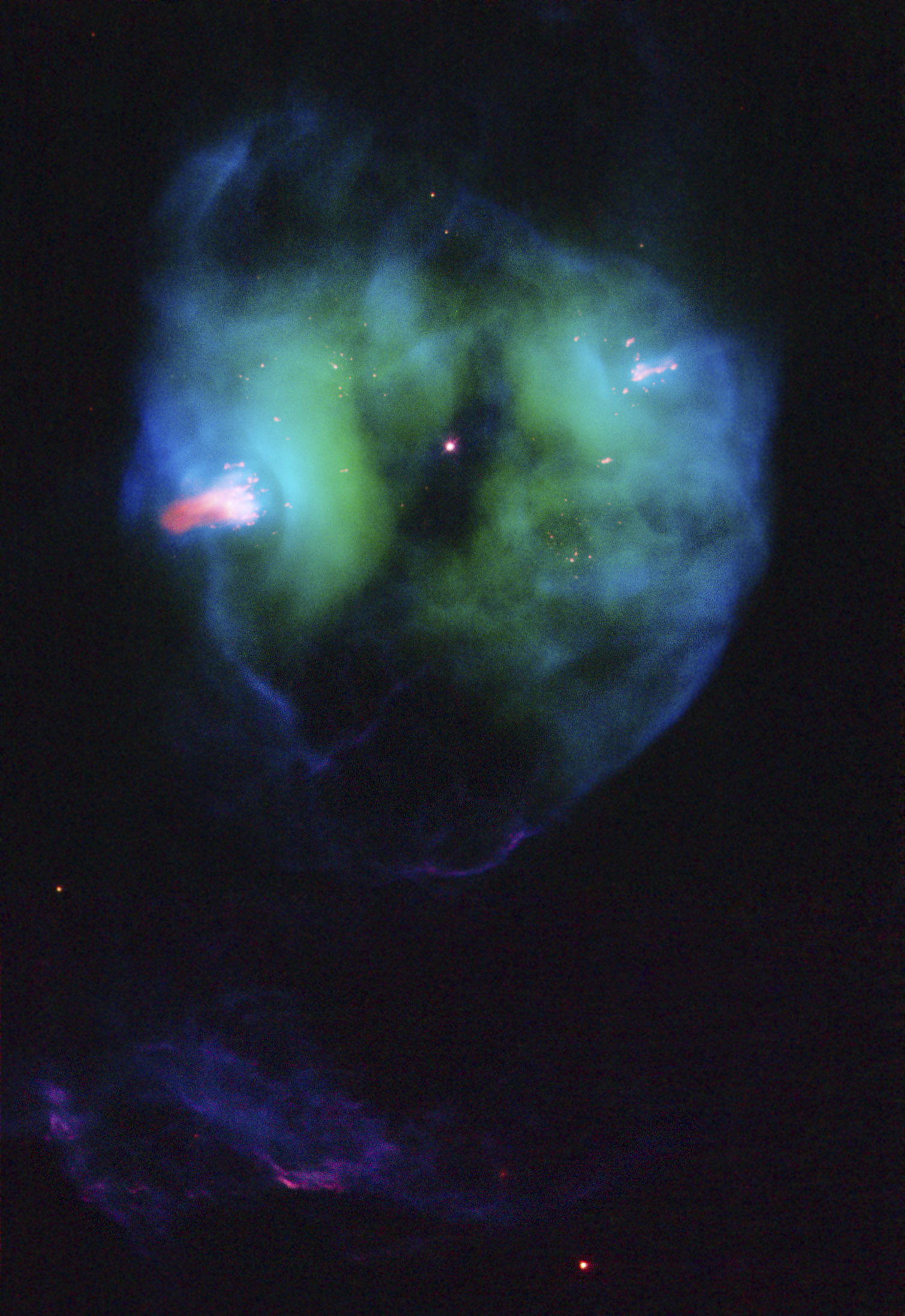
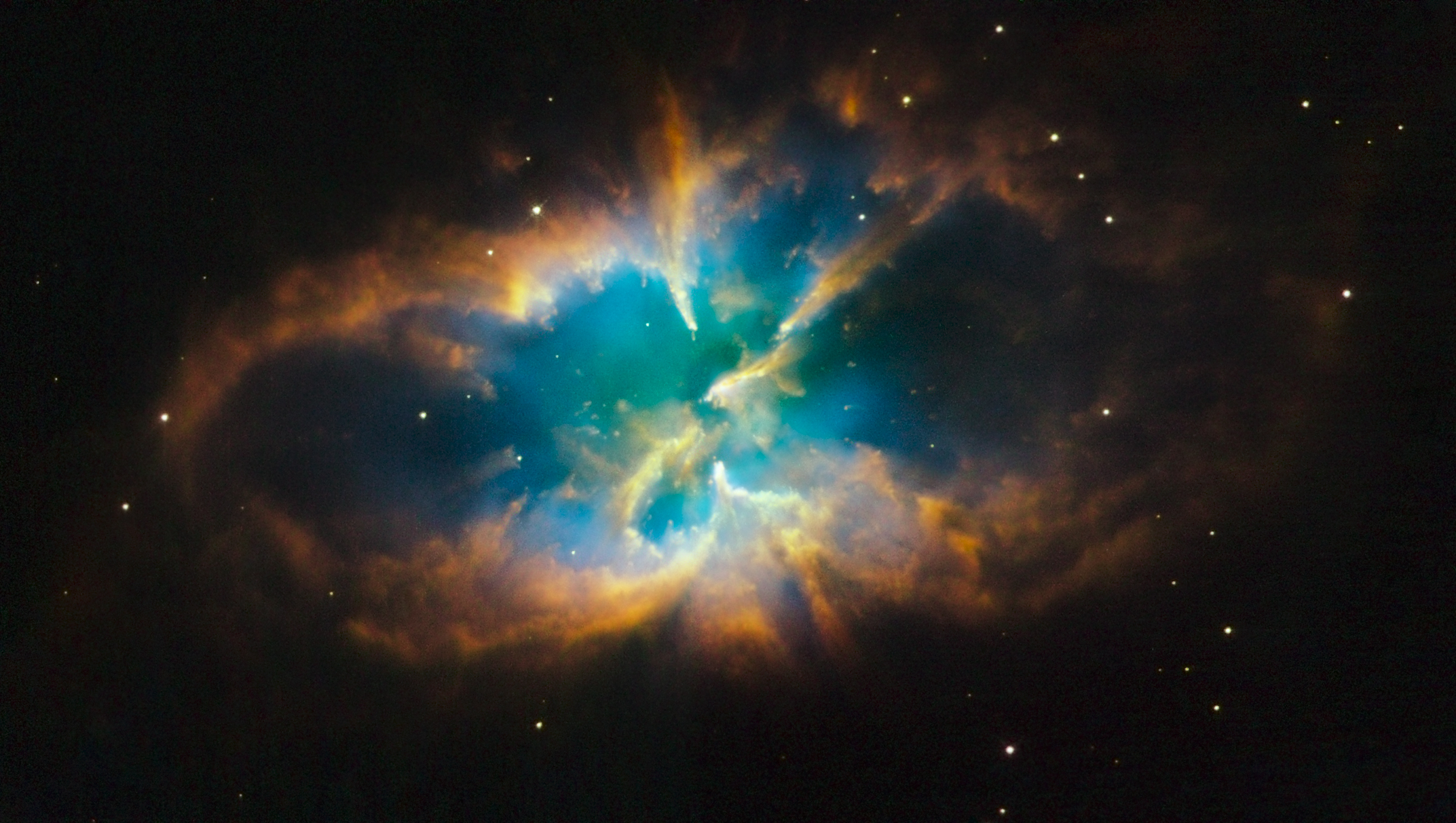
This spectacular cosmic butterfly showcases the planetary nebula NGC 2818, a luminous monument to stellar mortality located within an open star cluster of the same name. The nebula's stunning structure represents the outer layers of a Sun-like star that were expelled into space as the star exhausted its nuclear fuel and could no longer sustain itself against gravitational collapse. The delicate shells and streamers of gas visible here were once part of the star's atmosphere, now illuminated from within by the intensely hot stellar core — a nascent white dwarf with temperatures exceeding 100,000 degrees Kelvin. The vivid colors trace different chemical elements and ionization states: red regions are dominated by nitrogen emission, while blue and green areas reveal oxygen and hydrogen. Our own Sun will undergo a similar transformation approximately 5 billion years hence, shedding its outer layers to create a planetary nebula before fading into white dwarf senescence.
Scientific Significance
NGC 2818 is scientifically notable for its apparent association with an open star cluster of the same name, making it one of only a handful of planetary nebulae potentially linked to cluster environments. If the planetary nebula truly belongs to the cluster (rather than being a chance alignment), it provides a unique opportunity to constrain the progenitor star's mass and age based on the cluster's properties. Open clusters are collections of stars that formed together and thus share the same age and chemical composition — knowing when the cluster formed tells us how long the planetary nebula's progenitor star lived before expelling its outer layers. The nebula's complex bipolar structure, with multiple shells and knots, reveals the intricate mass-loss history during the star's final evolutionary stages. Spectroscopic studies have measured the expansion velocity of different nebular components, allowing reconstruction of the ejection chronology. The chemical abundances determined from nebular spectroscopy constrain the nucleosynthesis and dredge-up processes that occurred in the progenitor star's interior.
Observation Details
Hubble observed NGC 2818 using the Wide Field Planetary Camera 2 (WFPC2) with narrowband filters isolating emission from ionized hydrogen (H-alpha), ionized nitrogen ([NII]), doubly ionized oxygen ([OIII]), and neutral oxygen. The combination of these filters reveals the ionization and temperature structure of the nebula, with different colors tracing regions of different excitation conditions. The [OIII] emission (rendered in blue-green) dominates in the inner, hotter regions closest to the central star, while [NII] emission (rendered in red) is stronger in the cooler outer zones. The surrounding star cluster is visible as the scattered point sources surrounding the nebula.
Location in the Universe
Constellation
Pyxis
Distance from Earth
10,400 light-years
Fun Facts
- 1
NGC 2818 is unusual because it appears to be embedded within an open star cluster, suggesting the cluster is old enough for its most massive stars to have already evolved into planetary nebulae.
- 2
The nebula spans about 4 light-years across — roughly the distance from the Sun to its nearest stellar neighbor, Alpha Centauri.
- 3
Planetary nebulae like NGC 2818 are relatively short-lived cosmic phenomena, lasting only 10,000-20,000 years before they fade and disperse into the interstellar medium.
Image credit: NASA, ESA, Hubble Space Telescope