About This Image
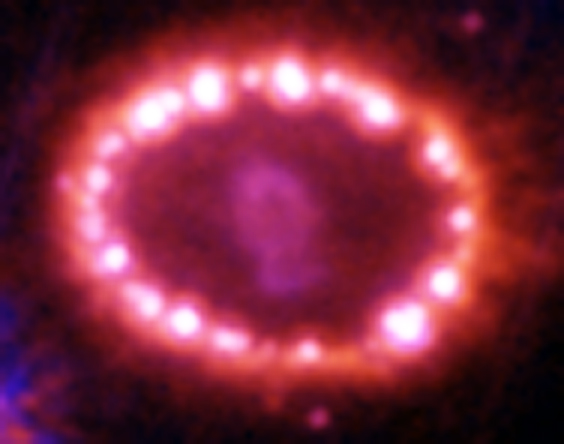
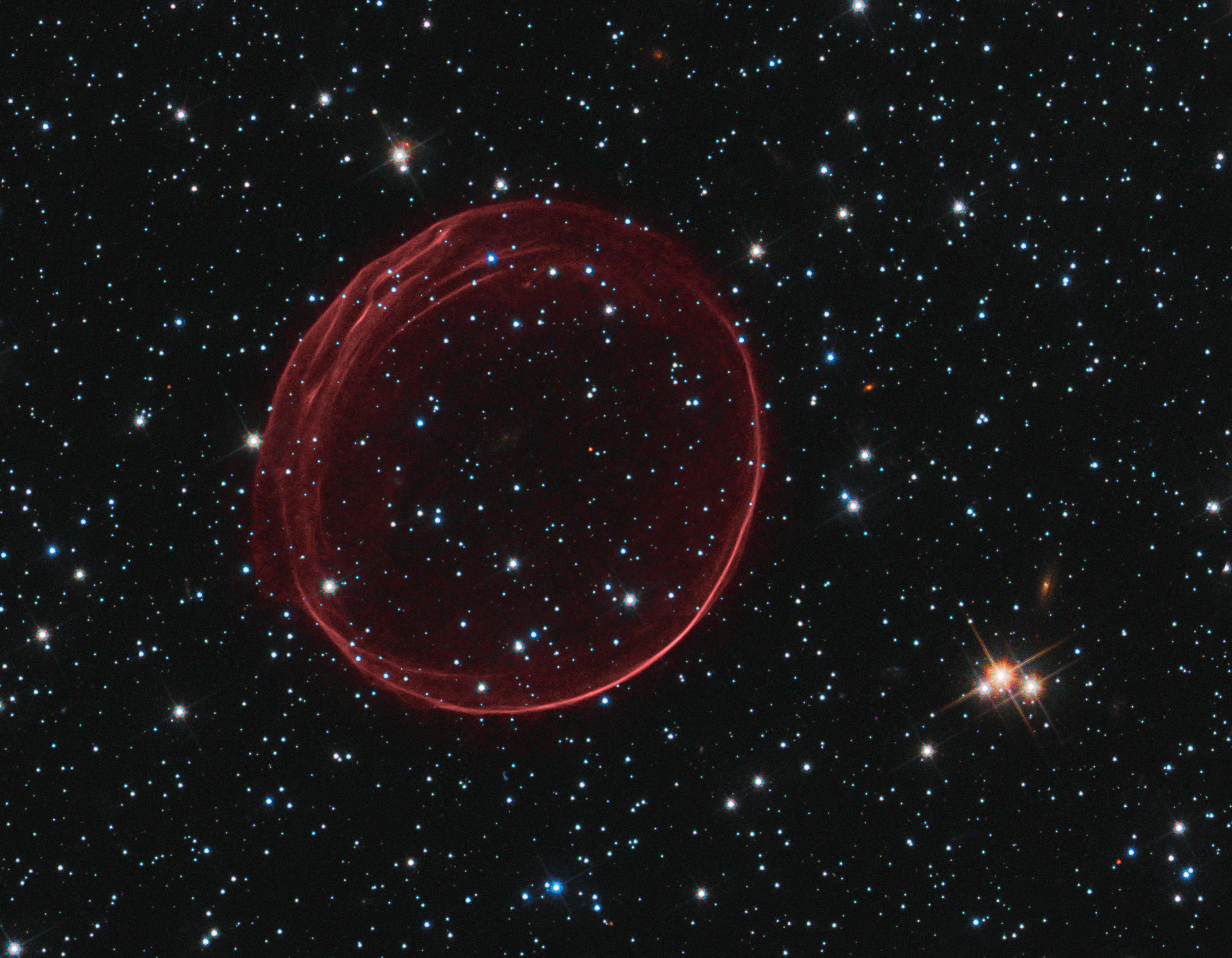
This ethereal red bubble of shocked gas marks the remains of a catastrophic stellar explosion that occurred approximately 400 years ago in the Large Magellanic Cloud, a satellite galaxy of our Milky Way. The supernova remnant SNR 0509-67.5 is the expanding debris shell from a Type Ia supernova — the thermonuclear detonation of a white dwarf star that exceeded its maximum stable mass. Now spanning 23 light-years in diameter, this delicate-looking sphere of gas is racing outward at more than 11 million miles per hour, sweeping up and heating the surrounding interstellar medium as it expands. The remarkable spherical symmetry of this remnant provides important clues about the explosion mechanism and the environment into which it is expanding. Despite extensive searches, no surviving companion star has been found at the center of this remnant, constraining theories about what drove the white dwarf to explode.
Scientific Significance
SNR 0509-67.5 is one of the most important supernova remnants for understanding Type Ia supernova explosions — the 'standard candles' used to measure cosmic distances and discover the accelerating expansion of the universe. The exceptional spherical symmetry of this remnant indicates the explosion was remarkably uniform, supporting models where the white dwarf detonated symmetrically rather than exploding asymmetrically from an ignition point. Deep searches for a surviving companion star at the remnant's center have found nothing, challenging the traditional 'single-degenerate' scenario where a white dwarf accretes matter from a normal star companion. This non-detection supports alternative 'double-degenerate' models where two white dwarfs merge and explode. The remnant's location in the Large Magellanic Cloud, at a well-determined distance, allows precise measurements of its expansion velocity and physical size, providing constraints on the explosion energy and the density of the surrounding medium. X-ray observations reveal the chemical composition of the ejected material, testing nucleosynthesis predictions for Type Ia supernovae.
Observation Details
This composite image combines visible-light observations from Hubble's Advanced Camera for Surveys (ACS) with X-ray data from NASA's Chandra X-ray Observatory. The red coloring represents hydrogen emission captured through a narrowband H-alpha filter, tracing the thin shell of shocked interstellar gas swept up by the supernova blast wave. The underlying stellar field shows stars in the Large Magellanic Cloud surrounding the remnant. Hubble's high angular resolution was essential for resolving the thin shell structure and searching for any potential surviving companion star at the remnant's center. The combination with Chandra data revealed the distribution of hot gas and heavy elements synthesized in the explosion.
Location in the Universe
Constellation
Dorado (Large Magellanic Cloud)
Distance from Earth
160,000 light-years
Fun Facts
- 1
SNR 0509-67.5 is expanding so fast that if you could watch it in real-time, the edge would move about 5,000 miles every second — fast enough to travel from Earth to the Moon in under a minute.
- 2
The light from this supernova explosion would have reached Earth around 1600 AD, but no historical records document its appearance — likely because it was only visible from the Southern Hemisphere.
- 3
Despite the violent explosion that created it, no stellar remnant (neutron star or black hole) exists at the center because Type Ia supernovae completely destroy the exploding white dwarf.
Image credit: NASA, ESA, Hubble Space Telescope