About This Image
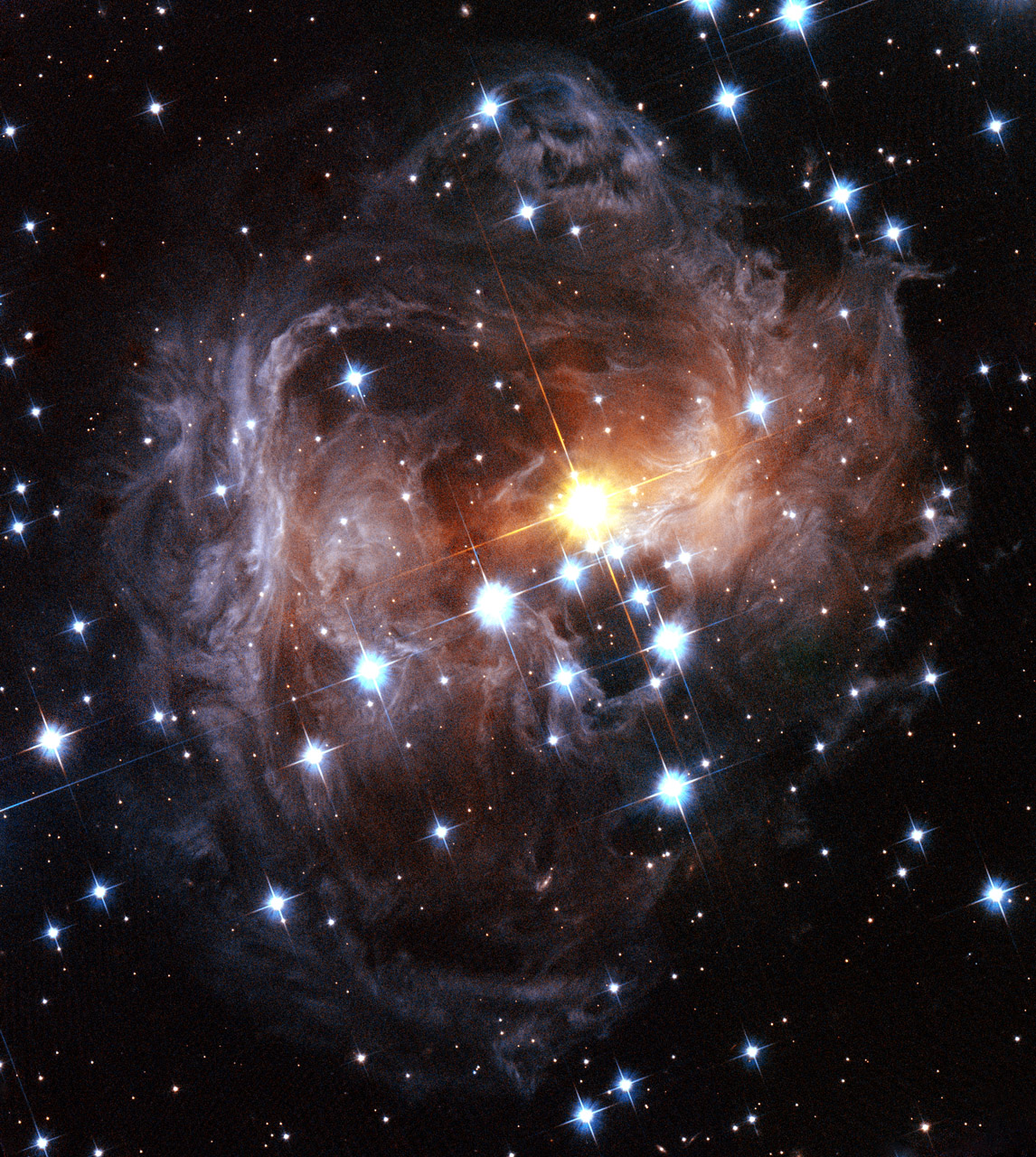
This breathtaking image captures one of the most unusual astronomical phenomena ever observed: a light echo from the enigmatic star V838 Monocerotis. In early 2002, this previously unremarkable star suddenly brightened by a factor of 10,000, temporarily becoming one of the most luminous stars in our entire galaxy before fading back to obscurity. But the light from that brilliant outburst did not simply vanish — it propagated outward at the speed of light through a vast surrounding cloud of dust, illuminating successive layers like a flashlight beam sweeping through fog. As the light echo expands, it reveals the intricate three-dimensional structure of the dust shells surrounding the star, creating the illusion of material rushing outward at impossible speeds. In reality, nothing physical is moving; we are simply seeing different parts of a pre-existing dust cloud lit up in sequence.
Scientific Significance
V838 Monocerotis represents an entirely new class of stellar eruption that does not fit into any previously known category. Unlike classical novae (thermonuclear explosions on white dwarfs) or supernovae (core collapse or thermonuclear destruction of entire stars), V838 Mon's outburst left the star intact but dramatically cooler and larger than before. The leading hypothesis is that V838 Mon underwent a stellar merger, engulfing one or more companion objects — possibly planets or brown dwarfs — whose orbital energy was released as the observed outburst. The spectacular light echo provides a unique tool for studying the three-dimensional distribution of dust around the star, revealing concentric shells that suggest previous mass-loss episodes. By monitoring how the echo evolves over years, astronomers have reconstructed the geometry of the surrounding nebula and constrained the distance to the star. V838 Mon challenges stellar evolution theory by demonstrating that stars can undergo dramatic, rapid transformations outside the standard evolutionary sequences.
Observation Details
Hubble observed V838 Monocerotis repeatedly using the Advanced Camera for Surveys (ACS) over several years, creating a remarkable time-lapse sequence of the expanding light echo. The observations employed broadband filters spanning visible wavelengths to capture the full color and morphology of the illuminated dust. Each new observation revealed previously dark regions of the surrounding nebula as the light echo expanded at an apparent rate of about 4 light-months per year. The echo's color variations trace differences in dust grain properties and scattering angles at different locations within the nebula. These observations provided unprecedented views of interstellar dust structure on scales impossible to resolve through direct imaging.
Location in the Universe
Constellation
Monoceros
Distance from Earth
20,000 light-years
Fun Facts
- 1
The light echo appears to expand faster than the speed of light — but this is an optical illusion caused by geometry, not actual superluminal motion.
- 2
The cause of V838 Monocerotis's eruption remains mysterious — proposed explanations include a stellar merger, swallowing of giant planets, or a peculiar nova-like event.
- 3
At its peak brightness, V838 Monocerotis was briefly one of the most luminous stars in the Milky Way, outshining even supergiant stars like Betelgeuse.
Image credit: NASA, ESA, Hubble Space Telescope