About This Image
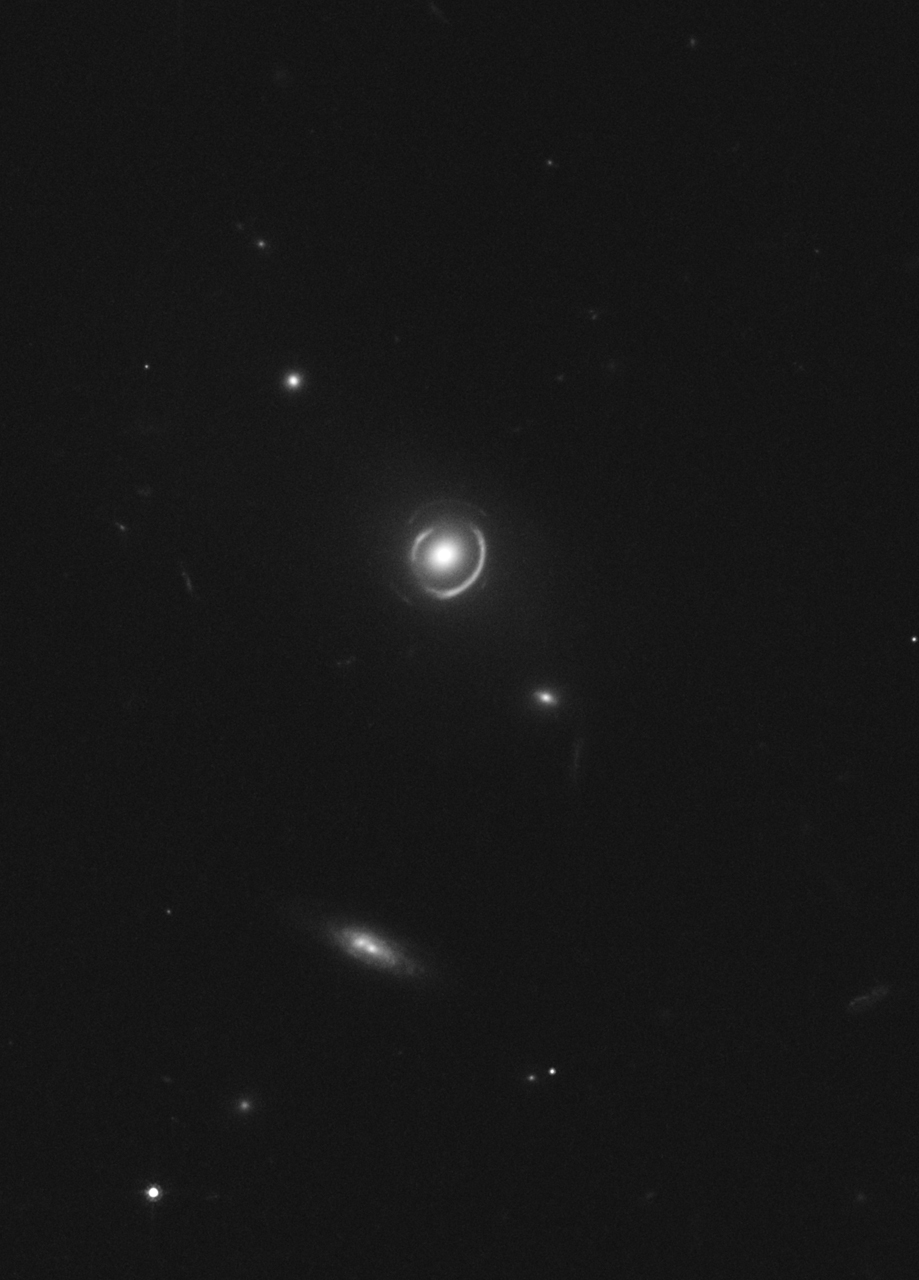
This spectacular Einstein ring forms when two galaxies align almost perfectly along our line of sight, causing the massive foreground galaxy to bend and distort the light from the more distant background galaxy into a nearly perfect ring. Named after Albert Einstein, who predicted this gravitational lensing phenomenon as a consequence of his general theory of relativity, such rings are among the most visually striking confirmations of Einstein's revolutionary ideas about the nature of space and time. The foreground galaxy in SDSS J0946+1006 acts as a cosmic magnifying glass, warping spacetime so severely that the background galaxy's light is bent completely around it, creating the luminous arc we see. What makes this particular system extraordinary is that it contains not one but two Einstein rings — a rare double ring created by two background galaxies at different distances, both lensed by the same foreground galaxy.
Scientific Significance
Einstein rings like SDSS J0946+1006 are among the most powerful tools astronomers have for studying dark matter and testing general relativity on cosmic scales. The geometry of the ring directly traces the total mass distribution of the lensing galaxy, including both the visible stars and the invisible dark matter halo that dominates the mass. Unlike other methods that only measure mass within certain radii, gravitational lensing provides mass measurements at the precise distance where the ring forms. The discovery of a double Einstein ring in this system was particularly valuable because it provided two independent constraints on the lens galaxy's mass profile at different radii. Comparing the dark matter distributions inferred from lensing with predictions from cosmological simulations tests our understanding of how dark matter halos form and evolve around galaxies. Einstein rings also magnify the background source galaxies, enabling detailed studies of distant galaxies that would otherwise be too faint to observe.
Observation Details
Hubble observed SDSS J0946+1006 using the Advanced Camera for Surveys (ACS) in multiple optical filters to capture both the foreground lens galaxy and the lensed background rings. The high angular resolution of Hubble was essential for separating the two concentric Einstein rings, which have angular diameters of only a few arcseconds. The inner ring arises from a background galaxy at redshift z=0.609, while the outer ring comes from a more distant galaxy at z=2.035. Spectroscopic observations from ground-based telescopes confirmed the redshifts and provided velocity dispersion measurements that complemented the lensing mass estimates. Detailed modeling of the ring shapes constrained the ellipticity and radial profile of the lens galaxy's dark matter halo.
Location in the Universe
Constellation
Leo
Distance from Earth
3 billion light-years (lens galaxy)
Fun Facts
- 1
SDSS J0946+1006 is one of only a handful of known 'double Einstein rings' — systems where a single foreground galaxy creates two concentric rings from two different background galaxies.
- 2
The precise alignment required to create a perfect Einstein ring is so unlikely that fewer than 100 such systems are known among the billions of galaxies in the observable universe.
- 3
By measuring the size and brightness of Einstein rings, astronomers can 'weigh' the lensing galaxy, including its invisible dark matter — often finding dark matter masses 10 times greater than the visible stars.
Image credit: NASA, ESA, Hubble Space Telescope