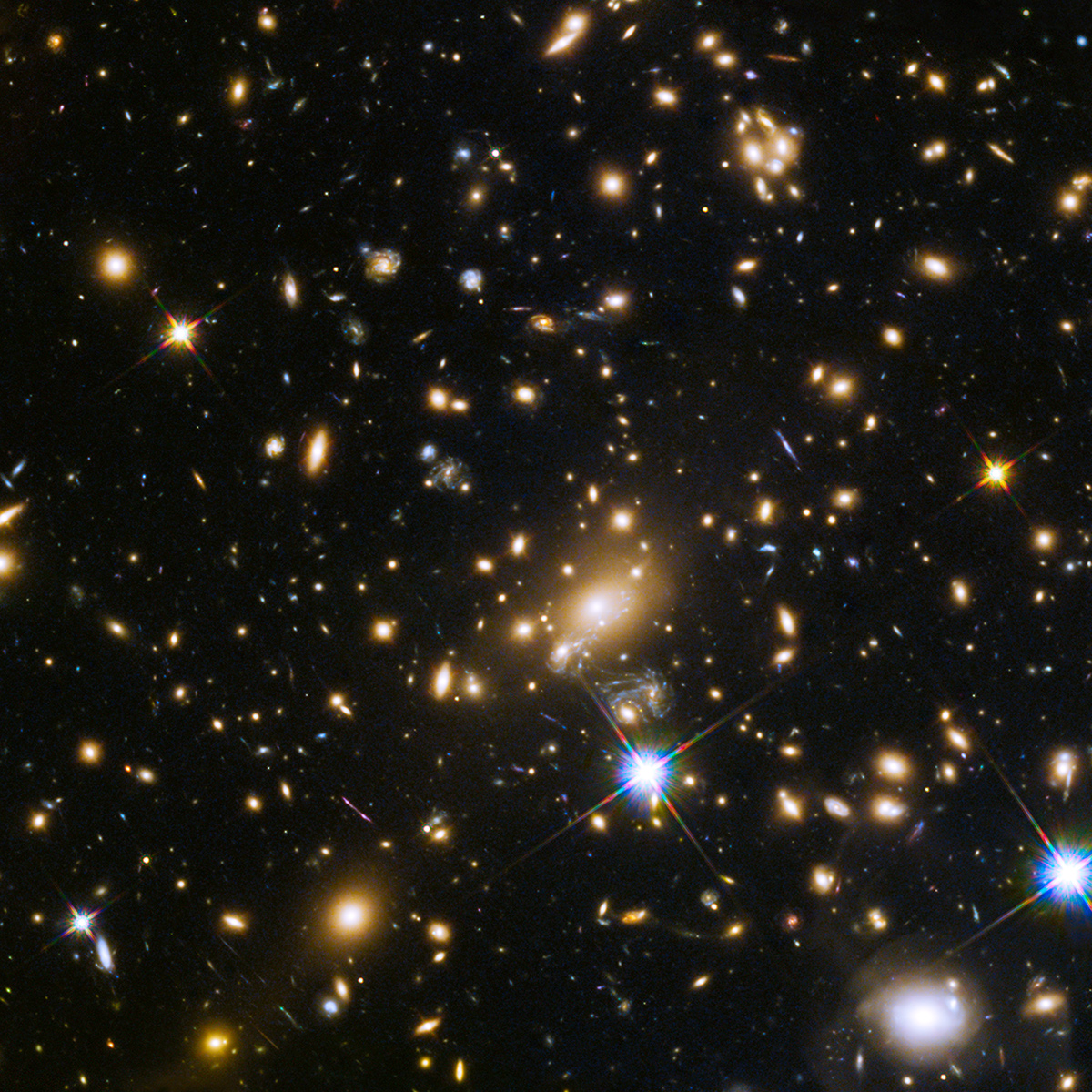
About This Image
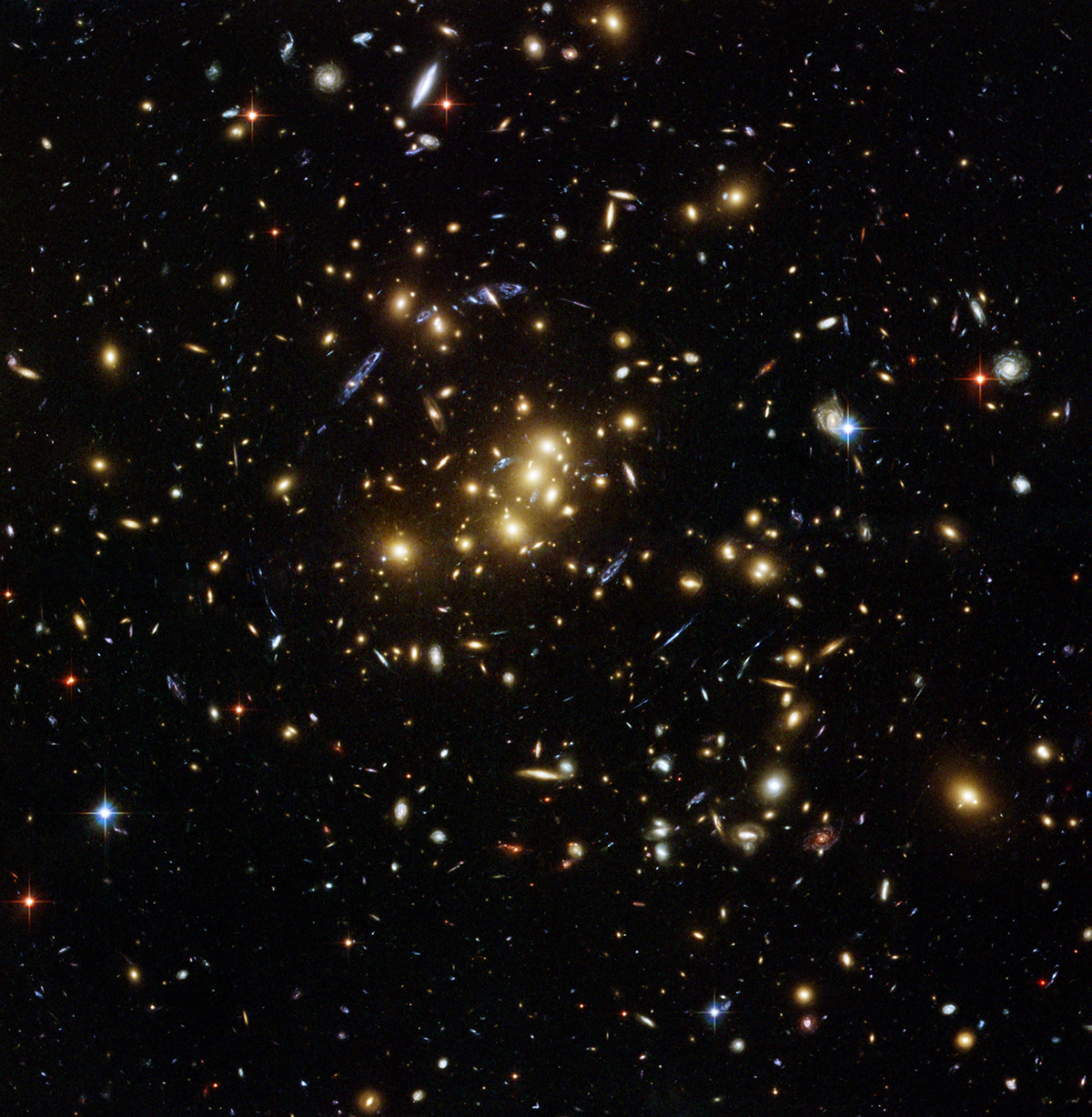
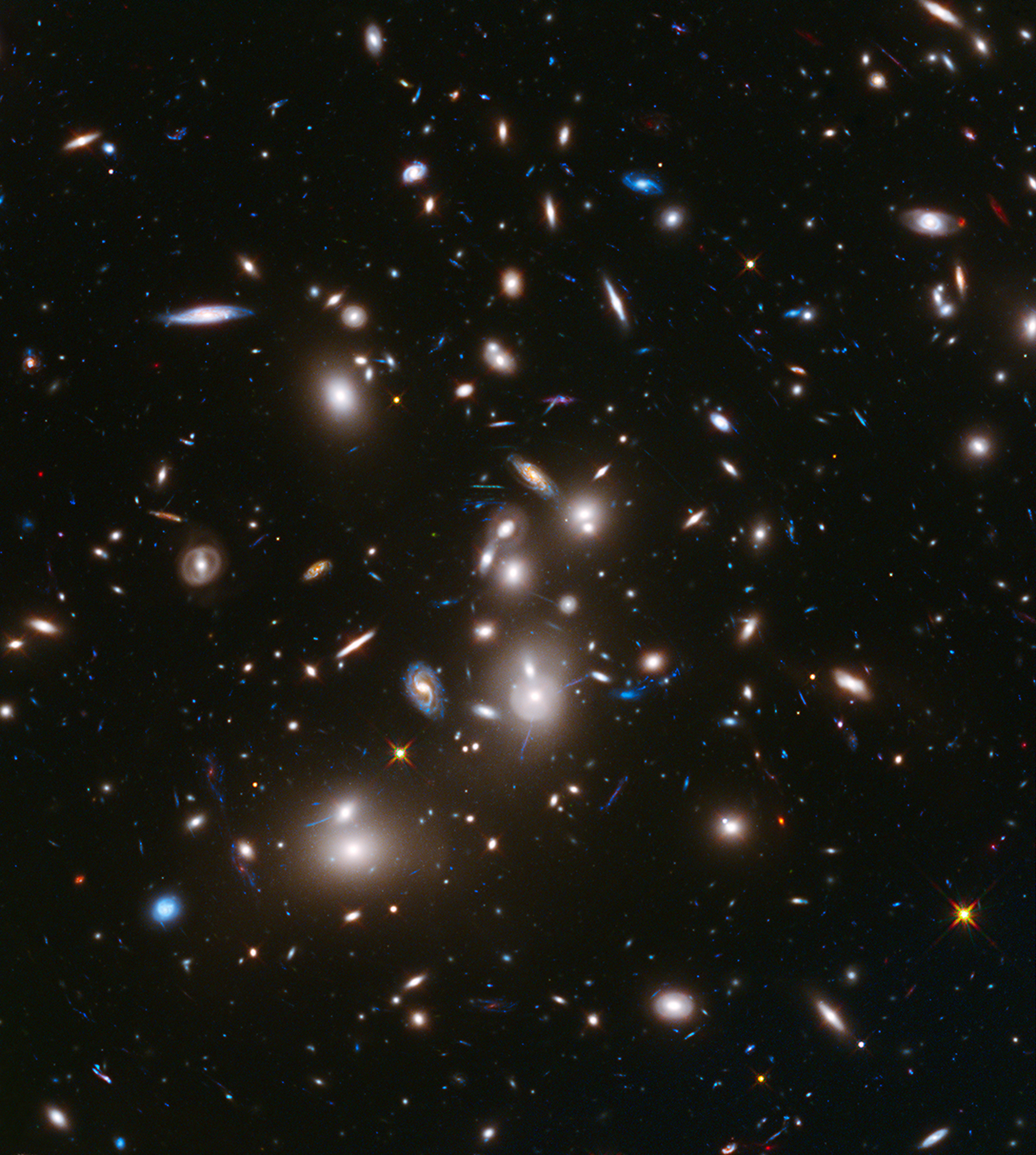
This spectacular image captures one of the most extraordinary gravitational lensing events ever observed: a distant supernova whose light has been split into four separate images by the warped spacetime around a massive galaxy cluster. MACS J1149.6+2223, located approximately 5 billion light-years away, is one of the most massive galaxy clusters known, containing thousands of galaxies bound together by gravity. The cluster's enormous mass — dominated by invisible dark matter — bends and distorts the fabric of spacetime so severely that light from objects behind it follows multiple curved paths around the cluster. In this case, light from a supernova explosion in a galaxy 9.3 billion light-years away was split into four distinct images arranged around an elliptical galaxy in the cluster, creating a pattern astronomers call an 'Einstein Cross.' This rare alignment allowed astronomers to observe the same supernova at four different times due to the varying light travel paths.
Scientific Significance
The gravitationally lensed supernova in MACS J1149.6+2223, nicknamed 'Supernova Refsdal,' represents a landmark achievement in observational cosmology. The time delays between the multiple images — caused by differences in path length through the cluster's gravitational field — provide an independent method for measuring the Hubble constant, the rate at which the universe is expanding. This measurement is particularly valuable because it uses completely different physics than other methods, helping to resolve tensions between different cosmological measurements. The successful prediction of the fifth supernova image's appearance date and location was a spectacular confirmation of general relativity and gravitational lensing theory. MACS J1149 also serves as a powerful cosmic telescope, magnifying distant background galaxies and enabling detailed studies of star formation and galaxy structure when the universe was less than one-third its current age. The cluster itself provides insights into the formation of the largest gravitationally bound structures in the universe.
Observation Details
Hubble observed MACS J1149.6+2223 repeatedly over several years using the Wide Field Camera 3 (WFC3) and the Advanced Camera for Surveys (ACS) in visible and near-infrared filters. The observations tracked the appearance and evolution of all five supernova images as they brightened and faded. Time-series photometry measured the light curves of each image, while spectroscopy confirmed the supernova type and redshift. The combination of high angular resolution and multi-epoch monitoring was essential for separating the multiply-imaged supernova from the complex background of lensed galaxies and cluster members. Gravitational lens models of the cluster were continuously refined using the supernova observations as constraints.
Location in the Universe
Constellation
Leo
Distance from Earth
5 billion light-years
Fun Facts
- 1
The four supernova images appeared at different times over a span of years because light followed different path lengths around the lensing galaxy — the longest path took roughly 5 years longer than the shortest.
- 2
This 'supernova Refsdal' was named after Norwegian astronomer Sjur Refsdal, who predicted in 1964 that gravitationally lensed supernovae could be used to measure the expansion rate of the universe.
- 3
Astronomers predicted when and where a fifth image of the supernova would appear, and it emerged exactly as calculated about a year after the initial discovery — a triumphant test of general relativity.
Image credit: NASA, ESA, Hubble Space Telescope