About This Image
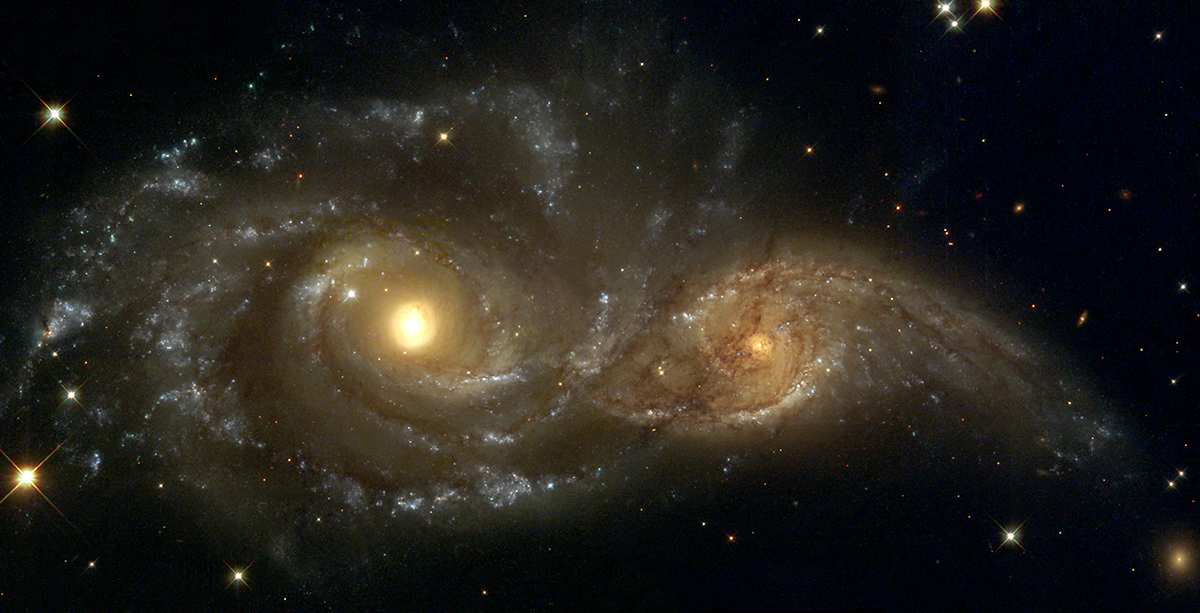
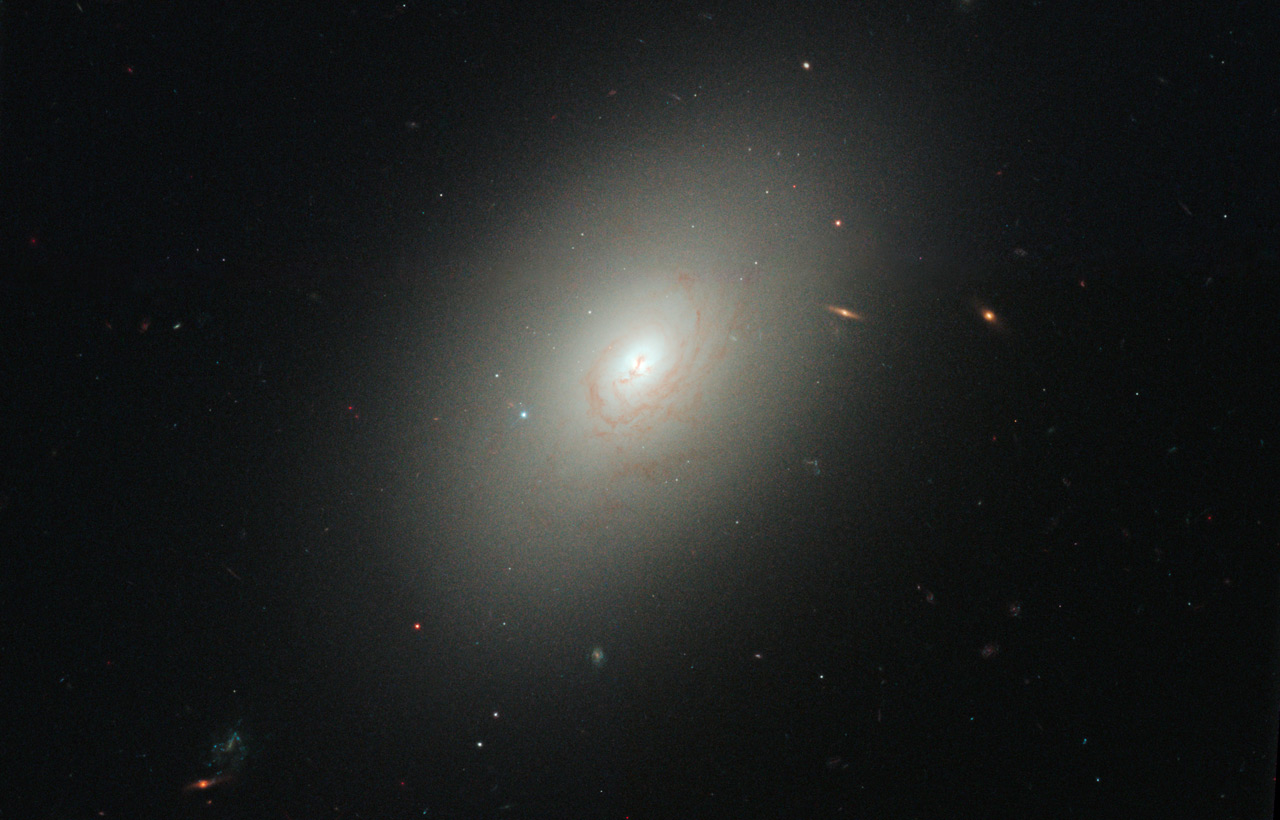
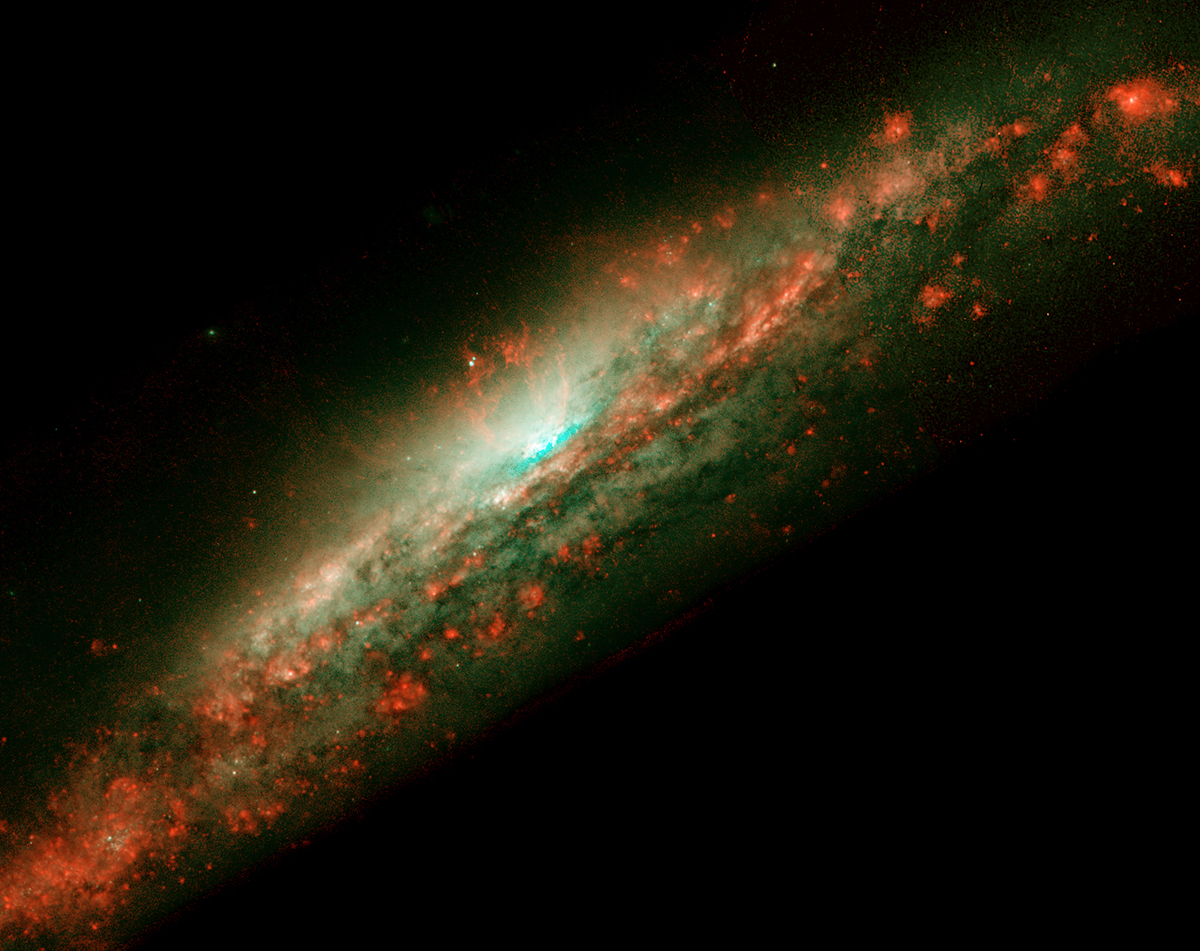
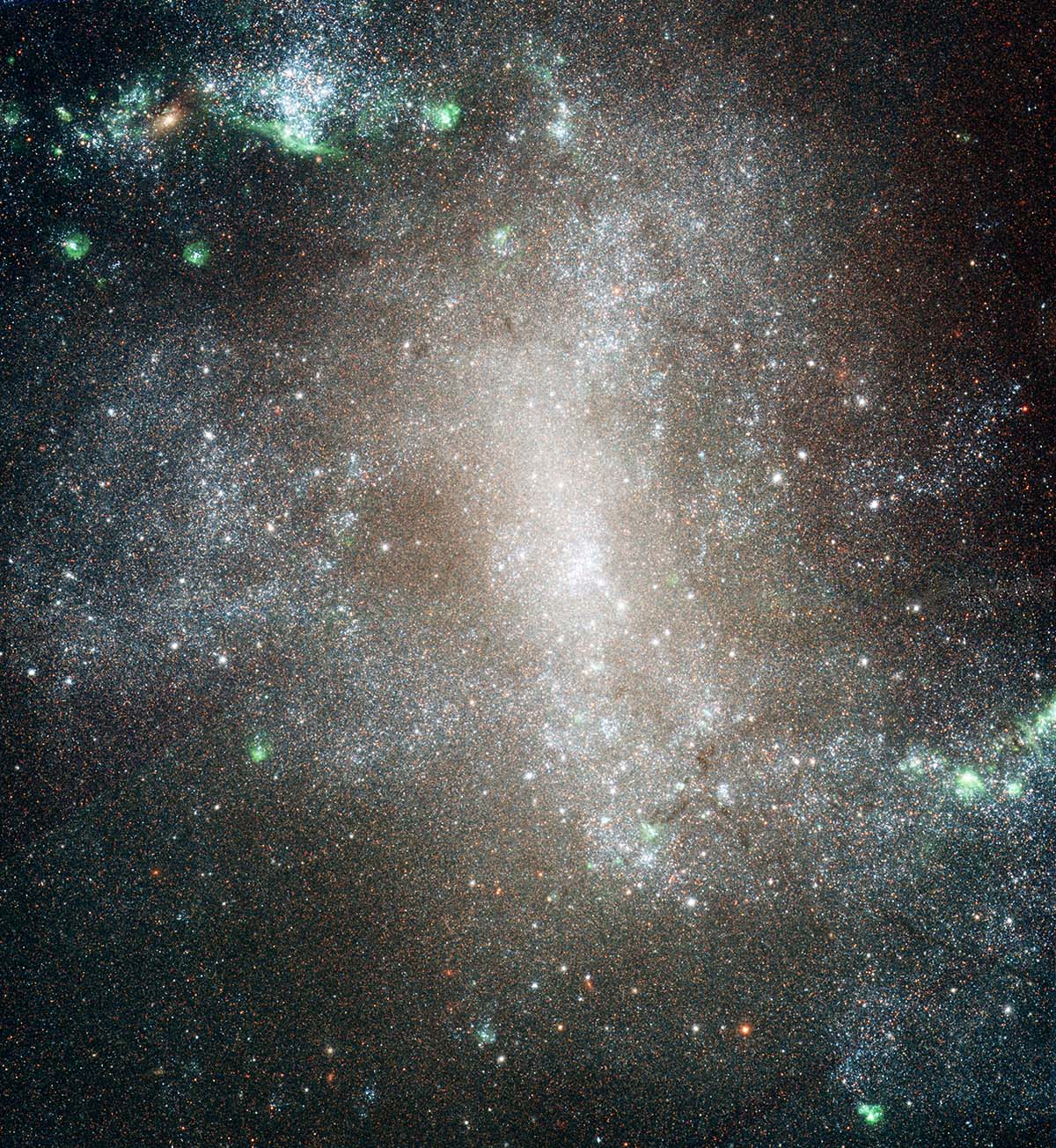
This vibrant image captures the turbulent central region of NGC 1313, a barred spiral galaxy undergoing violent bursts of star formation approximately 14 million light-years away in the southern constellation Reticulum. Unlike the orderly spiral patterns seen in many galaxies, NGC 1313 presents a chaotic, disrupted appearance, with irregular patches of star formation scattered across its disk rather than confined to well-defined spiral arms. The brilliant blue knots throughout the image are massive stellar nurseries containing thousands of hot, young stars born within the last few million years. This galaxy's active star formation is so intense that it qualifies as a starburst galaxy — a cosmic factory producing new stars at a rate many times higher than our relatively sedate Milky Way. The disturbed morphology and intense activity suggest NGC 1313 may have experienced a recent interaction or merger with a smaller companion galaxy.
Scientific Significance
NGC 1313 is one of the nearest and most actively star-forming galaxies outside our immediate Local Group, making it an exceptional laboratory for studying starburst physics and extreme stellar populations. The galaxy hosts multiple ultraluminous X-ray sources (ULXs) — compact objects accreting material at rates that appear to exceed the theoretical Eddington limit for normal stellar-mass black holes. These ULXs may represent either intermediate-mass black holes (with masses between stellar black holes and supermassive black holes) or stellar-mass black holes with unusual beamed emission. Understanding ULXs is crucial for tracing the formation pathways of supermassive black holes in the early universe. The disturbed morphology of NGC 1313, lacking coherent spiral arms despite being classified as a barred spiral, challenges our understanding of how galactic structure responds to internal perturbations or external interactions. Studies of the galaxy's numerous giant HII regions and young stellar clusters provide benchmarks for interpreting observations of more distant starburst galaxies.
Observation Details
Hubble observed NGC 1313 using the Advanced Camera for Surveys (ACS) in broadband optical filters, resolving the galaxy into millions of individual stars and revealing the detailed structure of its star-forming regions. The observations were part of a program studying stellar populations and star cluster formation in nearby galaxies. Hubble's resolution was essential for separating individual massive stars and compact star clusters in the crowded starburst regions. Complementary X-ray observations from the Chandra telescope identified the locations of ULXs, which were then cross-referenced with Hubble optical data to search for optical counterparts and constrain the nature of these mysterious objects.
Location in the Universe
Constellation
Reticulum
Distance from Earth
14 million light-years
Fun Facts
- 1
NGC 1313 is sometimes called the 'Topsy-Turvy Galaxy' because of its chaotic, asymmetric structure that defies the orderly patterns typical of spiral galaxies.
- 2
This galaxy hosts at least two ultraluminous X-ray sources (ULXs) — mysterious objects that may be intermediate-mass black holes far more massive than typical stellar black holes.
- 3
Despite being quite close to us cosmically, NGC 1313 is difficult to observe from the Northern Hemisphere because it lies deep in the southern sky.
Image credit: NASA, ESA, Hubble Space Telescope