About This Image
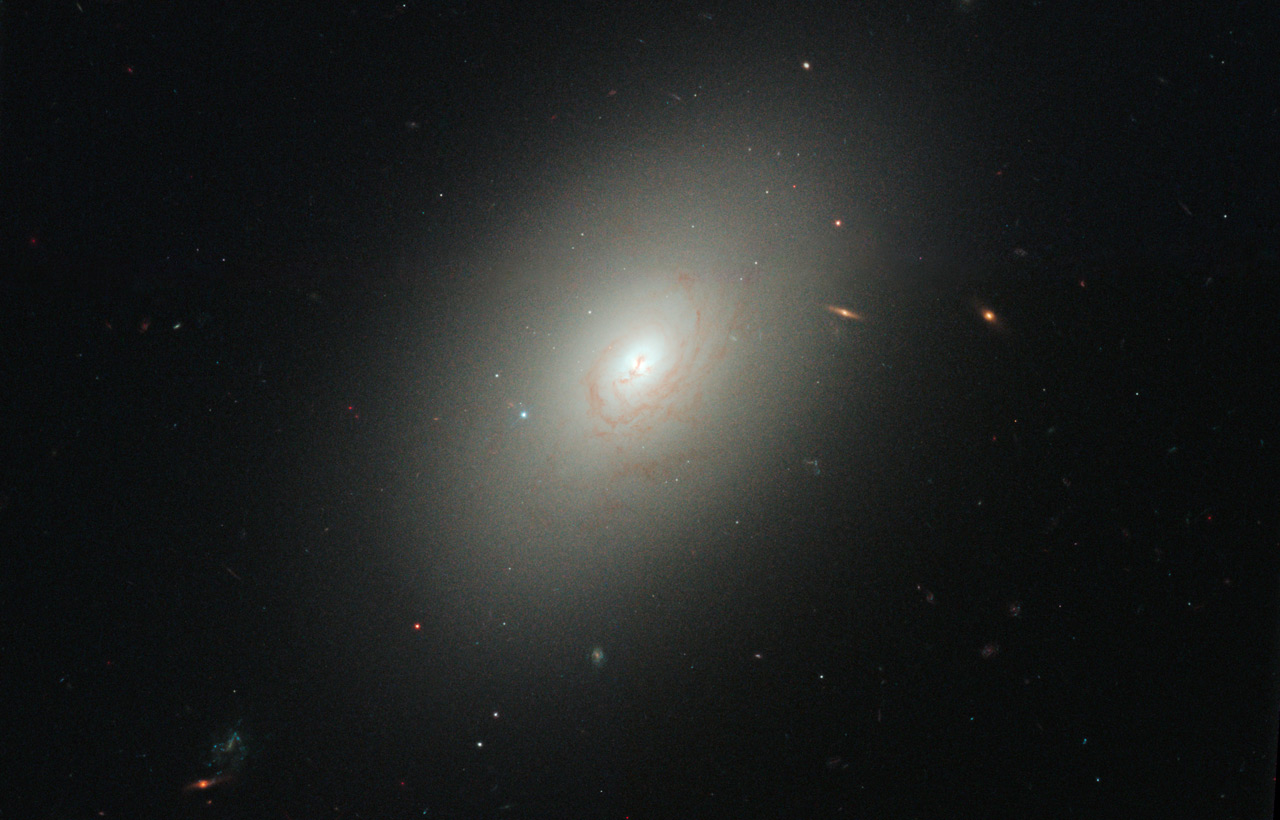
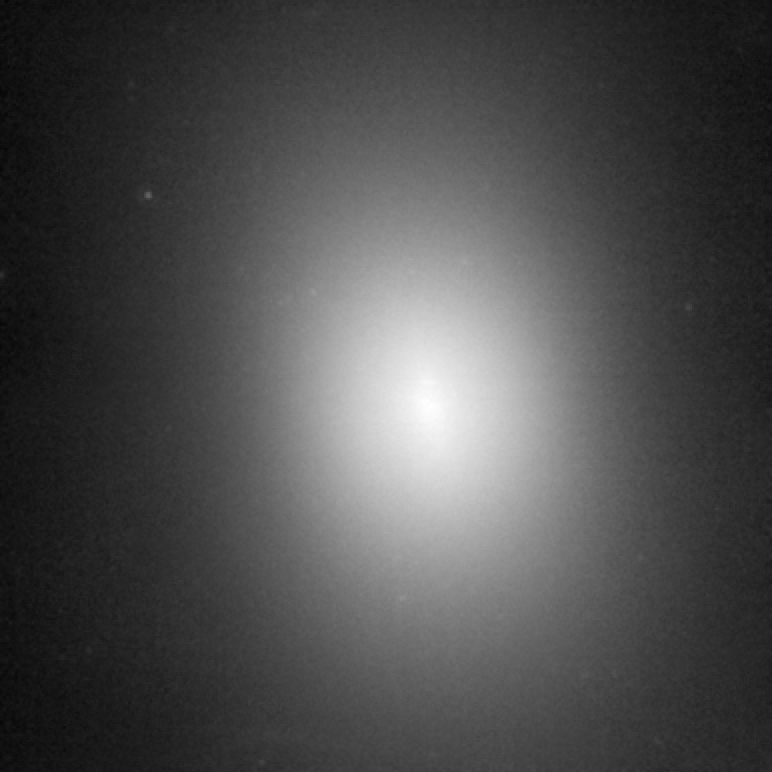
The massive elliptical galaxy NGC 1600 dominates its cosmic neighborhood from a distance of 209 million light-years, but its most remarkable feature lies hidden at its heart: one of the most massive black holes ever detected. Weighing in at approximately 17 billion times the mass of our Sun, this supermassive black hole is a true cosmic leviathan — 10 times more massive than what astronomers would predict based on the galaxy's size and stellar mass. This surprising discovery challenges our understanding of how black holes and galaxies co-evolve, suggesting that the most massive black holes may not always reside in the largest galaxies or the densest cosmic environments. NGC 1600's relatively isolated location in a sparse galaxy group makes its oversized black hole even more puzzling, as the mergers that typically build massive black holes are less frequent in such environments.
Scientific Significance
NGC 1600's central black hole fundamentally challenges the established correlations between black hole mass and host galaxy properties. For decades, astronomers have found tight relationships between black hole mass and galaxy bulge mass, bulge luminosity, and stellar velocity dispersion — relationships thought to reflect the co-evolution of black holes and galaxies through mergers and feedback processes. NGC 1600's black hole is a dramatic outlier, being roughly 10 times more massive than these correlations predict. The galaxy's location as the dominant member of a sparse galaxy group, rather than a rich cluster, makes this excess mass even more surprising. One proposed explanation is that NGC 1600 underwent numerous 'dry mergers' with other massive elliptical galaxies early in cosmic history, allowing the black holes to merge while adding relatively few new stars. This scenario suggests that the most massive black holes formed primarily through direct black hole mergers rather than gas accretion, with profound implications for gravitational wave astronomy.
Observation Details
Hubble observed NGC 1600 using the Wide Field Planetary Camera 2 (WFPC2) in optical wavelengths to map the stellar distribution and kinematics near the galactic center. The key observation was measuring how rapidly stars orbit the central black hole — the faster they move, the more massive the central object must be. Hubble's spatial resolution was essential for probing the gravitational 'sphere of influence' of the black hole, the region where stellar motions are dominated by the black hole rather than the galaxy's overall mass. Spectroscopic observations from ground-based telescopes measured the stellar velocity dispersion, which combined with Hubble imaging enabled the definitive black hole mass measurement.
Location in the Universe
Constellation
Eridanus
Distance from Earth
209 million light-years
Fun Facts
- 1
The black hole in NGC 1600 has a mass of 17 billion Suns, making it one of the largest black holes ever measured — yet it resides in a relatively modest cosmic backwater.
- 2
This black hole's event horizon — the boundary beyond which nothing can escape — is roughly 100 billion kilometers across, large enough to swallow our entire solar system multiple times.
- 3
The discovery of such an unexpectedly massive black hole in a relatively isolated galaxy suggests there may be many more giant black holes hiding in overlooked cosmic corners.
Image credit: NASA, ESA, Hubble Space Telescope