About This Image
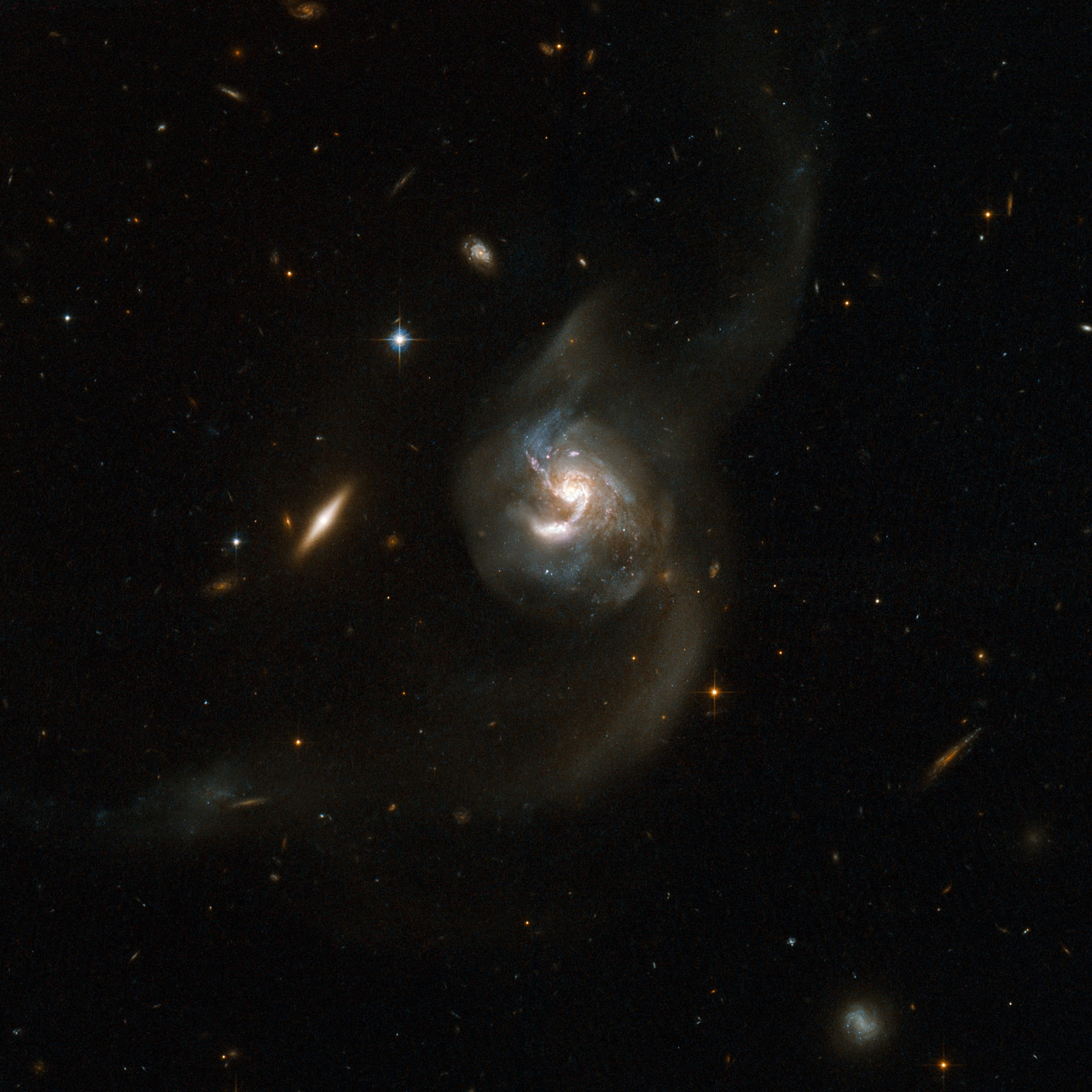
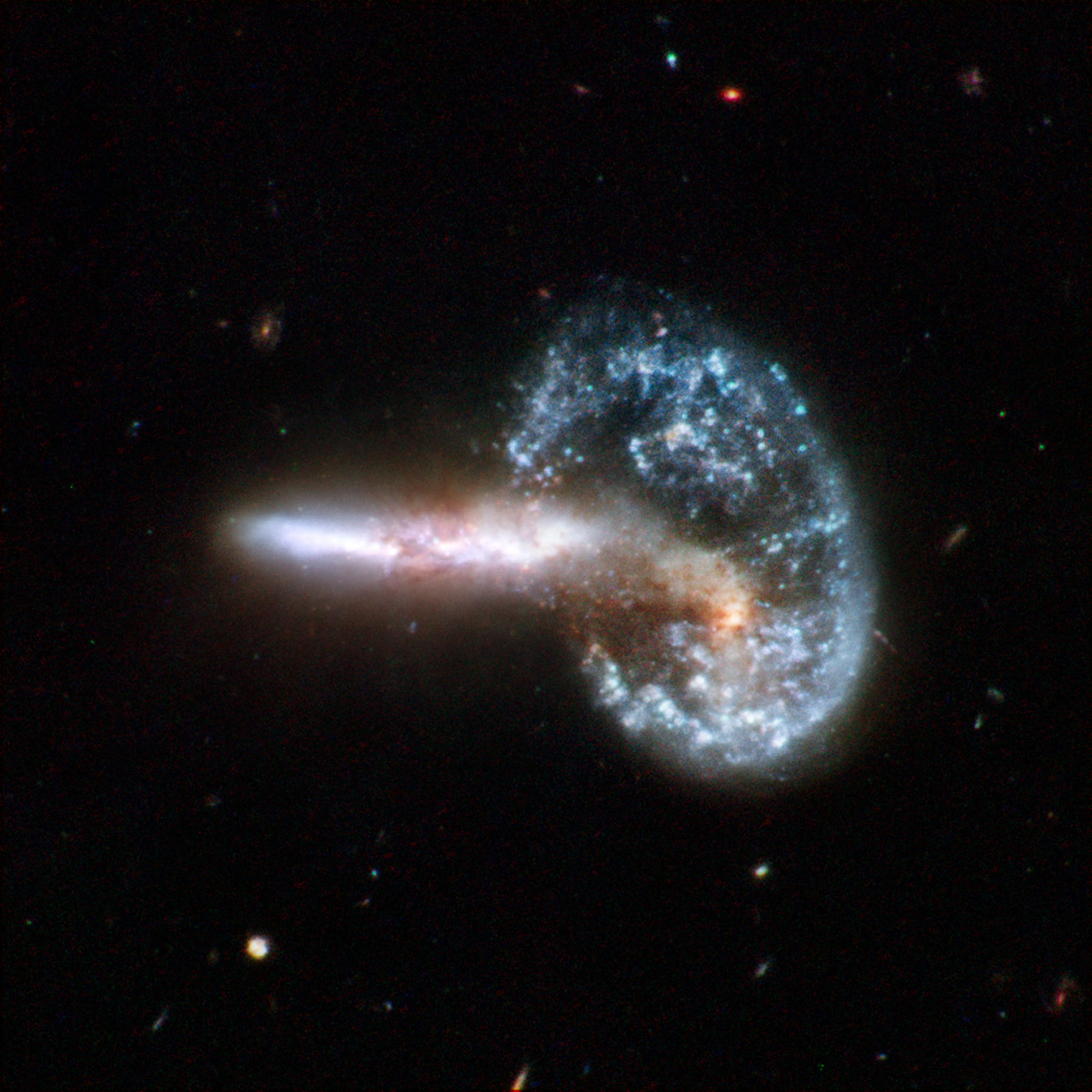
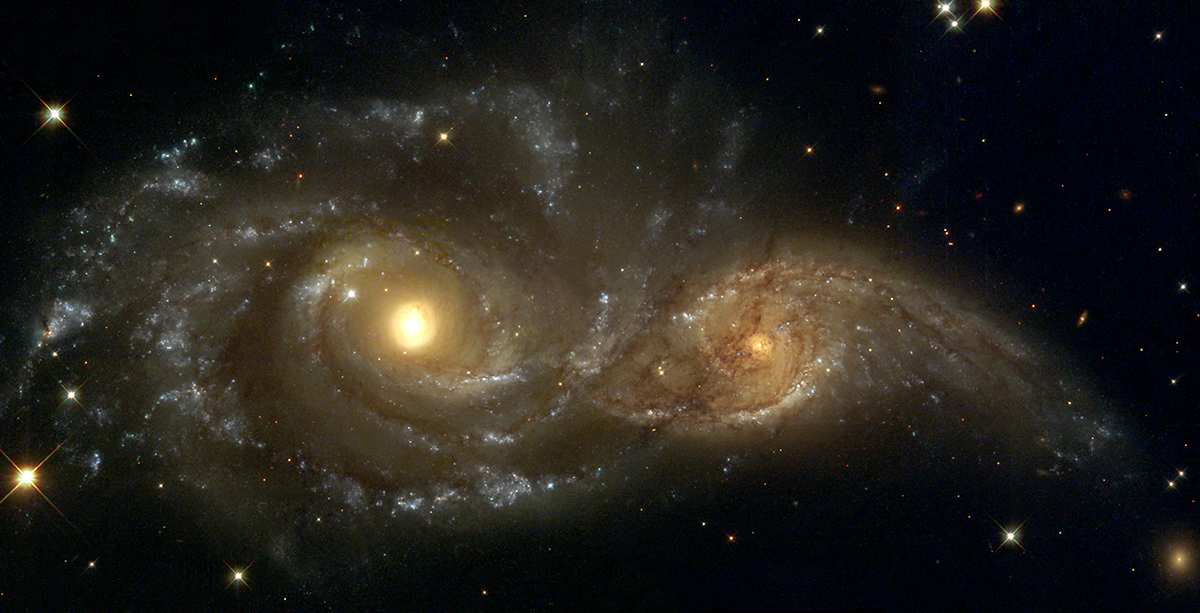
This dramatic cosmic dance captures two spiral galaxies locked in a gravitational embrace that will ultimately end in their merger. The larger and more massive NGC 2207 dominates the left side of the image, its superior gravitational pull distorting and stretching its smaller companion IC 2163 into an elongated, warped shape. The interaction has triggered intense bursts of star formation across both galaxies, evident in the brilliant blue clusters of hot young stars scattered throughout their spiral arms. Tidal forces have drawn out long streamers of gas and stars from IC 2163, while also sending density waves rippling through both galactic disks. This system provides astronomers with a remarkable preview of what may happen when our own Milky Way galaxy collides with the Andromeda galaxy in approximately 4.5 billion years.
Scientific Significance
The NGC 2207/IC 2163 system is one of the nearest and most spectacular examples of a galaxy interaction in its early stages, providing critical observational constraints on merger simulations. The asymmetric distortion of IC 2163 — with its extended tidal arm pointing away from NGC 2207 — beautifully matches predictions from N-body simulations of grazing encounters between disk galaxies. The exceptional supernova rate observed in this system demonstrates how gravitational interactions trigger starbursts by compressing gas and accelerating star formation. Studies of the stellar populations across both galaxies reveal that the most intense star formation occurs where the tidal compression is strongest, directly connecting dynamical perturbation to stellar birth. X-ray observations have detected numerous ultraluminous X-ray sources (ULXs) in this system — bright compact objects that may be intermediate-mass black holes or extreme stellar-mass black holes accreting material at high rates — adding another dimension to our understanding of energetic phenomena in interacting galaxies.
Observation Details
Hubble observed this interacting galaxy pair using the Wide Field Planetary Camera 2 (WFPC2) in multiple broadband filters spanning blue through near-infrared wavelengths. The multi-color imaging revealed the distribution of young blue star clusters concentrated along the compressed spiral arms and tidal features, while also mapping the older stellar populations and dust lanes threading through both galaxies. The high angular resolution of WFPC2 was essential for resolving individual star-forming complexes and detecting the detailed structure of the tidal features connecting and surrounding the two galaxies.
Location in the Universe
Constellation
Canis Major
Distance from Earth
114 million light-years
Fun Facts
- 1
NGC 2207 and IC 2163 have produced an extraordinary number of supernovae — at least seven have been observed in this system since 1975, one of the highest rates known.
- 2
The two galaxies are currently separated by only about 40,000 light-years edge-to-edge, roughly the distance from the Sun to the center of the Milky Way.
- 3
In about 1 billion years, these two galaxies will fully merge into a single, larger galaxy, likely transforming from spirals into an elliptical galaxy.
Image credit: NASA, ESA, Hubble Space Telescope