About This Image
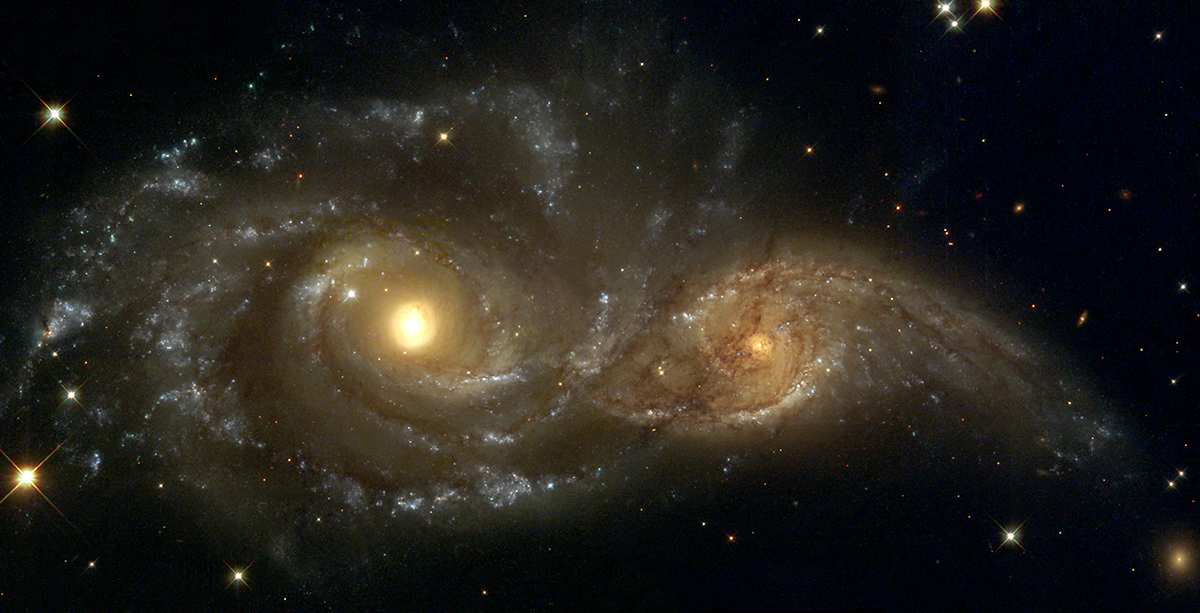
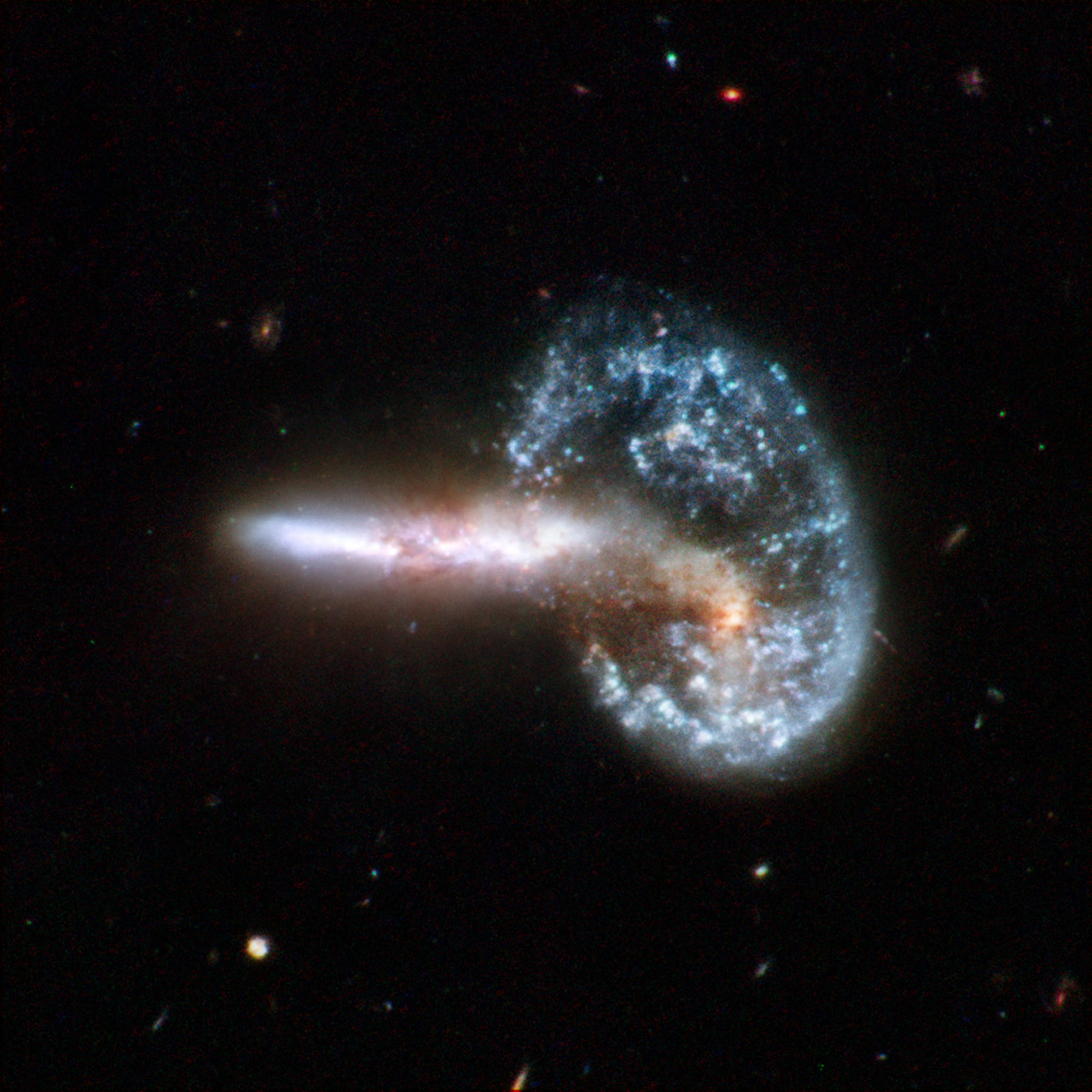
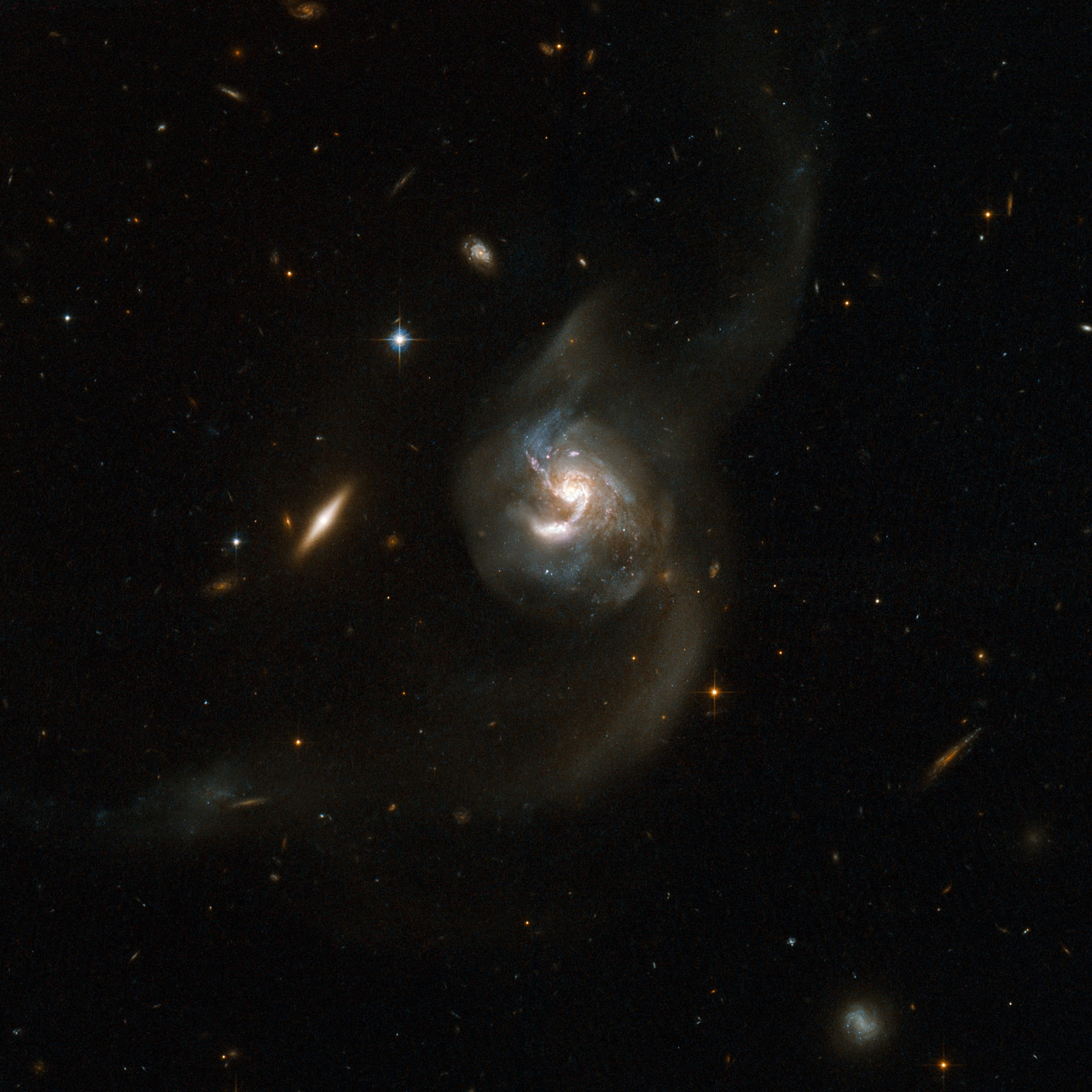
This stunning image captures NGC 6090, a dramatic collision between two spiral galaxies whose overlapping central regions reveal the violent beauty of galactic mergers. The two galactic nuclei, now separated by only about 10,000 light-years, are surrounded by a chaotic tangle of stars, gas, and dust as their parent galaxies interpenetrate and begin their final coalescence. Two spectacular tidal tails sweep outward from the merger remnant — long streamers of stars and gas gravitationally ripped from the galaxies' outer regions during their close encounters. The extreme gravitational stresses have triggered intense starbursts throughout the system, creating luminous knots of young stellar clusters that trace the disturbed spiral structure. NGC 6090 is classified as a Luminous Infrared Galaxy (LIRG), radiating enormous amounts of energy in the infrared as dust heated by the starburst re-emits absorbed starlight.
Scientific Significance
NGC 6090 is a critical object for understanding the intermediate stages of major galaxy mergers — the period after first passage when the two nuclei are rapidly approaching final coalescence. As a Luminous Infrared Galaxy, NGC 6090 represents a class of objects that may dominate the cosmic star formation rate in the early universe, when mergers were more frequent. The dual nuclei and prominent tidal tails provide observational benchmarks for testing numerical simulations of galaxy collisions. By measuring the stellar populations in different regions — the nuclei, the tidal tails, and the bridge of material connecting them — astronomers can reconstruct the merger chronology and determine when and where star formation was triggered. The eventual merger of NGC 6090's black holes will produce a powerful burst of gravitational waves, making understanding systems like this important for predicting gravitational wave event rates. NGC 6090 also serves as a local analog for studying the more distant, more extreme mergers observed in deep surveys of the early universe.
Observation Details
Hubble observed NGC 6090 using the Advanced Camera for Surveys (ACS) in broadband optical filters as part of a survey of nearby luminous infrared galaxies. The observations captured both the detailed nuclear structure — resolving the two merging cores and the disturbed disk morphology between them — and the extended tidal tails stretching far beyond the main body. Narrowband imaging in hydrogen-alpha traced the distribution of ionized gas and active star-forming regions. The combination of optical Hubble data with infrared observations from the Spitzer Space Telescope revealed how the starburst activity is distributed across the merger and how much is hidden behind thick dust obscuration.
Location in the Universe
Constellation
Draco
Distance from Earth
400 million light-years
Fun Facts
- 1
NGC 6090's two galactic cores are separated by only 10,000 light-years — just one-tenth the diameter of the Milky Way — and will merge completely within a few hundred million years.
- 2
The infrared luminosity of NGC 6090 exceeds 100 billion solar luminosities, powered almost entirely by furious star formation triggered by the merger.
- 3
The long tidal tails extend over 100,000 light-years from the central merger, containing enough gas to form millions of new stars.
Image credit: NASA, ESA, Hubble Space Telescope