About This Image
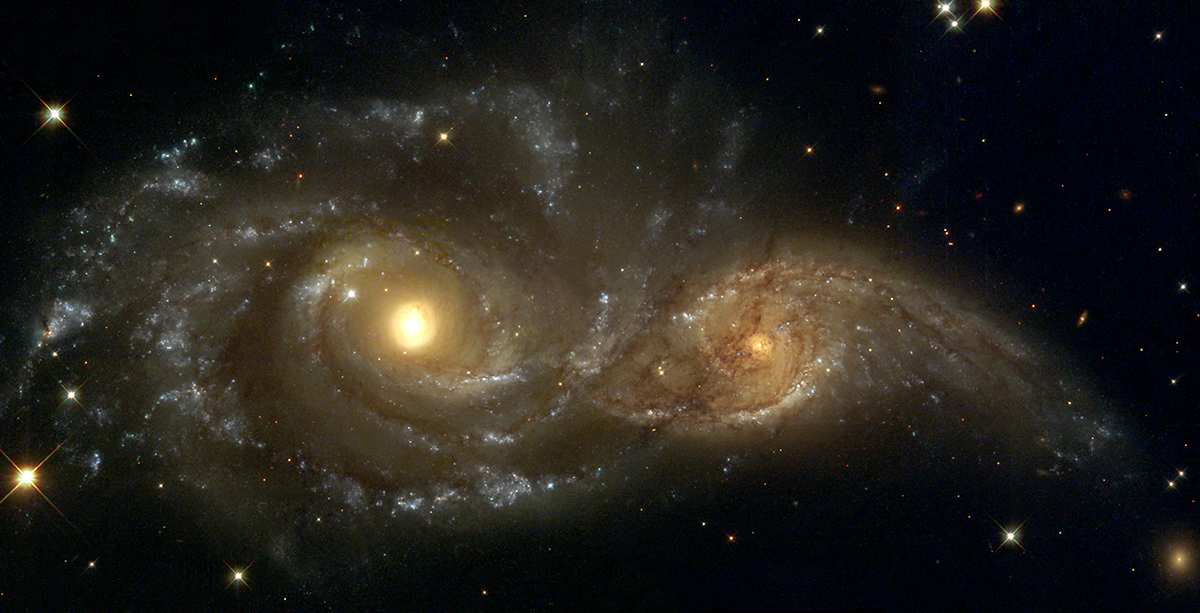
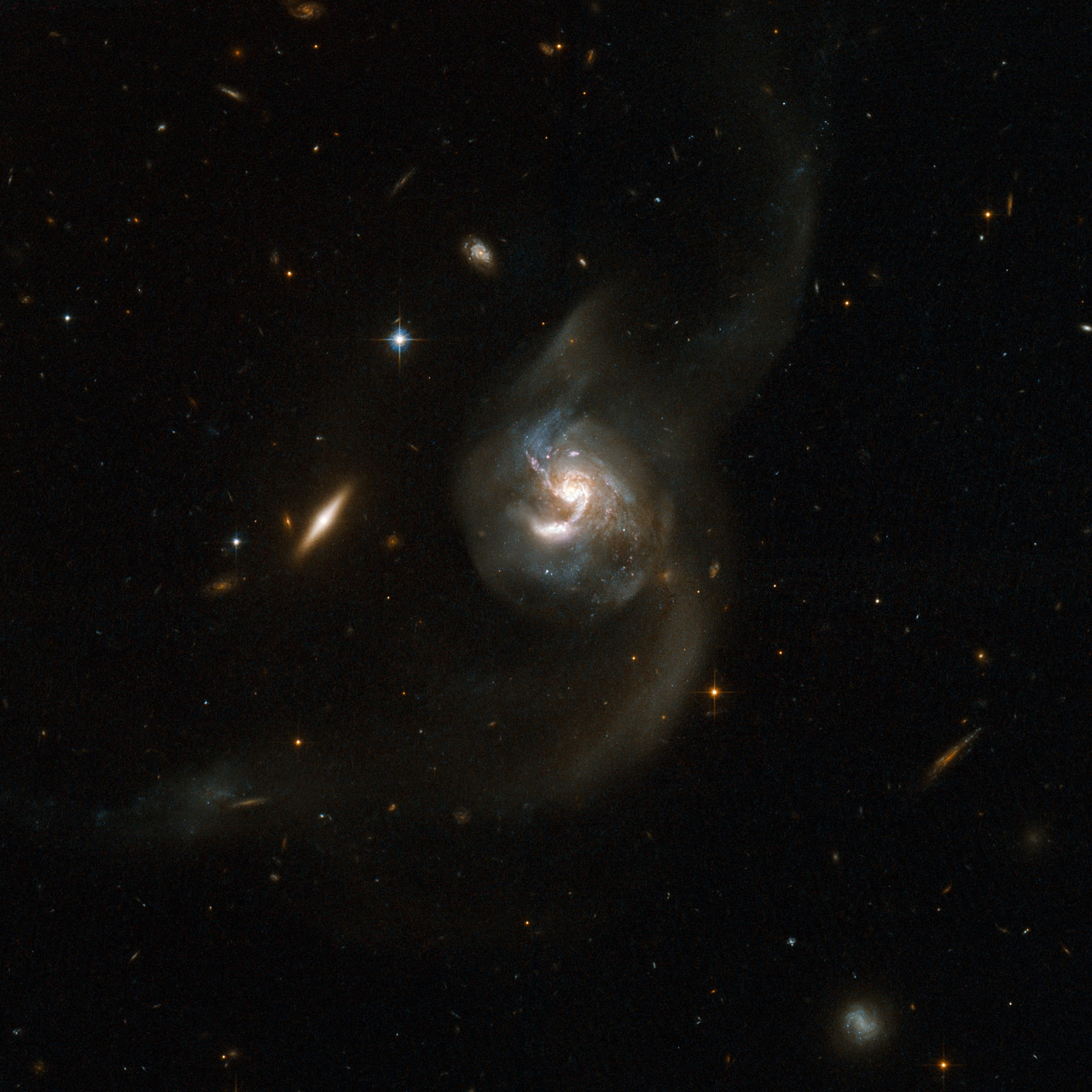
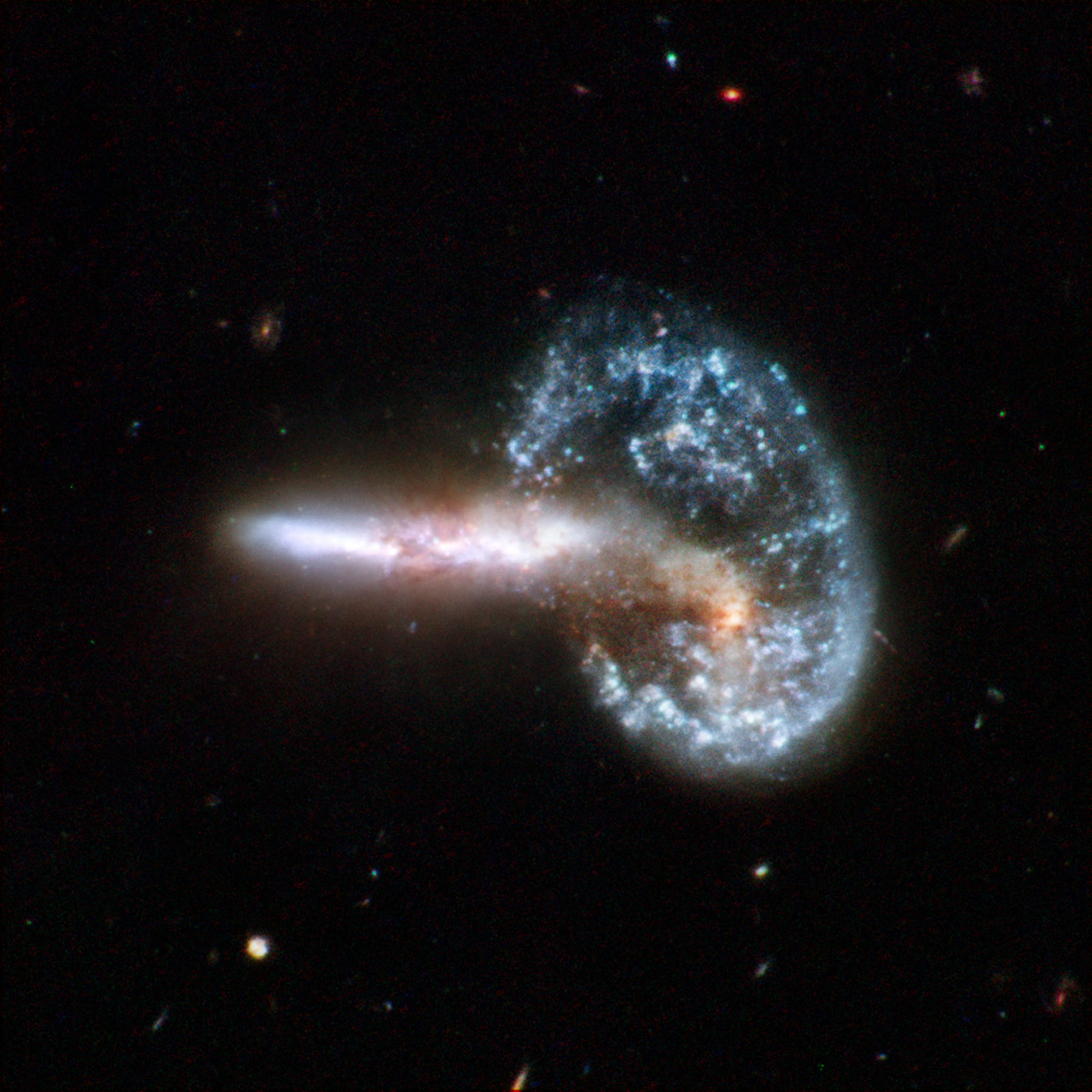
This dramatic image captures Arp 148, nicknamed 'Mayall's Object,' an extraordinary cosmic collision frozen in mid-action approximately 500 million light-years from Earth. The encounter between two galaxies has produced a striking configuration: a nearly perfect ring-shaped galaxy connected to an elongated, distorted companion by a bridge of stars and gas. The ring structure formed when one galaxy plunged directly through the center of another, sending a ripple of gravitational compression expanding outward like a stone dropped in a cosmic pond. This expanding wave triggered intense bursts of star formation along its crest, creating the luminous blue ring of young stellar clusters visible in the image. The elongated companion shows the severe distortion inflicted by the gravitational interaction, its original spiral or elliptical structure stretched beyond recognition by tidal forces.
Scientific Significance
Arp 148 is a spectacular example of a collisional ring galaxy, providing direct observational evidence for theories of galaxy interaction dynamics. The nearly head-on collision that created this system is a relatively rare event cosmically, requiring a small intruder galaxy to pass almost directly through the center of a larger disk galaxy. The resulting density wave propagates outward through the disk like a ripple, compressing gas and triggering sequential star formation in an expanding ring. By measuring the ring's diameter and expansion velocity, astronomers can estimate when the collision occurred — typically 50-100 million years before the current snapshot. Arp 148 is classified as a Luminous Infrared Galaxy (LIRG), indicating that the collision-triggered starburst produces substantial infrared emission from heated dust. The system provides important tests for numerical simulations of galaxy collisions, as the ring morphology is highly sensitive to the impact geometry, mass ratio, and gas content of the progenitor galaxies. Understanding collisional ring galaxies helps constrain the physics of galaxy interactions that were more common in the early universe.
Observation Details
This image was captured using Hubble's Wide Field Camera 3 (WFC3) in broadband optical filters spanning blue through red wavelengths. The observations were part of a larger program studying interacting galaxies in the Arp catalog. The color composite reveals the contrast between the blue ring — dominated by young, hot stars formed in the collision-triggered starburst — and the redder central regions where older stellar populations reside. Hubble's resolution was essential for separating the ring structure from the elongated companion and tracing the bridge of material connecting them.
Location in the Universe
Constellation
Ursa Major
Distance from Earth
500 million light-years
Fun Facts
- 1
Arp 148 is named after astronomer Halton Arp, who catalogued 338 peculiar galaxies in his 1966 Atlas of Peculiar Galaxies — this system is number 148 in that catalog.
- 2
The ring of Arp 148 is over 30,000 light-years in diameter and is expanding outward at roughly 100 kilometers per second.
- 3
Ring galaxies like Arp 148 are among the rarest galaxy types — fewer than 1 in 1,000 galaxies display this distinctive morphology.
Image credit: NASA, ESA, Hubble Space Telescope