About This Image
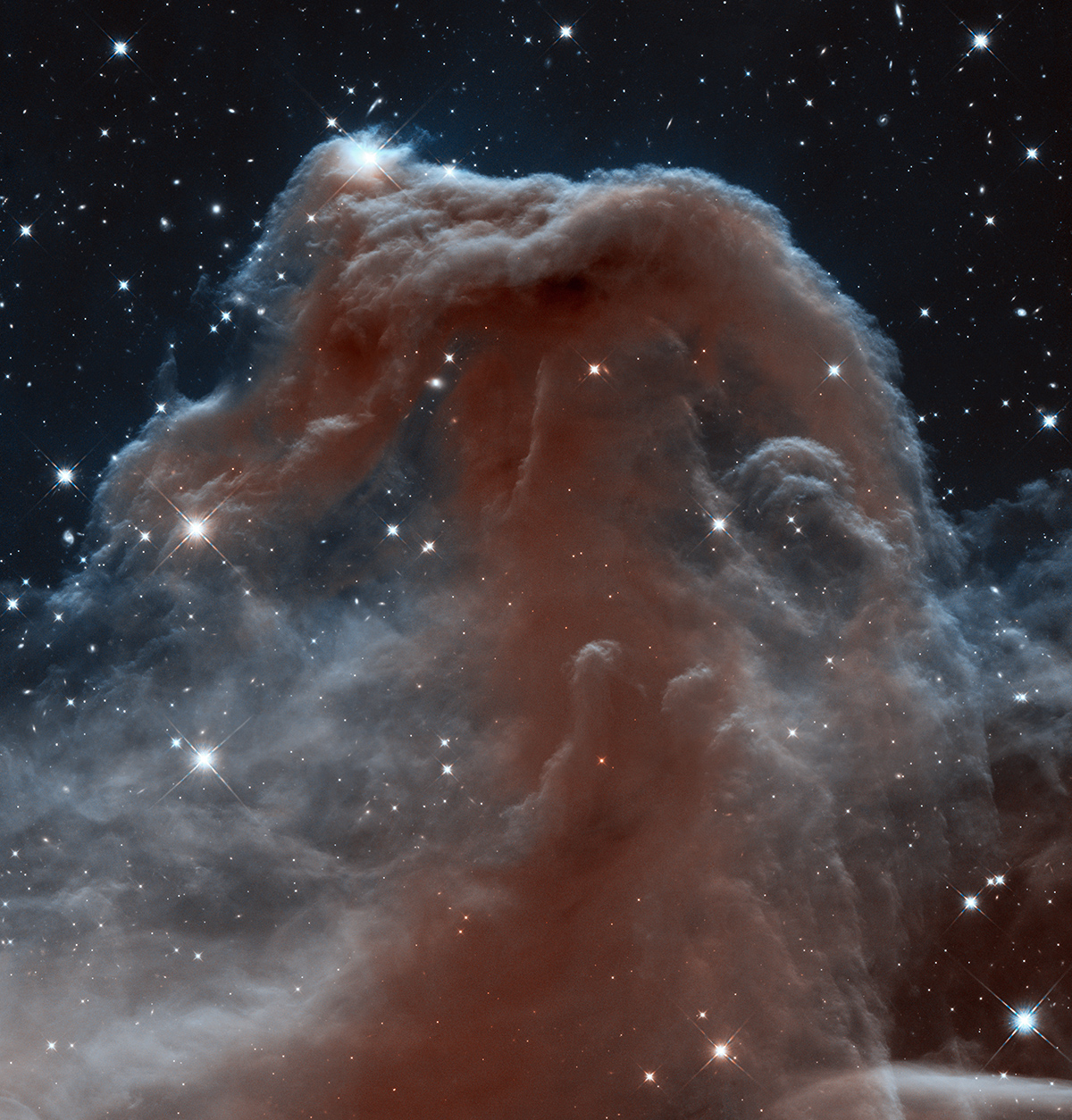
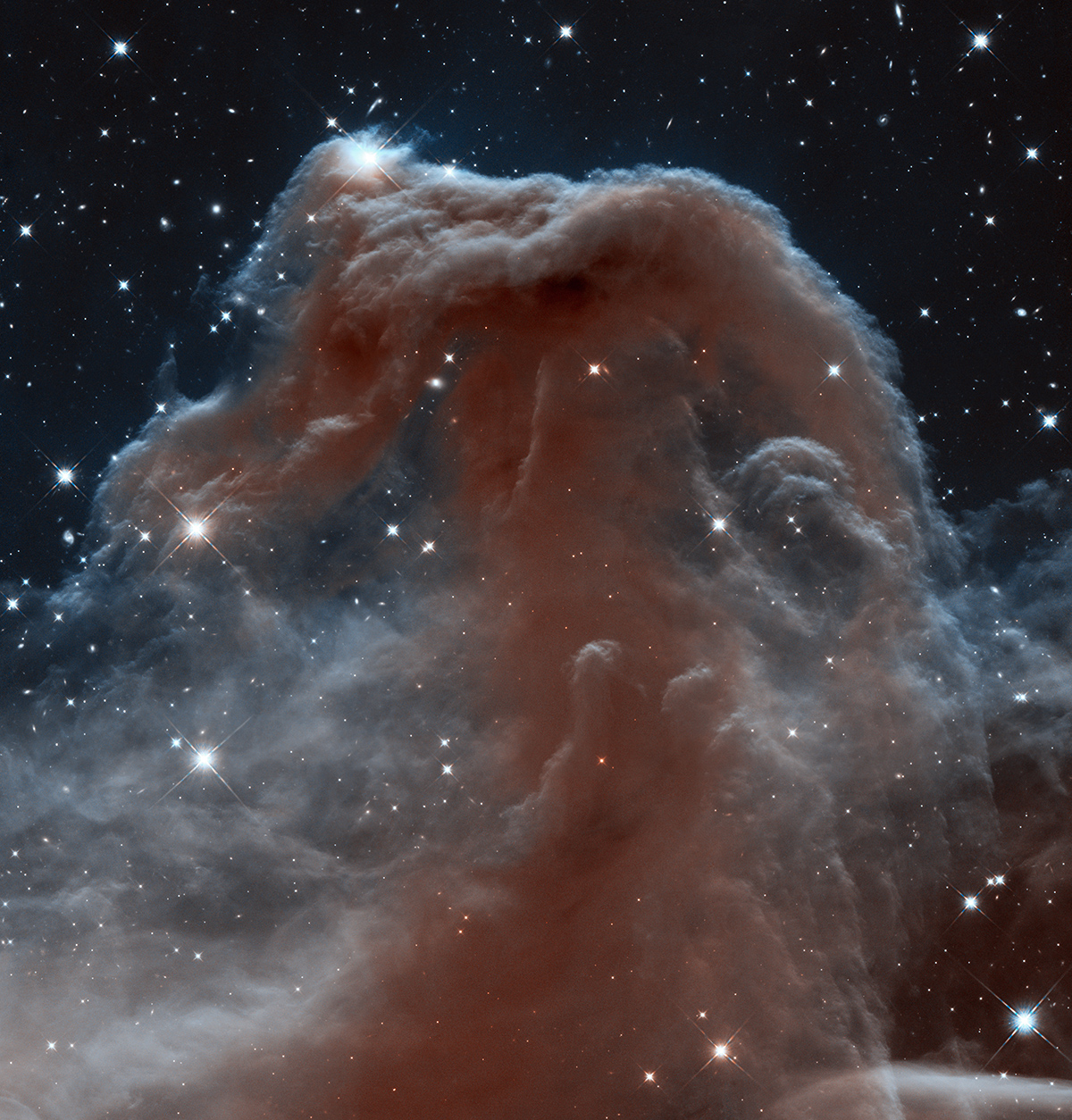
This stunning infrared portrait reveals the iconic Horsehead Nebula in an entirely new light, penetrating the dense dust that makes this object appear as a dark silhouette in visible-light images. In infrared, the Horsehead's distinctive profile glows with the warmth of dust heated by nearby young stars, while the backlit wisps along its upper ridge trace where intense stellar radiation is actively sculpting and eroding the nebula's surface. The Horsehead is a pillar of dense gas and dust protruding from a vast molecular cloud complex in the Orion constellation, one of the most active star-forming regions in our galactic neighborhood. A young five-star system just beyond the top of this image bathes the nebula in harsh ultraviolet radiation that is slowly evaporating the Horsehead's outer layers, a process that will eventually destroy this cosmic landmark over the next few million years.
Scientific Significance
The Horsehead Nebula is one of the most studied examples of a photodissociation region (PDR), where ultraviolet radiation from nearby hot stars drives the chemistry and physics of a molecular cloud's surface. Hubble's infrared observations revealed for the first time the internal structure of the Horsehead, showing how dense cores of gas are shielded from radiation while the nebula's surface is actively ablated. The sharp boundary between the ionized surface and the molecular interior creates a layered chemical structure that serves as a natural laboratory for studying astrochemistry. Observations have detected over 30 molecular species in the Horsehead, including complex organic molecules that are precursors to the chemistry of life. The pillar's survival against photoevaporation depends on its internal density — the densest regions will outlast the diffuse outer layers and may eventually collapse to form new stars. The Horsehead thus provides a snapshot of the competition between star formation and stellar feedback that regulates the efficiency of star formation throughout the galaxy.
Observation Details
Hubble captured this image using the Wide Field Camera 3 (WFC3) in near-infrared filters at wavelengths of 1.1 and 1.6 micrometers. Infrared light penetrates the dust that makes the Horsehead opaque in visible wavelengths, revealing the warm dust emission from within the pillar. The observations were released to celebrate Hubble's 23rd anniversary in 2013. The color mapping assigns shorter infrared wavelengths to blue and longer wavelengths to red, creating a false-color representation that highlights temperature variations across the nebula. The glowing edges trace where stellar radiation heats the dust to several hundred degrees Kelvin.
Location in the Universe
Constellation
Orion
Distance from Earth
1,500 light-years
Fun Facts
- 1
The Horsehead Nebula will eventually be destroyed by the same radiation that makes it glow — in about 5 million years, the pillar will be completely eroded away.
- 2
In visible light, the Horsehead appears as a dark shape against a glowing background; only in infrared can we see the warm dust that makes up its structure.
- 3
The Horsehead is about 3.5 light-years tall from base to tip — roughly the distance from the Sun to its nearest stellar neighbor, Alpha Centauri.
Image credit: NASA, ESA, Hubble Space Telescope