About This Image
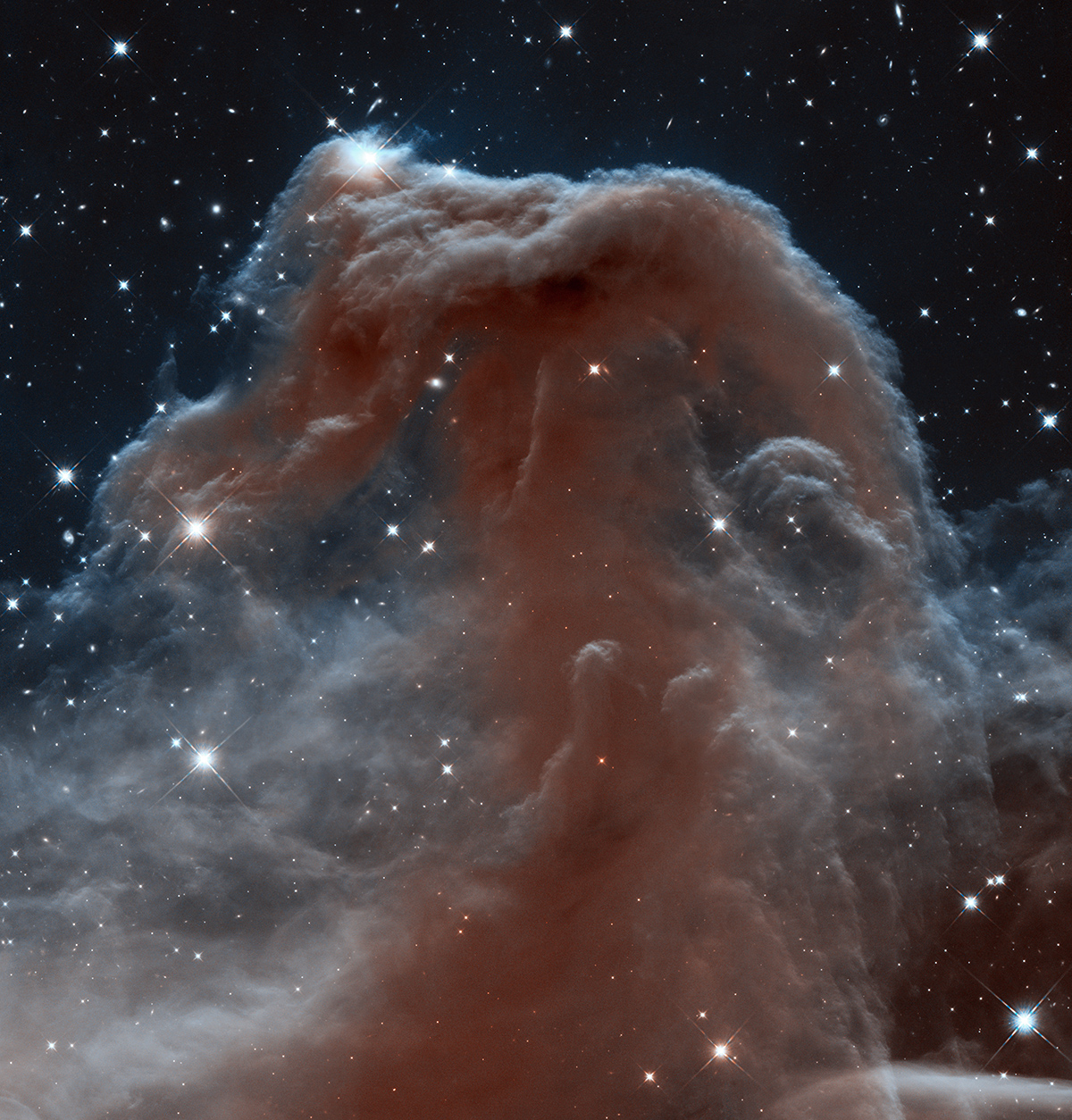
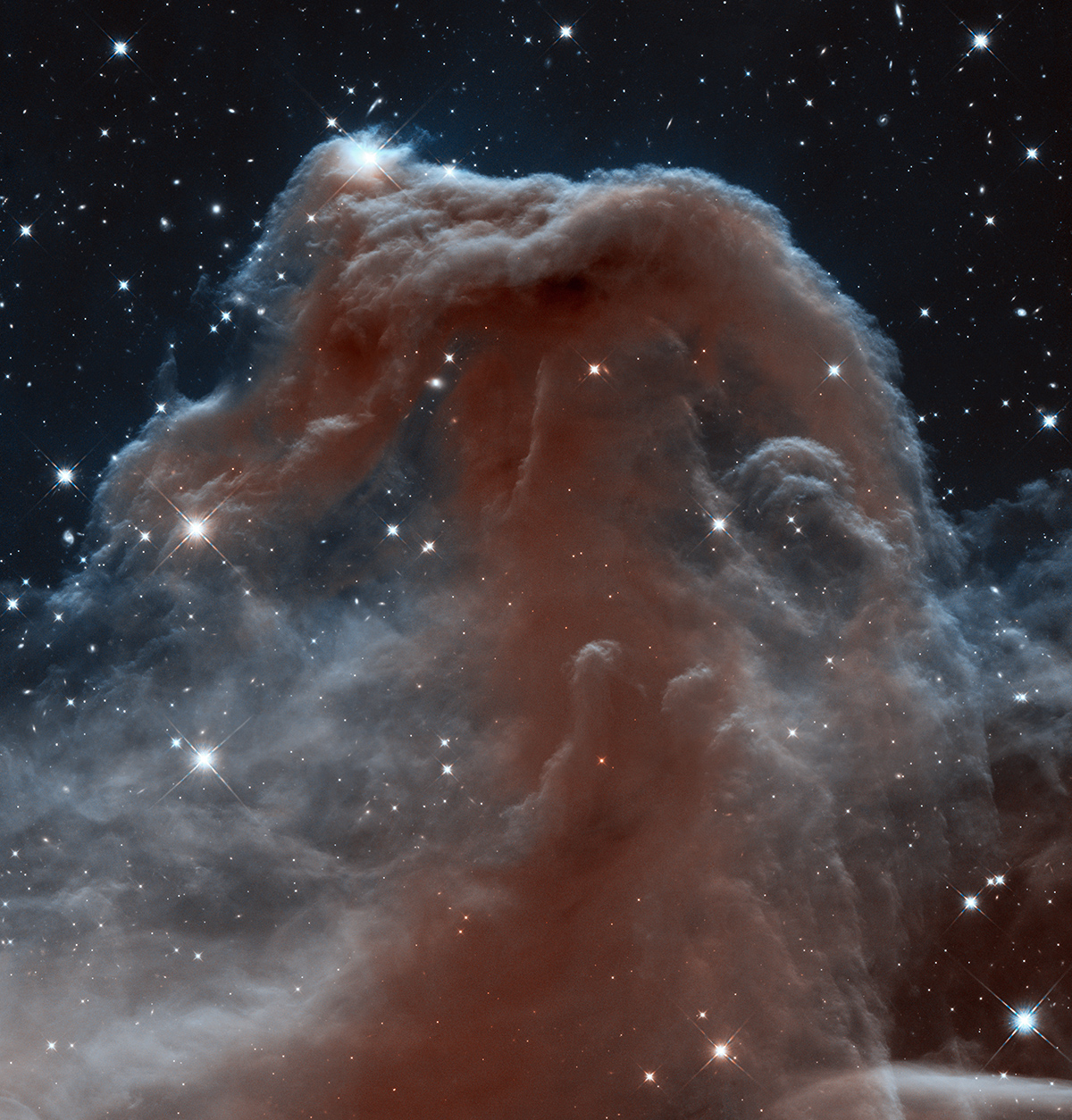
This alternative infrared view of the Horsehead Nebula reveals different details of this iconic cosmic sculpture as it emerges from its parent molecular cloud in the Orion constellation. The warm glow of heated dust outlines the distinctive equine profile, while wispy filaments along the nebula's upper edge trace where ultraviolet radiation from a nearby stellar quintet is actively photoevaporating the dense pillar. In this rendering, the internal structure of the Horsehead becomes visible — regions that appear completely opaque in visible light reveal themselves as complex networks of dense gas and dust with varying temperatures and densities. The Horsehead's characteristic shape results from its higher density compared to surrounding material, allowing it to resist erosion longer than the nebula that once surrounded it. This cosmic landmark has endured for perhaps a million years but will eventually succumb to the relentless radiation bathing it.
Scientific Significance
This complementary view of the Horsehead Nebula highlights different aspects of its structure and evolution compared to other Hubble observations. The Horsehead is embedded in the much larger Orion B molecular cloud, one of the nearest giant molecular cloud complexes to Earth and an active site of ongoing star formation. The sharp boundary between the Horsehead and the ionized region to its left marks a photodissociation front — a transition zone where molecular gas is being converted to atomic form by ultraviolet radiation. Studies of this boundary region have revealed how radiation feedback from massive stars influences the physical and chemical state of star-forming clouds. The Horsehead's survival as a coherent structure while surrounding material has been ionized demonstrates the role of density in protecting molecular gas from stellar feedback. Infrared observations reveal embedded protostars forming within the Horsehead's densest regions, showing that star formation continues even as the nebula is being destroyed from the outside in.
Observation Details
This infrared image was captured using Hubble's Wide Field Camera 3 (WFC3) infrared channel. The observations employed multiple near-infrared filters to probe different depths into the dusty structure and reveal temperature variations. At these wavelengths, dust scatters and absorbs much less efficiently than in visible light, allowing astronomers to peer into regions that would be completely obscured optically. The image processing emphasizes the thermal emission from warm dust grains heated by the embedded stellar sources and by the external radiation field. The ethereal quality of the image results from the combination of scattered starlight and thermal dust emission at near-infrared wavelengths.
Location in the Universe
Constellation
Orion
Distance from Earth
1,500 light-years
Fun Facts
- 1
The Horsehead Nebula was first recorded on a photographic plate at Harvard College Observatory in 1888 by astronomer Williamina Fleming.
- 2
If you could travel at the speed of light, it would take you 3.5 years to traverse the Horsehead from its base to the tip of its 'head.'
- 3
The dense gas within the Horsehead contains the raw materials for dozens of future stars, though most will never form before the nebula is destroyed.
Image credit: NASA, ESA, Hubble Space Telescope