About This Image
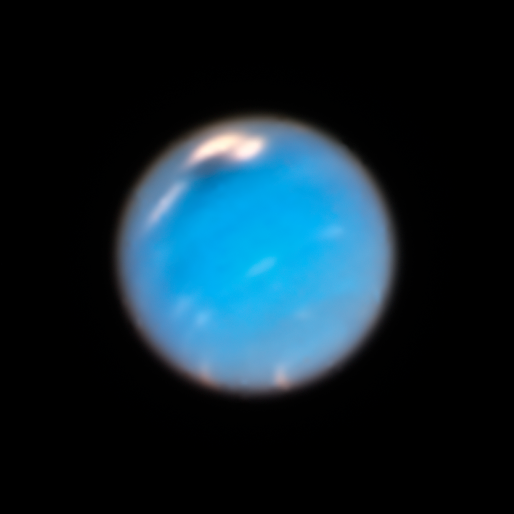
This remarkable image captures a massive dark storm system raging in Neptune's atmosphere, visible as a prominent dark vortex near the planet's northern hemisphere. Spanning approximately 6,800 miles across — larger than the entire Atlantic Ocean — this anticyclonic storm represents one of the most powerful weather phenomena in our solar system. The bright white companion clouds to the right of the dark feature are composed of methane ice crystals pushed to high altitudes as air flows around and over the vortex, much like orographic clouds forming over mountains on Earth. These companion clouds help astronomers track the storm's movement and evolution over time. Unlike Jupiter's Great Red Spot, which has persisted for centuries, Neptune's dark storms are relatively short-lived, typically fading away within just a few years as they migrate toward the equator where dynamical instabilities tear them apart.
Scientific Significance
Neptune's dark storms provide crucial insights into atmospheric dynamics on giant planets, particularly those far from the Sun where solar heating plays a minimal role. Unlike Jupiter's persistent Great Red Spot, Neptune's dark vortices are transient features that form, migrate, and dissipate on timescales of years, offering opportunities to study the complete life cycle of giant planetary storms. Hubble's long-term monitoring of Neptune has revealed that these storms form preferentially at certain latitudes and invariably migrate toward the equator, where wind shear destroys them. The 2018 storm captured in this image exhibited unusual behavior — it appeared to reverse its equatorward drift and spawn a new smaller storm — providing new constraints on vortex dynamics in Neptune's atmosphere. Understanding why Neptune, despite receiving 900 times less solar energy than Earth, generates such powerful storms is a major puzzle in planetary science. The internal heat flow from Neptune's core appears to drive convection that powers its extreme weather.
Observation Details
Hubble observed Neptune using the Wide Field Camera 3 (WFC3) in blue, visible, and near-infrared filters to capture different atmospheric layers. Blue filters reveal the dark storm itself, which appears dark because it is a region of decreased cloud opacity allowing views to deeper, darker atmospheric levels. The bright companion clouds appear prominently in methane-band filters that are sensitive to high-altitude methane ice clouds. By imaging Neptune multiple times over several months, Hubble tracked the storm's position and measured its drift rate across the planet's disk. The observations were part of the Outer Planet Atmospheres Legacy (OPAL) program, which monitors all four giant planets annually.
Location in the Universe
Constellation
N/A (Solar System)
Distance from Earth
2.7 billion miles (average)
Fun Facts
- 1
Neptune's dark storms can have wind speeds exceeding 1,500 miles per hour — the fastest sustained winds of any planet in our solar system.
- 2
This dark storm was first discovered by Hubble in 2018 and was observed slowly migrating toward the equator, where Neptune's storms typically dissipate.
- 3
The bright companion clouds alongside Neptune's dark spots can form and dissipate within just hours, making them among the most rapidly changing features on any planet.
Image credit: NASA, ESA, Hubble Space Telescope