About This Image
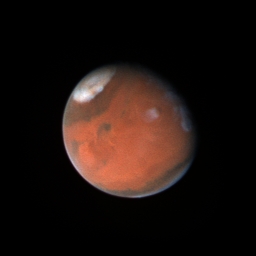
This remarkable image captures Mars during an active meteorological period, with Hubble tracking a dramatic dust storm churning near the Red Planet's northern polar cap. The salmon-colored streaks visible against the white polar ice are the dusty remnants of this atmospheric disturbance, carried by Martian winds and spread across the frozen landscape. Mars experiences some of the most extreme weather in our solar system — from localized dust devils to global dust storms that can engulf the entire planet for months. The distinctive ruddy hue of Mars comes from iron oxide, essentially rust, that covers much of the planet's surface. The white northern polar cap visible here is composed primarily of water ice, unlike the southern cap which contains significant amounts of frozen carbon dioxide. Hubble's long baseline of Mars observations has revealed how the planet's atmosphere and surface features change with the seasons, providing crucial context for robotic missions exploring the Martian surface.
Scientific Significance
Hubble's observations of Mars provide a crucial perspective that complements data from spacecraft orbiting and operating on the Martian surface. While orbiting spacecraft provide detailed views from close range, Hubble captures the entire planet in a single image, revealing global atmospheric patterns and seasonal changes that are difficult to observe from nearby vantage points. The dust storm observed in this image is part of the complex interplay between solar heating, atmospheric circulation, and surface processes that drives Martian weather. Understanding Martian dust storms is essential for planning robotic and eventually human missions, as these storms can threaten solar-powered equipment and dramatically alter surface conditions. Hubble observations have tracked the seasonal retreat and advance of the polar caps, monitored dust storm activity over multiple Mars years, and documented long-term changes in surface features. These observations help calibrate atmospheric models and reveal how Mars's climate has changed over recent decades.
Observation Details
Hubble observed Mars using the Wide Field Planetary Camera 2 (WFPC2) in multiple broadband filters spanning blue through near-infrared wavelengths. The multi-filter imaging revealed both atmospheric features (which appear differently at different wavelengths depending on scattering and absorption properties) and surface details (which reflect different proportions of light at different wavelengths based on composition). The timing of the observation was coordinated with Mars's orbital position to capture the planet near opposition, when it is closest to Earth and presents its fully illuminated face. The image resolution corresponds to features roughly 20 kilometers across on the Martian surface.
Location in the Universe
Constellation
N/A (Solar System)
Distance from Earth
34-250 million miles (varies)
Fun Facts
- 1
Dust storms on Mars can grow from localized events to planet-encircling storms in just a few weeks, blocking so much sunlight that surface temperatures drop dramatically.
- 2
The northern polar cap of Mars is roughly 1,000 kilometers in diameter and up to 3 kilometers thick, containing enough water ice to flood the entire planet to a depth of about 5 meters if melted.
- 3
Hubble has observed Mars at every opposition since the telescope's launch in 1990, creating a decades-long record of atmospheric and surface changes.
Image credit: NASA, ESA, Hubble Space Telescope